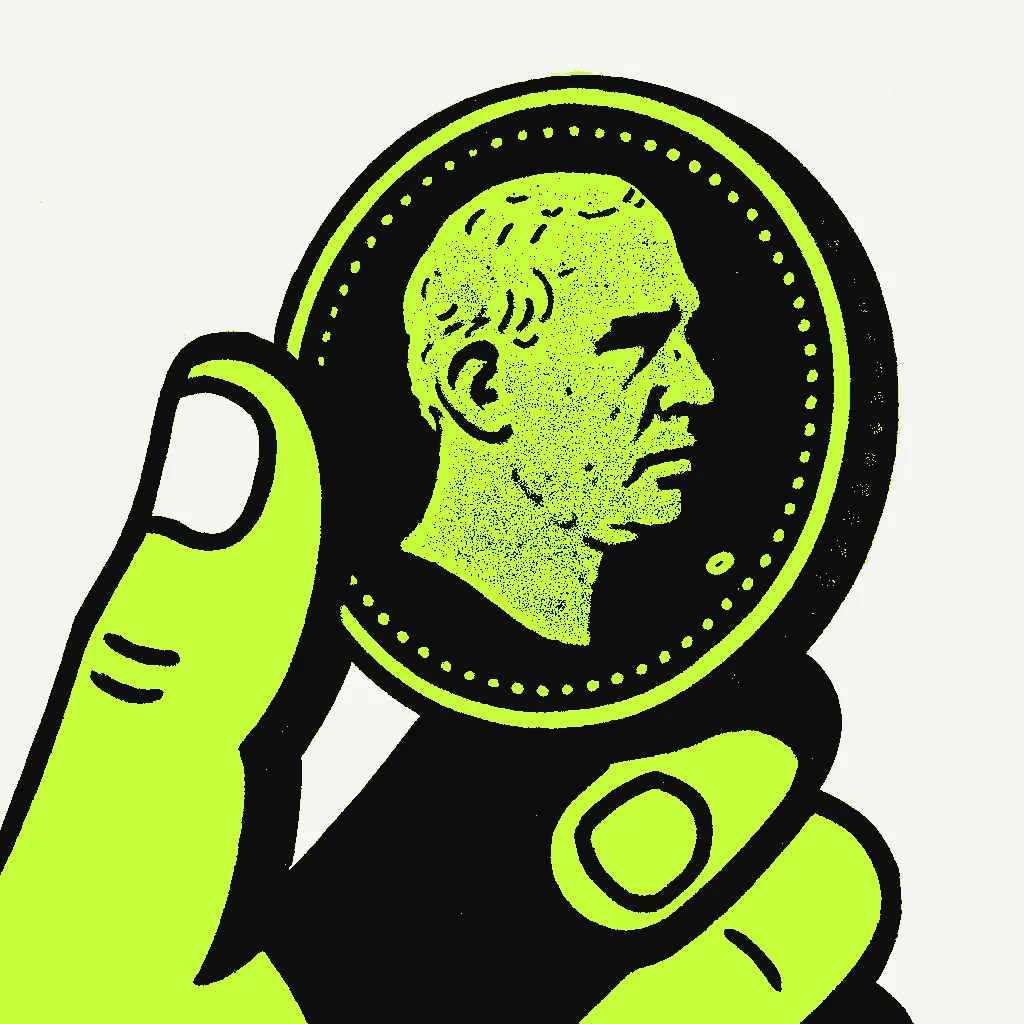
A man came in last Tuesday with a Morgan dollar wrapped in a paper towel. 1893-S. He set it on the felt like he already knew. The date was right. The mint mark was right. The portrait, from a foot away, was right. He watched me pick it up and he watched me set it back down without saying anything, and he already knew what I was going to say. Most people do, by the time they walk through the door. They just want somebody else to say it first.
Here is the trouble with a cast fake. It is close. It is close enough that the photo on your phone looks correct, and the weight in your palm feels correct, and the reverse, in bad light, reads correct. It is built to survive arm's length. The forger is not trying to fool the man with the loupe. The forger is trying to fool the man who wants to believe. That is a much easier job.
So you have to slow down. Bring the coin close. Closer than that. The first place a cast piece tells on itself is the edge. A struck coin has an edge that was formed inside a collar, sharp where the die met the planchet, clean all the way around. A cast coin came out of a mold in two halves, and those two halves had to meet somewhere. That somewhere is the rim. Sometimes it is a ridge you can feel with a fingernail. More often it is a whisper. A faint line running the circumference, visible only when you tilt the coin against a lamp and let the light skate across it. The mint mark's the tell, people say, and often it is, but on a cast piece the edge tells first.
The details go next. A struck coin was hit hard, one blow, metal driven up into the recesses of the die under tons of pressure. The letters have crisp shoulders. The hair has separation. The eagle's feathers, on the reverse, stand apart from each other. A cast coin was poured. Molten metal into a mold, cooled, released. What you get is a shape that is roughly right and softly wrong. The letters look a little swollen. The hair looks a little melted, as if somebody breathed on a wax model. Nothing is sharp. Nothing has an edge. If the coin looks like it has been in a warm pocket for a hundred years but the wear is even everywhere, it is not wear. It is casting.
Then there is the tone of the metal itself. Silver that was struck rings. Drop a genuine Morgan on a wooden counter, gently, from an inch up, and it sings a note that holds for a second and a half. Drop a cast copy the same way and it goes thud. A dull, closed sound, no ring, no length to it. Cast metal is porous at the microscopic level, and porous metal cannot ring. Your ear knows this before your brain does. If a silver dollar sounds like a washer, it is a washer wearing a costume.
The scale is the last stop, not the first. A scale is a tool for confirming what your eye and your ear already suspect. Genuine Morgan dollars weigh 26.73 grams, and a good cast will get within a tenth of that, because the forger knows about scales too. But no forger yet has cast a coin that passes the edge, the softness, and the sound all three. One of them will fail. Usually two.
With the man on Tuesday, it was the edge. A hairline seam at four o'clock, visible only when I tilted it. Then the softness in Liberty's hair, once I looked for it. Then the dull tap on the felt when I set it down a second time. He nodded before I said anything. He had been carrying it around for six months, waiting for a day when he had the stomach to hear it.
So when a coin walks in that seems too good, and it might be, run it in that order. Edge, details, sound. Let me get the loupe on that, I say, and what I mean is, let me give this coin the three seconds it deserves before we talk about anything else. A struck coin will hold up to being looked at closely. A cast one shrinks under the light. The story's better than the price, and the story here is a simple one. It was made twice. Once at the mint, and once in somebody's garage. You can tell which is which. You just have to get close enough.