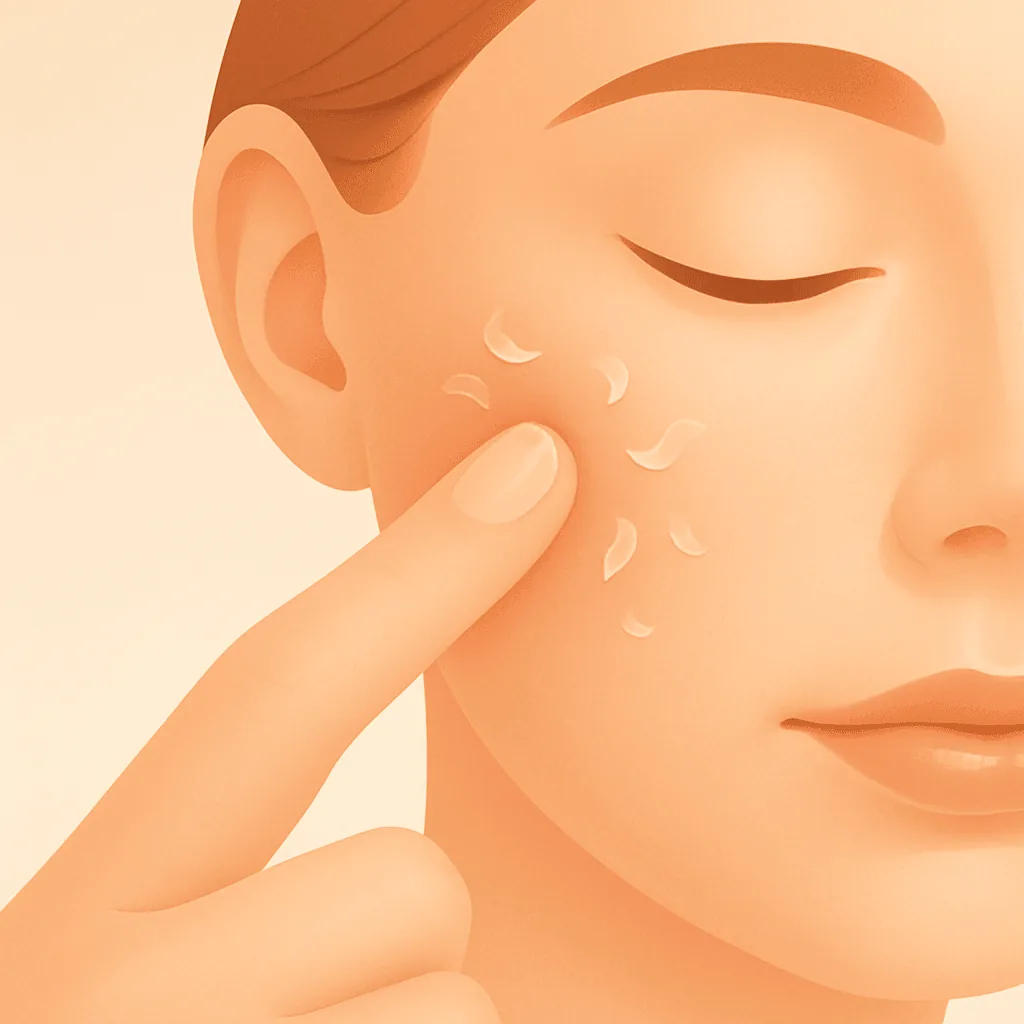
The morning after the first night, your cheek feels a little papery under your fingertip. Not raw, not sore. Just papery, the way a page feels when it has been left near a window. You touch the part near your mouth, and the part by the outer edge of the nose, and there it is again. Something is different, in a small way, and your skin is telling you first thing, before coffee, before the light is fully in the room.
Most of what gets said about retinol reads like a protocol. Two nights a week, then three, then four, buffered with moisturizer, avoided near the eye, paused if irritation appears. The chart is not wrong. But it treats the skin like a machine you are calibrating, and that is not quite what is happening on your face. What is happening is a relationship. A slow one. Your skin is meeting a molecule it has not met before, and it is deciding, in its own time, how much of it to accept.
So, let's look at the skin you're in tonight, and think about the low-and-slow way.
Low-and-slow means a pea, or less than a pea, on dry skin, once a week to start. Not because more would be dangerous, but because your skin has its own pace, and the pace is slower than the internet suggests. One night a week, for a few weeks. That is the whole first chapter. Nothing dramatic. You are letting your face get to know the ingredient in small conversations, not one long argument.
Then comes the flake. Usually somewhere near the side of the nose, or the crease by the mouth, or the little stretch under the brow. A fine, dry lift of skin you can feel more than see. This is not damage. This is turnover, sped up a little, and the top layer catching up with itself. I would not scrub it. I would not exfoliate over it. I would put something calm on it, a plain moisturizer, and let it settle. A few nights, and the flake goes quiet.
The sting is the next chapter, and it usually arrives the third or fourth time you apply. A brief warmth, mostly around the nose, sometimes at the jaw. It lasts a minute, maybe two, and then it is gone. If it lasts longer than that, or if the warmth turns into a flush that stays into the morning, your skin is telling you the conversation is moving too fast. You slow down. You skip a week. You go back to every ten nights instead of every seven. Nothing is lost by waiting. The molecule does not stop working because you took a pause.
And then, somewhere around week four or week five, comes the quiet week. You will notice it before you can name it. The papery feeling is gone. The little flake by your mouth has not shown up in a few days. The skin around your eye looks a bit smoother in Sunday's photo than in the one from two Sundays ago, and you are not sure if it is the light or the skin. This is the week the skin quiets down. This is the point of the slow way. Not a transformation. A settling.
After the quiet week, you can add a night. Not two, not three. One. And you watch again. The flake might come back for a day. The sting might visit once and leave. You keep going, one night at a time, one small addition, letting the notebook fill up with what you notice. In three months you might be at three nights a week, and your skin will feel like your skin, only a little more even, a little more settled in itself.
The thing nobody says about retinol is that the slow way is not a compromise. It is the actual path. The fast way ends in a red, tight face and a bottle pushed to the back of the drawer. The slow way ends in a face that has quietly learned something, over weeks, at the pace faces learn.
So if your cheek feels papery in the morning, do not panic and do not push. That is the beginning of the conversation, not the end of it. Put something soft on it tonight. Skip the retinol for a few more nights than you meant to. We've been keeping notes, and the notebook says the same thing every time. The skins that end up softest are the ones whose people were willing to wait.
No verdict, just what I'm seeing. Still settling in.