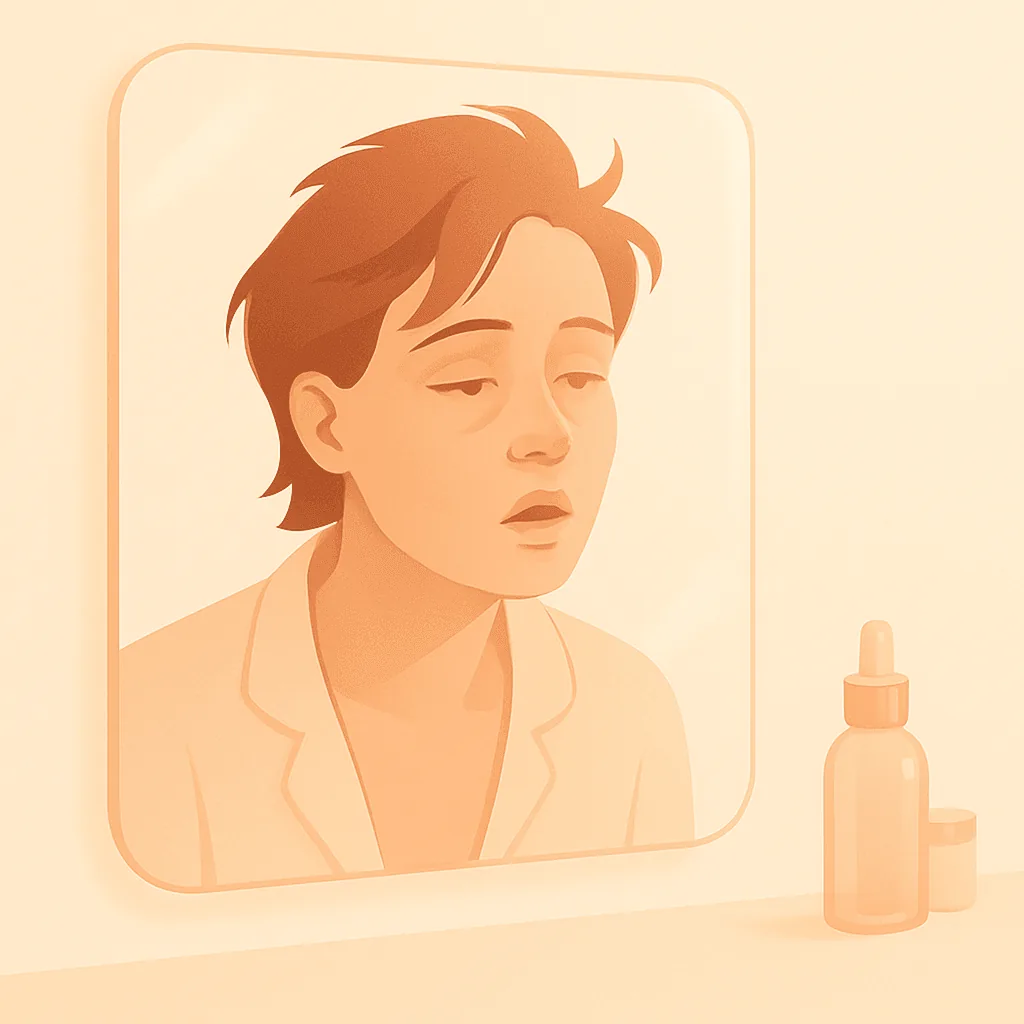
Seven in the morning, before the kettle, before the phone. The face in the mirror is not the face you'll wear at noon. There's a crease running from the corner of your mouth toward the cheek, a soft pillow-print you slept into for hours. The lower lids are a little full. The undertone is warm, almost pink near the nose. You look, for a moment, like someone who has just returned from somewhere.
Most mornings, we don't stay with this face long. We rinse it, we pat it, we cover the puff and hurry the crease along. There's a quiet worry underneath the rushing, that the morning face is the true face and the mid-morning one is the trick. That the softness we chase with serums all week is being undone every night by something as ordinary as a pillow.
It isn't.
Let's look at the skin you're in tonight, or rather, the skin you'll meet tomorrow at seven. A full night does something no bottle can. While you're resting, the barrier is quietly repairing itself. Water is redistributing. The little bits of the day, the squint at the screen, the wind on the walk home, the salt in dinner, are all settling. The puff you see in the mirror is not damage. It's fluid pausing on its way through. Give it an hour upright, a glass of water, the small movements of getting dressed, and it goes.
The pillow crease is the same. It's not a wrinkle arriving early. It's the skin remembering, for a little while, the shape it was pressed into for six or seven hours. Skin that's resting well lets go of that shape faster. Skin that's tired, or dehydrated, or asked to do too much the day before, holds the crease longer. That's information, not a verdict. If the line by your eye is still there at nine, the night was shorter than the body needed. If it's gone by the time you've brushed your teeth, the night did its work.
I notice this most on the cheek. First thing, the cheek can look a little flat, a little creased, holding the map of the pillowcase. By mid-morning, it's back, quietly plumped, drinking in the water you've had, the light you're standing in. That returning is the thing to watch. Not the puff itself. The return.
The softness that arrives around ten or eleven is not a different skin. It's the same skin, finished with the night's small tasks. Barrier settled. Fluid moved on. Warmth evened out. The face you take into the day is a rested face that has caught up with itself. No serum builds that. Serums support the barrier, they hydrate, they nudge cell turnover along, but they don't replace the hours the skin needs lying down, undisturbed, doing its own quiet housekeeping.
This is why I'm gentle about the morning mirror. The seven-o'clock face is a face in the middle of something. It's not the after photo. It's not even the before. It's the interval. Judging the skin then is a little like judging a bed halfway through being made.
A few things are worth noticing, though, without turning them into a project. Which side of the face carries the crease. If it's always the right, the right is where you sleep. That side may look a fraction more settled over the years, and that's not a flaw, that's a record. Whether the puff sits under the eyes or across the whole midface. Whether the warmth near the nose cools by breakfast or stays into the afternoon. These are notes, not problems. We've been keeping them.
And notice, if you can, the moment the morning face gives way to the mid-morning one. It's usually quieter than you'd expect. You catch it in a shop window, or the visor mirror in the car, and the crease is gone and the cheek is back and you didn't do anything for it. The night did. The water did. The upright hours did. The skin has its own pace.
So the pillow isn't undoing your week. The puff isn't the truth the day hides. The crease by your mouth at seven is a shape, not a sentence. Meet the morning face the way you'd meet a friend who slept on the couch, with a little tenderness, a little curiosity, and no rush to fix anything.
By eleven, it will have settled. No verdict, just what I'm seeing. Still settling in.