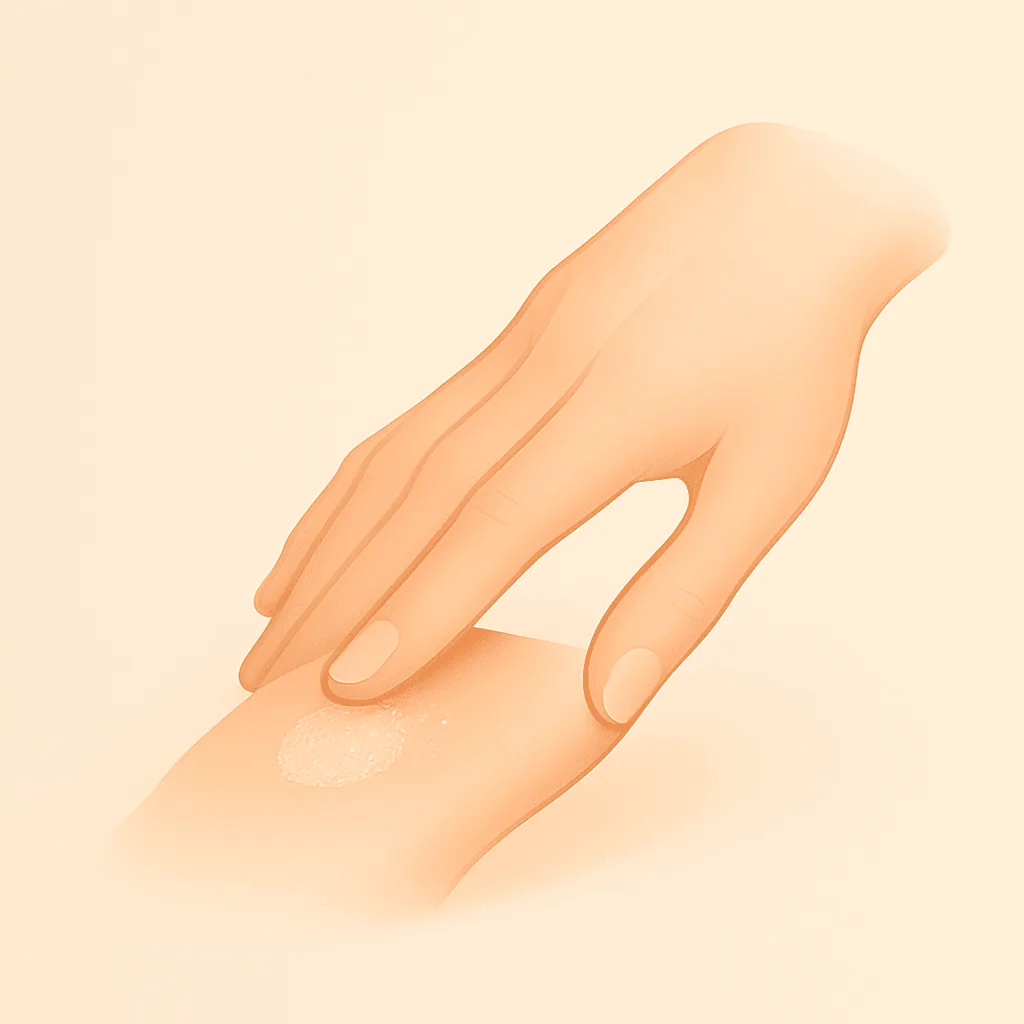
Your finger found it again, didn't it. Somewhere beside the mouth, or near the outside of the nose, that small rough place you weren't looking for. You weren't even at the mirror. You were on the phone, or resting your chin in your hand, and your fingertip caught on it, the way it did last week, and the week before. Not painful. Not red, not really. Just there. A tiny stretch of skin that feels a beat behind the rest of your face.
And you've tried, I know. A richer cream one night. An exfoliating pad another. A tissue-off of the balm because maybe it was too much. Then back to the cream because maybe it was too little. The patch softens for a day, and then your finger finds it again on Thursday, in the same place, and you wonder what you're missing.
Here's what I've noticed, from this side of the sink. The patch that keeps coming back isn't usually a patch that needs more. It's a patch that's been getting a little too much of everything, and hasn't had a quiet week to catch up.
The skin beside the mouth and the outer curve of the nose is thinner than the cheek. It folds when you talk, when you smile, when you sleep on that side. It sits where the mask of expression moves the most. Every time you wash, the water pools there a second longer. Every acid, every retinoid, every scrub, that little stretch gets the same dose as the sturdier parts of your face, but it doesn't have the same reserves. So it goes dry, and the dryness reads as a patch, and the patch reads as something to treat. And the treating is what keeps it coming back.
Underneath the roughness, most of the time, is a barrier that's just tired. Not broken, not damaged in some dramatic way. Tired. The way a piece of clothing looks after too many washes, still whole, just thinned. The little rough feeling is the top layer holding on unevenly, some cells still stuck, some already lifted, because the water and oil balance underneath hasn't had time to settle.
That's why the patch feels worse some mornings than others. It isn't misbehaving. It's telling you which nights were dry-air nights, which nights you slept on that side, which mornings you washed with water a little too warm. The roughness is a record, not a rebellion.
So when it returns, I'd try the opposite of what feels obvious. Not another active. Not a stronger cream over the top. A quiet stretch. A few nights of the gentlest cleanse you have, water closer to cool, and one plain moisturizer, the boring one, nothing with a percentage on the label. Skip the acids near that spot. Skip the retinoid there too, just around it, a small island of rest. Let the rest of the face carry on.
Your skin is asking for water, not another serum.
And then wait. This is the part that's hard. The patch won't be gone tomorrow. Barriers don't heal on the schedule we'd like. They heal on the schedule of the cells underneath, which is roughly a slow week, sometimes two. In the meantime the patch will still be there when your finger goes looking, and you'll want to do something. Try not to. One thing at a time, that's how skin listens.
What I usually see, when someone gives that little stretch a real rest, is that the roughness quiets first at the edges. The center takes a little longer. Then one evening you'll reach up out of habit, and your finger won't catch. It'll just be skin. Not a triumph, just skin. And a week after that you might forget the patch was ever the thing you were thinking about.
If it doesn't quiet, that's information too. A patch that stays exactly the same after two slow weeks is a patch worth showing to someone who can look closely in person. Not because anything is wrong, but because it's earned a second pair of eyes. We've been keeping notes, and the notes will help.
For tonight, though. Let's look at the skin you're in tonight. The patch is where it was, a little softer at the corner nearest your lip. Not gone. Just softer. The rest of the cheek is holding water again. Your undertone is calmer than Sunday's photo. Nothing urgent.
Still settling in.