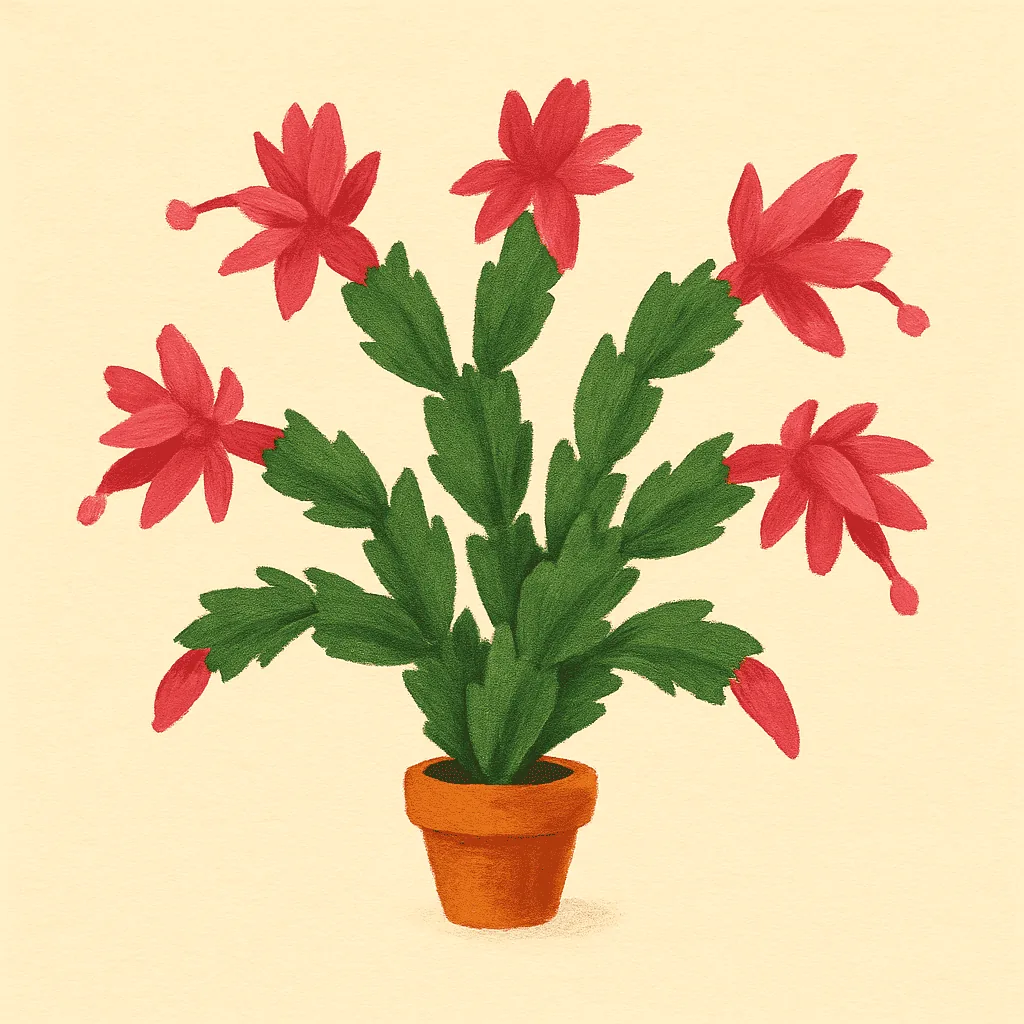
The segments are flat and slightly scalloped, hanging over the edge of the pot like soft chains. In the cool months a bud appears at the very tip of one. Pink, or coral, or white, depending on the plant. It opens slowly, over days, with no announcement. Then another opens beside it. By the time you notice, half the plant is flowering, and the room is a little different than it was last week.
Most of us inherit a christmas cactus and treat it the way we'd treat any cactus on the shelf. Bright sun. Sparse water. A gritty soil that drains in seconds. And then the plant sulks, and the segments wrinkle, and we wonder what we did wrong. The trouble is the name. The plant on your shelf is not from a desert at all. It comes from the cloud-forests of Brazil, where it grows on the sides of trees in dappled green light, with rain and mist most of the year. It is a cactus the way a fern is a flowering plant — technically yes, but the company it keeps tells you more than the family does.
Once you know that, the care starts to make a different kind of sense. Bright indirect light, not direct afternoon sun. A spot near the window, not pressed against the glass. The segmented stems look like they should store water, but they don't, not really. They are leaves more than reservoirs. If you let the soil go bone-dry for too long, the segments will wrinkle and start to drop, and the plant will tell you, plainly, that it has been thirsty. The top inch will tell you. Press a finger in. If it's dry, a small drink. If it's still cool and damp, let the soil dry a little longer. The plant is teaching you the schedule.
In summer, if you have a shaded balcony or a porch with morning light, the christmas cactus is happier outside than in. The humidity is higher. The air moves. The light is filtered through whatever leaves are above it, which is much closer to the cloud-forest than any windowsill can be. Bring it back in before the nights get cold. A spell outside through the warm months is one of the kindest things you can do for it.
And then there is the bloom, which is the whole reason most of us keep this plant. The buds are set by two things working together. Long, dark nights. And slightly cool temperatures. Starting around mid-October, the plant wants a stretch of about six weeks where the nights are truly dark — no lamp left on in the same room after sunset, no hallway light spilling onto its shelf. Cool nights help, the kind a slightly drafty window gives you in autumn. After about six weeks of that, the buds are set, and from there normal household lighting won't disturb them. You can put the plant back where you like to see it, and the flowers will open on their own clock.
This is the part that asks the most patience. Not the watering, not the light in summer. The dark autumn nights. A lamp in the wrong place in November can quietly cancel a december bloom, and you won't know until the buds don't come. If you've had a christmas cactus that never flowers, the light at night is usually where to look first.
Patience reads like neglect, until it doesn't.
The plant on your shelf might be older than it looks. Christmas cacti live for decades, sometimes generations, passed from one keeper to the next. The one your grandmother kept on the kitchen sill may still be flowering somewhere, in someone's home, every winter, on the same quiet schedule it has kept its whole life. They are not difficult plants. They are particular, which is a different thing. They want what they want, and what they want is mostly to be let alone in the right corner, with the right light, and a small drink when the soil tells you.
So if yours is sulking, start with the corner. Move it a little closer to the window, not against the glass. Check the top inch. In autumn, notice what light reaches it after sunset, and see if you can give it the dark it's asking for. Then wait. The buds will appear at the tips of the segments, small and tight, and one morning you'll notice the first one has opened. We'll watch for it. One day at a time.