Tonight, run your fingertips very lightly across your cheek, the part just under the eye. Feel that faint tightness, the way the skin seems to pull a little when you smile. That's not dryness the way a glass is empty. That's the top layer of your face, the barrier, telling you something about its afternoon. Maybe the water was too hot this morning. Maybe the wind on the walk home. Maybe nothing dramatic at all, just a long day of being a face in the world.
Most of what gets said about the barrier makes it sound like a wall that either holds or breaks. A fortress. A shield. And when the pink shows up around the nose by four in the afternoon, or the little patch by the jaw goes tight and papery, the story becomes about failure. Something broke. Something needs fixing. Another serum, another acid, another step. But the barrier isn't a wall. It never was. And the flare-up isn't failure, it's fatigue, which is a very different thing.
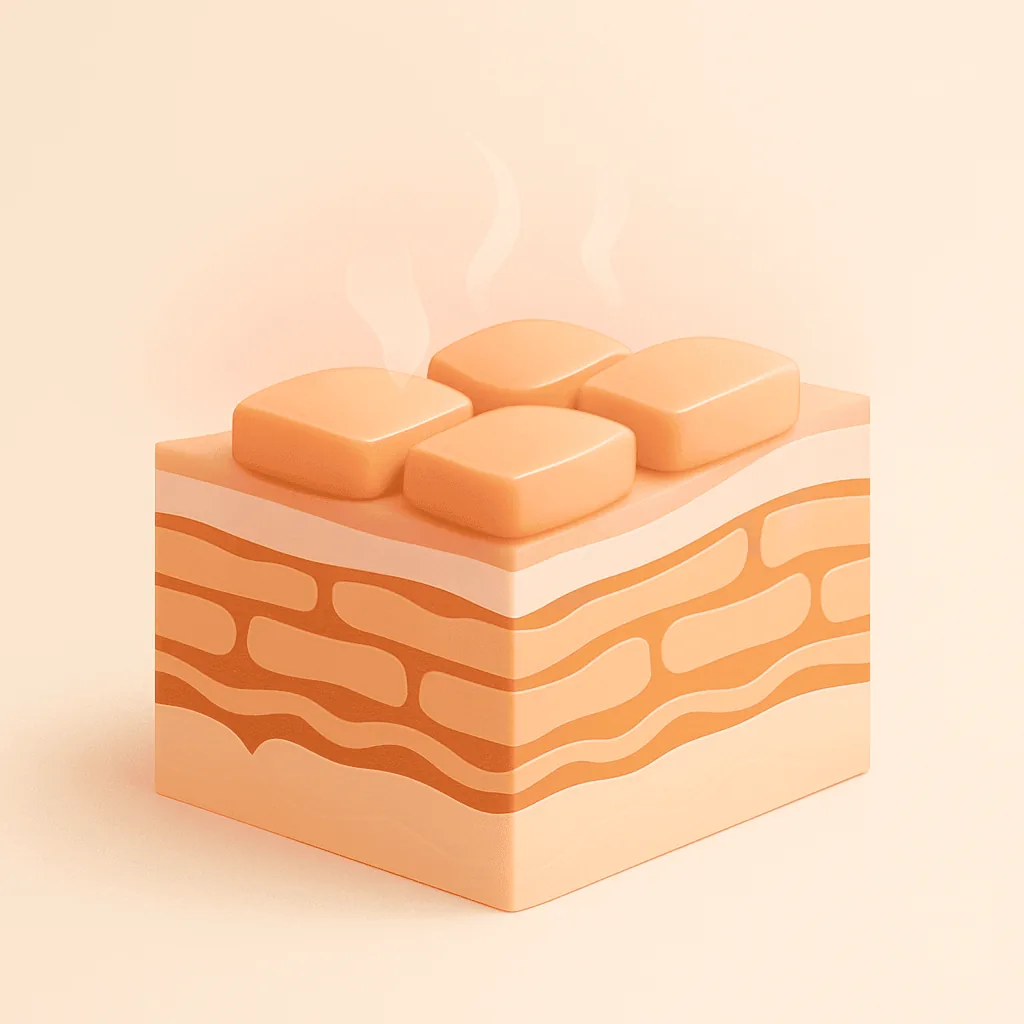
Think of the barrier as a living layer, not a surface. It's made of cells and the soft substance between them, the way a brick wall is bricks and mortar, except the mortar is doing most of the quiet work. That in-between substance is what holds water inside your face and holds the noise of the world, the pollution, the friction, the cold air, gently out. When it's resting well, you don't notice it. Your skin feels like skin. When it's tired, it lets a little water leave that should have stayed, and lets a little irritation in that should have stayed out. That's the tightness. That's the afternoon pink. That's the small patch that stings when the toner goes on.
Here's the part I think about most. The barrier is always working. Right now, while you're reading, it's making new lipids, sending old cells up to the surface to be shed, keeping the pH somewhere around slightly acidic because that's where it likes to live. It doesn't stop. It doesn't take nights off. So when it looks tired, the question isn't what to add. The question is what it's been carrying. A week of poor sleep. A new acid used a little too often. A flight. A cold snap. The barrier remembers all of it, in its own quiet way.
This is why I keep saying, one thing at a time. When the cheek goes pink and the jaw goes tight in the same week, the temptation is to reach for the calming serum, the barrier cream, the ceramide something, the oil, all of it, all at once. And I understand the reach. But a tired barrier doesn't need more layers on top of it. It needs fewer things to respond to. A slow week. Warm water instead of hot. The gentle cleanser you already own. The moisturizer that's been sitting there working the whole time. Most of what your skin needs to recover, it's already getting, if you'll let it.
And the things that already are working, notice them. The forehead, quiet tonight. The undertone, even. The little patch by your mouth that was flaking last Tuesday, soft again now. These aren't small. These are the barrier doing exactly what it does when we stop asking it to sprint. It settles. It rebuilds the mortar between the bricks. It holds water again. The cheek starts holding water again, and you can see it in the way the light sits on your face in the morning.
So when the tightness comes tomorrow, or the pink in the afternoon, try to hear it the way you'd hear a friend saying, I'm tired, not, I'm broken. Nothing urgent. Nothing to zap or fix or attack. Just a layer that carried a lot this week and would like a slow few nights. No new step. No sixth product. Maybe even one less thing, for a stretch, to see what happens.
We've been keeping notes, you and I. And what the notebook keeps showing, over and over, is that the barrier answers slowness the way a plant answers water. Not quickly. Not dramatically. But it answers. Give it a slow week. Warm water, the cleanser you know, the moisturizer you trust, sleep if you can. Then let's look again.
For tonight, that tight feeling under your eye isn't a verdict. It's just what the skin is saying at the end of a long Wednesday. The barrier is doing its work. It's been doing it the whole time. Soft again, right where it was rough.