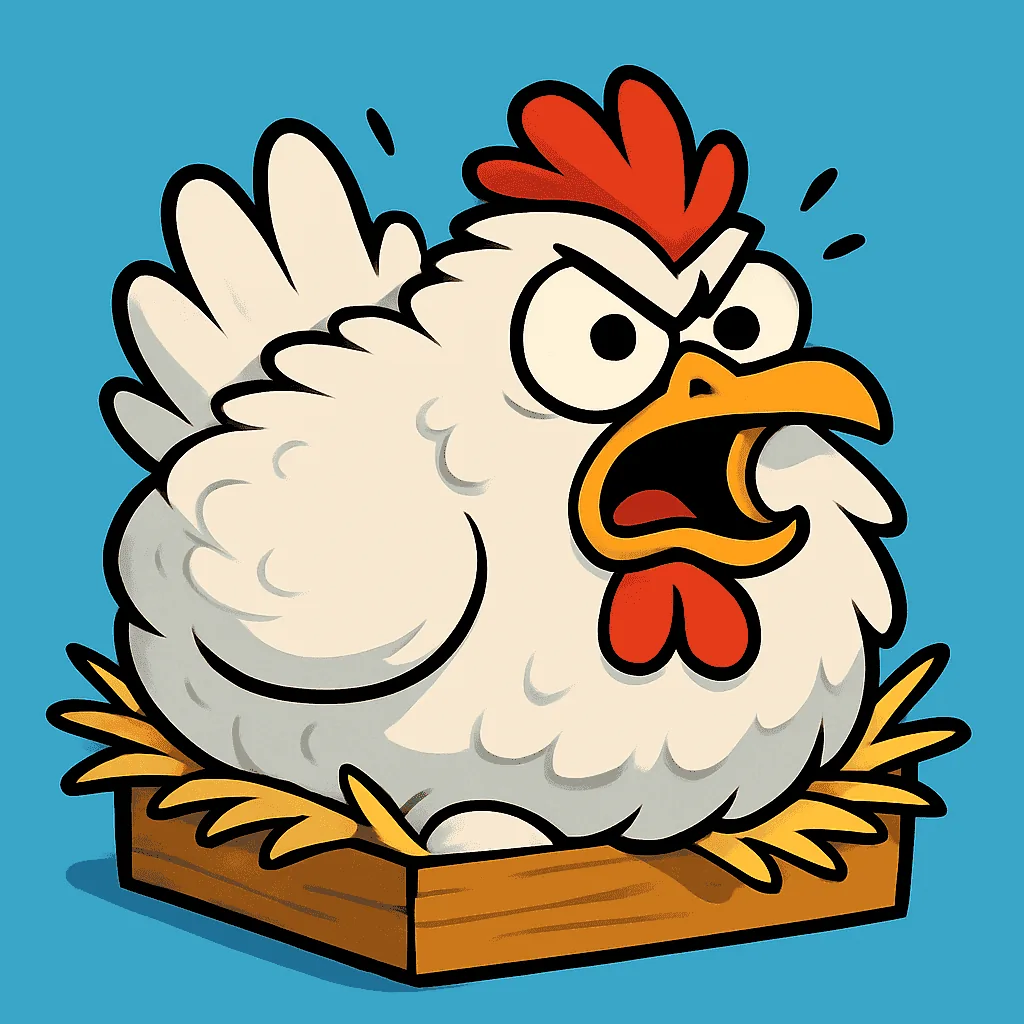
She hasn't been off the nest in two days. You lift the coop lid and there she is again, same corner, chest pressed flat to the straw, tail spread wider than a tail has any business being. When your hand goes near her, she makes a sound you didn't know a hen could make — low, throaty, halfway to a growl. Her feathers puff so she looks twice her size. Her eyes go glassy and far away. She is not the same girl who was chasing worms with the others on Tuesday.
This is the moment most keepers start to worry. She's not eating with the flock. She's warm to the touch, warmer than seems right. She's snapping at hands that have never given her anything but kindness. It looks like illness — the fluffed feathers, the stillness, the refusal to come out. And a poorly hen and a broody hen do share a look, from the doorway. So it's worth saying plainly, before we go further: that's a broody sit, not a poorly sit. Her comb is a good colour. Her wattles are a good colour. She's chosen this. Her body has decided it's time to be a mother, and no one told her there wasn't a rooster.
Let's have a proper look at her. A broody hen goes into a state that's really quite something when you know what you're seeing. She flattens herself over the eggs — or over nothing at all, if there are no eggs, which happens plenty. She pulls feathers from her own breast so her warm skin sits directly on the clutch. She leaves the nest maybe once a day, in a hurry, to eat and drink and pass one enormous dropping, and then she's back on. The growl is her whole vocabulary now. Everything she has is pointed at keeping that nest warm for the twenty-one days her body is counting down, whether there's anything under her or not.
If there's a rooster and you'd like chicks, this is straightforward — you let her get on with it, mark the calendar, and keep her fed and watered close by. But most backyard flocks don't have a rooster, and most keepers reading this weren't planning on chicks this spring. So the question becomes gentler: how do we help her come back to herself without making her miserable about it.
The first thing is simply to know it's happening and not panic. A broody spell isn't dangerous in itself. She'll lose a bit of condition — they always do — but a healthy hen can sit for two or three weeks and be perfectly fine on the other side of it. What you want to watch is that she is getting up at least once a day. Keep her water close and shallow, right by the coop door. A little food she likes — warm mash tonight, I think, or a scratch of corn just outside the pop hole — can tempt her off long enough to stretch her legs. No rush — she's holding steady.
Some hens break out of it on their own after a week or so, especially first-timers. Others settle in like they've signed a lease. If you'd rather not wait, the kindest approach most keepers use is the quiet interruption — lifting her off the nest a few times a day and blocking the nest box for a stretch, so she can't slide back in. Give her the quiet end of the run with the others in view. A cooler perch, a bit of a breeze under her, tends to bring her body temperature down and remind it that mothering isn't happening today. Nothing harsh. No dunking, no cold baths — you'll read about those and I'd leave them be. She's not being naughty. She's being a hen.
One thing to note, because it does come up: if she's genuinely not eating or drinking at all, if her crop feels empty morning after morning, if her comb goes pale or her droppings turn watery and green and stay that way — that's a different conversation. See a vet on this one, then come back and tell me. Broodiness looks dramatic but it doesn't drain a hen the way real illness does. Trust what you're seeing over more than a day or two.
Mostly, though, what a broody hen is asking for is a bit of patience and a bit of good sense. She's doing what her body told her to do. We're just here to make sure she eats, drinks, and finds her way back to the perch when the fever passes. We'll sit with her this morning. Worth another look tomorrow.
Roost first, questions later.