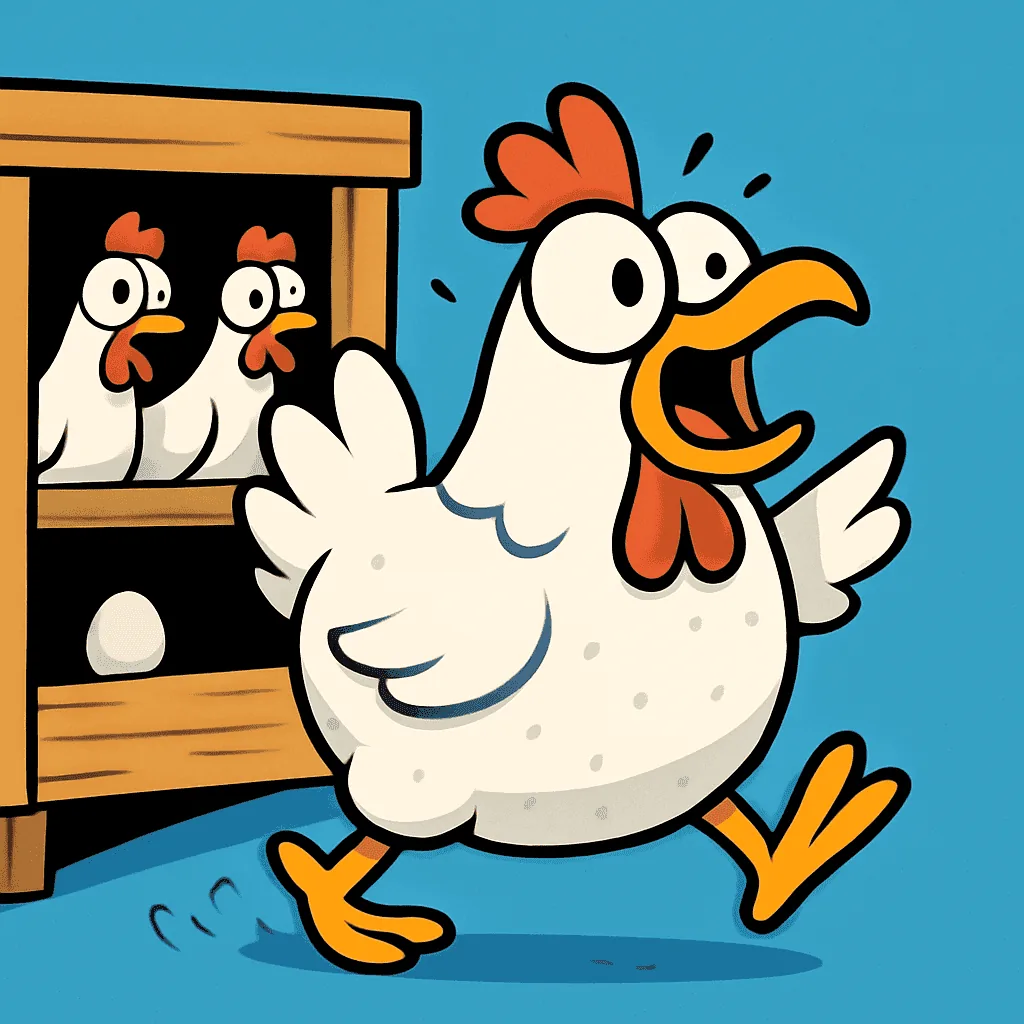
It's a bright morning and Marigold is stood on the ramp, chest puffed, throwing her voice at the whole garden. Buck-buck-buck-buck-BUGAWK. Again. And again. The others lift their heads from the dust bath. One of them answers back from the far corner of the run. A blackbird startles out of the hedge. And Marigold just carries on, telling everyone within earshot exactly what she's done.
First time you hear it, you'll think something's gone wrong. A fox at the fence, maybe, or a hen caught somewhere she shouldn't be. You'll put your mug down and go and look. And you'll find her stood on the ramp, comb bright, wattles a good colour, absolutely fine — and behind her, still warm in the straw, one egg. That's the moment it clicks. She's not distressed. She's announcing.
The post-lay cackle goes by a few names. Some folk call it the egg song. Some just call it the racket. It's the noise a hen makes in the minutes after she's left the nest box, and once you know it, you'll pick it out of any other sound in the garden. It's louder than her chatter. It's more insistent than her grumble. It has a rhythm to it — a run of low clucks that build, and then that high broken note at the end, like she's forgotten the tune and remembered it again.
Nobody knows for certain why hens do it. The old thinking is that it's a bit of misdirection — she's drawing attention to herself now that she's off the nest, so anything watching the hedge follows her instead of finding where she laid. There's something to that. A hen on the nest is quiet as a stone. A hen who's just finished is the loudest thing for a hundred yards. Whatever the reason, the pattern is old, and it's steady, and every hen who lays does some version of it.
The other thing you'll notice is that it isn't a solo. Marigold sings, and Henrietta answers from the run. The little grey one joins in from the perch. Sometimes the cockerel, if you've got one, crows over the top of the whole thing. It's flock communication, plain and simple — she's saying where she is, and they're saying they've heard her. It's the sound of a flock that knows itself. A quiet flock isn't always a happy flock. A noisy morning cackle, with the girls answering each other across the run, tells you plenty about how they're settled.
You'll also start to hear who sings and who doesn't. Some hens are proper announcers — Marigold-type girls who want the whole street to know. Others slip off the nest and go straight back to scratching without a word. Neither is a problem. It's temperament, same as with people. What matters is that a hen who usually sings and then goes quiet for a few mornings running is worth another look. Not urgent. Just noted. Her comb tells you plenty, and so does her song, or the lack of it.
She's not asking for anything. She's telling you.
There's nothing to do about the cackle, and that's rather the point. You don't need to soothe her, or shush her, or worry that the neighbours will complain — though if the coop is close to a fence, a bit of hedging softens the sound more than you'd think. She'll wind down in a minute or two on her own. She'll have a drink, have a scratch, wander off to find a patch of sun. By the time you've walked back to the kitchen the run is quiet again, and there's a warm egg in the straw waiting for you.
What I'd say is this. When you hear it, go and look. Not because anything's wrong — but because it's one of the small windows into normal hen life, and the more of those you see, the better you'll know your own girls. You'll learn which one is the loudest. You'll learn which of them answers first. You'll learn the difference between the egg song and the grumble that means a nest box is occupied and someone's cross about it. That's the sort of noticing that turns a run full of hens into your flock.
So let her sing. Marigold on the ramp, chest out, telling the garden. The others answering from wherever they are. It's a good sound. It means she's laid, she's off the nest, and she's pleased with herself — and there's not much in a morning that's better than that. No rush. She's holding steady. Warm egg in the straw, and the girls all talking at once.