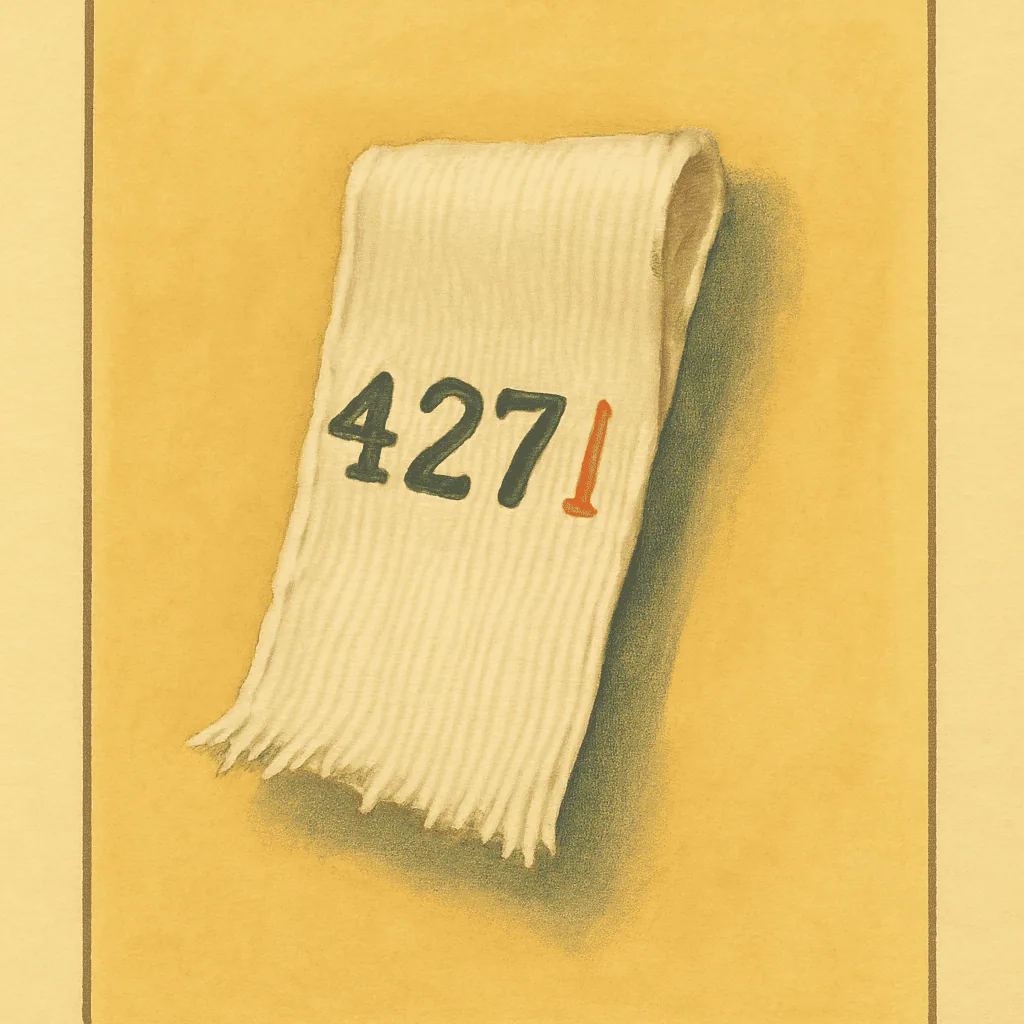
A four-digit number, hand-inked on a strip of twill tape, sewn into the side seam of a shirtwaist. The ink has bled a little into the weave. The numbers are 4127. Someone in a factory wrote them, by hand, in what I would place as 1962 — the twill is that particular unbleached cotton the mills stopped using once nylon tape came in cheap, and the ink is the old marking fluid, not a stamp. The tag is smaller than a postage stamp. Most people cut it off.
The brand label above it gets photographed, catalogued, discussed. The little strip below it gets nothing. That is the tension I want to sit with. The brand label tells you who. The lot number tells you when, and sometimes where, and occasionally which of two women on which shift. It is the more informative object, and it is the one everyone discards.
Start with what a lot number actually is. In a mid-century garment factory, a run of the same style went through the floor in batches. A batch had a number. That number followed the bundle through cutting, sewing, finishing, and shipping. If a defect turned up in inspection, the number told the foreman which batch to pull. When the batch cleared, the number stayed sewn in, because pulling it out would have cost more than leaving it. So it sits there, sixty years later, in the side seam of a blouse someone bought at a church sale for two dollars.
The form the number takes gives the decade away almost before you read the digits. Hand-inked on twill tape, unbleached — that is pre-war through the early sixties. Machine-stamped on white cotton tape, black ink, clean sans-serif — mid-sixties into the seventies. Printed on a synthetic ribbon, sometimes with a small logo repeat — later seventies onward. By the eighties the lot number often merges with the RN number or migrates to the care label, and the separate twill strip disappears. So the mere presence of a distinct lot tape, sewn independently of the brand label, is already telling you no later than roughly the early eighties.
Then the number itself. Four digits, hand-inked, is a small-shop practice — a factory running maybe a few dozen styles a season. Five or six digits, machine-stamped, is a larger operation with a numbering system that encoded season and style. A prefix letter — A, B, F — often meant the season within a fiscal year. A stamp that reads something like S-62 or F-71 is a season code, not a date exactly, but close enough to place the garment inside a twelve-month window. Read next to a union label, or an ILGWU local number, the lot tape becomes a coordinate rather than a clue.
Here is what I look for, in order. The tape stock first — its colour, its weave, whether it is cotton or synthetic. The ink or print method second. The number of digits third. The presence of a letter prefix fourth. And only then the number itself, which by that point I already half-know how to read. The stitch tells before the label does, and the lot tape tells before the brand mark does — because the brand mark was designed to be read, and the lot number was designed to be ignored.
A small caveat. Not every lot number pins to a year. Some factories reused numbers across seasons; some used a running count that reset annually with no indication of which year. What the lot tape gives you, reliably, is the production run — the batch this specific garment travelled through the floor with. Whether you can then place that run in calendar time depends on what else the garment carries: the union local, the RN number, the care-symbol adoption, the country-of-origin phrasing. The lot tape is one coordinate. It wants the others.
But treat it as furniture and you throw away the most specific object on the garment. The brand label was printed by the thousand. The care label was printed by the ten thousand. The lot tape was written, once, by one person, for one bundle, on one afternoon. It is the only mark on most mid-century garments that refers to a single event.
So when the blouse comes in and the brand label is faded and the RN number has been trimmed and the care symbols were never sewn in — before you decide the piece is undateable, turn the side seam out. Look for the small strip. Four digits in ink that has bled into unbleached twill. One observation, then you decide.