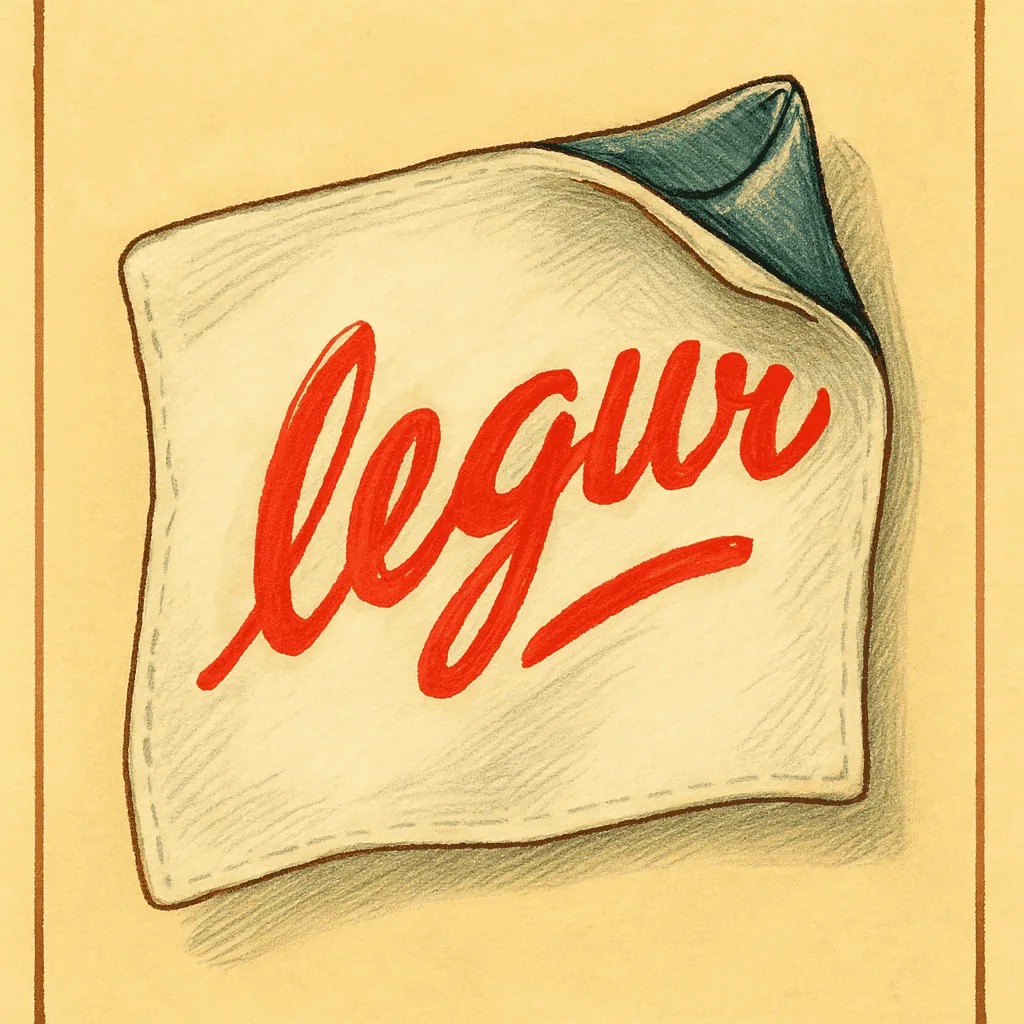
The label is small, rectangular, sewn into the side seam of a wool skirt. Red script on a white ground. No bar code beneath, no numeric string, nothing but the letters and the small union bug beside them. You can hold the whole thing under a thumb. And that thumbnail of red thread on white cotton has already told you, before the fibre content tag, before the RN number, before anything else you might turn over — a window of years the skirt cannot have been made outside of.
Most people read the ILGWU label as a yes-or-no. Union-made, therefore American, therefore old enough to matter. That reading throws away most of what the label is doing. The International Ladies' Garment Workers' Union used more than one label across its run, and the changes were not decorative. They were administrative — a redesign here, a new registry number there, a shift in colourway when the organisation restructured. Each version sat in the placket for a bounded number of years. The label is not a single stamp. It is a series of them, and the colour is the first thing your eye should sort by.
Start with the red-on-white script. That is the earliest of the common labels you will handle in the field, and it belongs to the run before the 1959 redesign. The lettering is cursive, the ground is plain white cotton, the union bug sits to one side. There is no consumer-protection text beneath it, because there was not yet a requirement for one on the union mark itself. If the garment carries only this label and nothing else on the interior seam — no care symbols, no fibre content tag, no RN number — you are looking at a piece from the earlier half of the union's mid-century activity. The cloth will usually agree. Heavier wool, rayon crepe that behaves like nothing woven after the war, a hem finished by lock-stitch rather than serger.
The 1959 redesign is the one people miss. The palette shifts. Red, white, and blue together — the tricolour version — replaces the plain red script, and the typography tightens. The bug is repositioned, the lettering squares up. If you see the tricolour, you are past 1959 and before the next major change. That is a fifteen-year window on its own, narrowed further by whatever else is stitched into the collar band or the side seam. A tricolour ILGWU label with no care symbols in the garment is before 1971. A tricolour label with the pictogram care symbols present is after. The label narrows it; the neighbours on the seam narrow it further.
Then the 1974 numeric code. This is the one that turns the label into an index card. From 1974 onward the ILGWU mark carries a small numeric string — the local number, the identifying digits — printed or woven alongside the union bug. If you find those digits, you are looking at a garment made in or after 1974, and the local number itself can be traced to the shop that produced it. Before that year, no digits. After it, digits. It is one of the cleanest hinges you get in a twentieth-century label, and it does not require you to know a font or a registry to use. Digits present, seventy-four or after. Digits absent on an otherwise 1970s-looking label, before seventy-four. Union label, so before eighty-three, when the ILGWU began phasing toward the merger that would eventually produce UNITE. The palette does the coarse dating. The digits do the fine.
What this gives you is a three-step read on a single label, done without turning the garment over. Colour first — red-on-white, or tricolour, or tricolour-with-digits. That places you in one of three bounded windows. Then the neighbours on the seam. Care symbols present or absent, fibre content tag present or absent, RN number present or absent. Each of those confirms or contradicts the window the colour proposed. If they contradict, trust the later feature; a garment can carry an older-looking union label if it was stocked deep, but it cannot carry a care symbol that had not yet been adopted.
Read the tag last, they say, and mostly that is right — the garment speaks first, the cloth and the seam finish and the hem. But the ILGWU label is a small exception. It is doing so much work in so little thread that it earns an early glance. One observation, then you decide. Red on white, no digits, no bar code beneath. You already know more than you did a minute ago, and you have not yet touched the fibre content tag.
the stitch tells before the label does — except when the label is this one.
Set the skirt down. The window is bounded. The rest of the seam will narrow it.