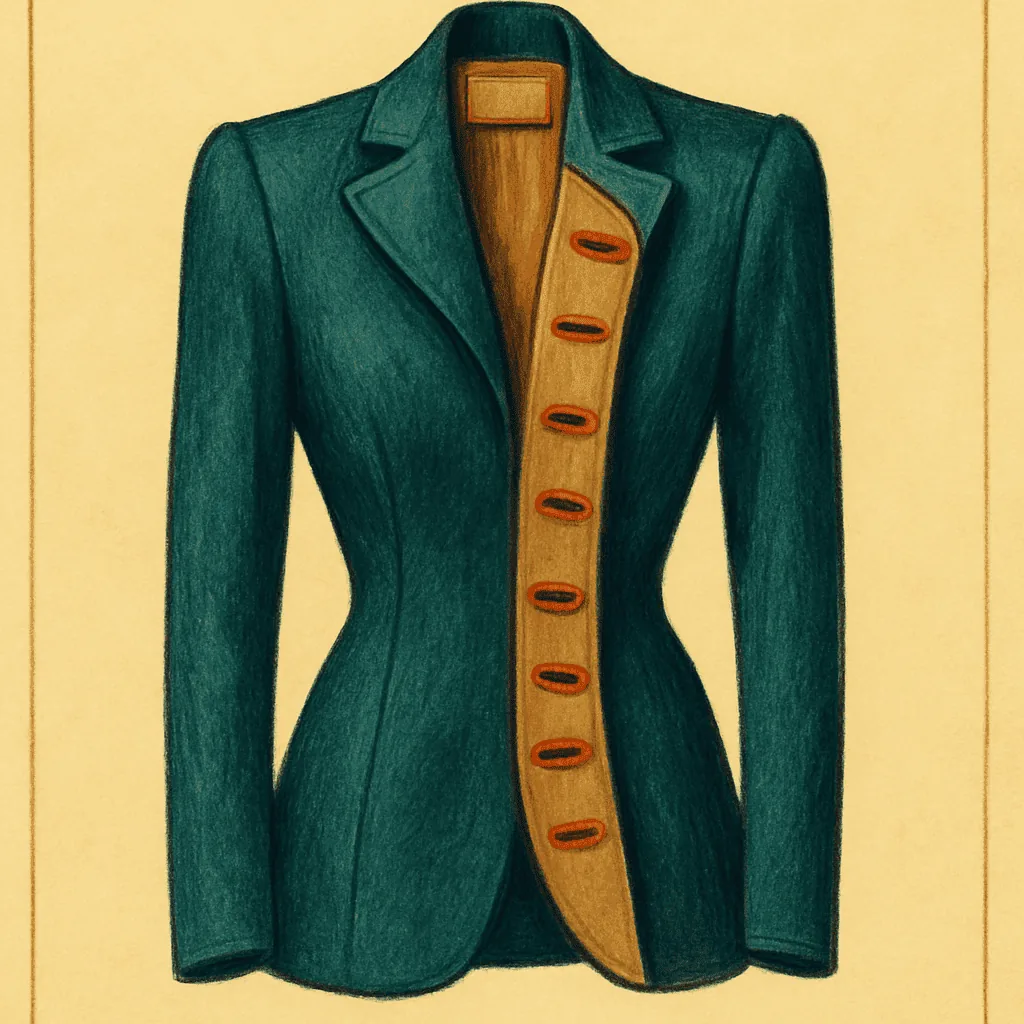
The label reads Bergdorf Goodman, or Bonwit Teller, or a small Madison Avenue house whose name you half-recognize. The woven tag is neat, centered on the collar band, the serif clean. You turn the garment inside out. The lining is bagged, not bound. The buttonholes are hand-worked, but not by the hand that finished the hem. The seam allowances are pinked on one side and overlocked on the other. Two people made this coat, and the tag only names one of them.
This is the thing the archive learns slowly. A label is a claim about who sold the garment, not always a claim about who sewed it. Department stores contracted their private-label work out to jobbing houses. Small couture rooms took in overflow from larger ones. A Seventh Avenue name would buy shells from a contractor in the garment district, finish the collar and cuffs in-house, and stitch its own woven label over whatever the contractor left behind. The tag tells you where the coat was sold. The inside tells you where it was made.
The seam finish gives the decade away, and it also gives the maker away. A single house tends toward a single hand. If the side seams are serged in a tight, even chain and the armhole is bound in Hong Kong finish with a bias strip that matches the lining, those are two different rooms. Serging is a contractor's economy — fast, clean, done by the machine. Hong Kong binding is slower, done by a finisher who was paid for time, not piece. When you find both in one garment, someone bought a shell and finished it.
Look at the lining next. A house that made a coat from cloth up will line it in a fabric it also uses elsewhere in the season — the same rayon twill turns up in three coats from the same year, and the archive knows this because the archive has seen the other two. A relabelled shell wears a lining the naming house didn't choose. The colour is close but not exact. The selvedge, if you can find it inside the hem, doesn't match the mill the house used that year. Small tells. They stack.
Buttonholes are the loudest tell. Hand-worked buttonholes have a rhythm — the purl sits on the outside edge, the stitches lean slightly toward the cut, and one worker's lean is consistent across a garment. Machine keyhole buttonholes belong to a specific machine and a specific room. When the buttonholes on the placket are hand-worked and the buttonholes on the cuffs are keyhole, the placket was finished after the shell arrived. That is a relabelling in progress, caught mid-sentence.
The tag names the seller; the inside names the sewer.
The union label complicates this and clarifies it. An ILGWU tag stitched into the side seam of a coat whose front label reads a non-union house is not a contradiction — it is a receipt. The contractor was union; the naming house may or may not have been. The union label sits where the contractor put it, usually low on the inside side seam or under the lining at the waist. If you find one there and a boutique label at the collar band, the boutique bought the coat finished and added its name. The garment has two authors and one is signed in a place most buyers never looked.
The reason to care about any of this is not to catch a house out. Houses relabelled openly for a hundred years; the practice was the industry, not a scandal. The reason to care is placement. A coat labelled by a Madison Avenue boutique in 1962 and made by a union contractor in 1961 is dated by the contractor, not the boutique. The shell was sewn before the label was sewn on. If you are trying to place a garment inside a fifteen-year window, the contractor's hand is the more honest witness. The naming house tells you when the coat was sold, which can be a season or two later, sometimes a year.
So when the tag and the inside disagree, they aren't disagreeing. They are telling two true things about the same coat. The buttonholes were sewn in one room, the label stitched in another, and the coat passed between them the way most coats did. Read the tag last; the garment already spoke. One observation, then you decide which author you're dating — the one who sewed the shell, or the one who signed the collar. They rarely worked in the same week, and the archive is patient enough to hold both.