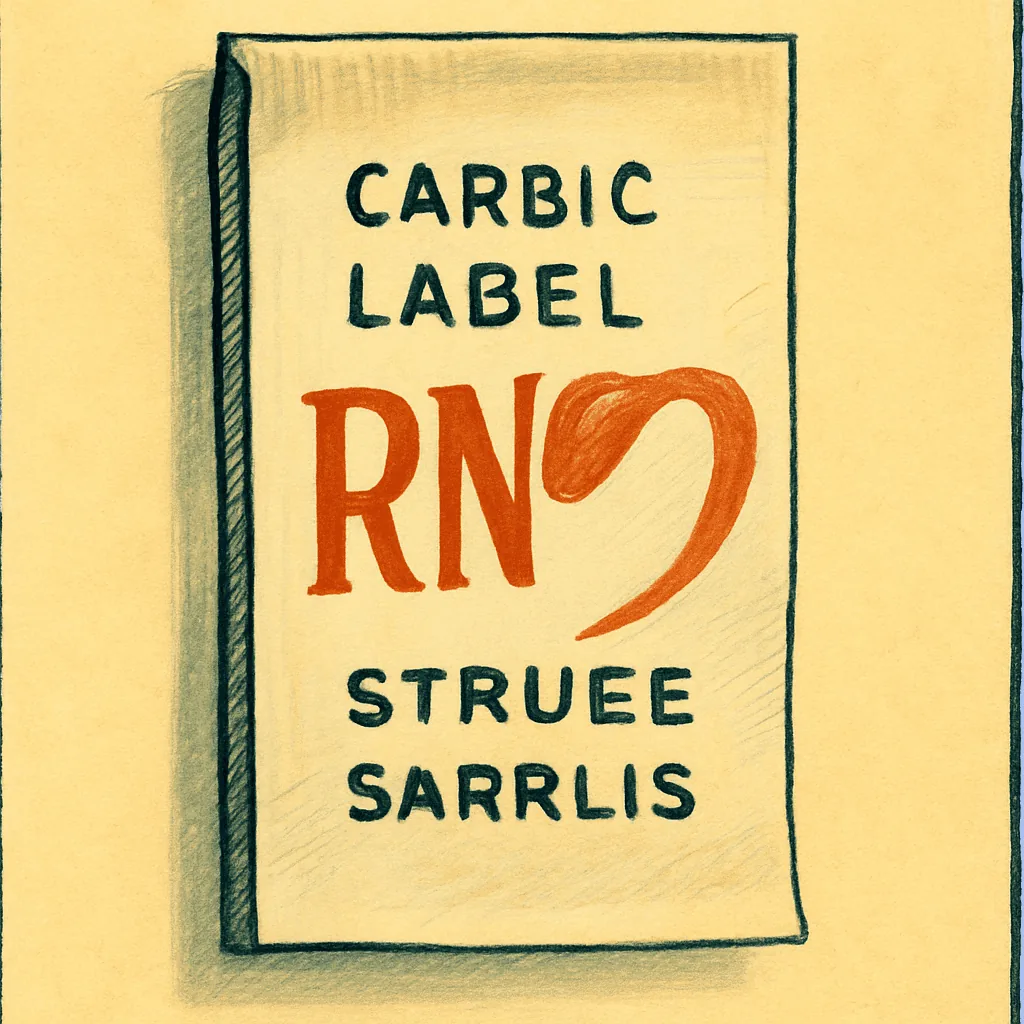
The label is beautiful. Cream ground, red script, a small union bug tucked into the corner where you want it to be. The serif on the brand mark leans a little; the weave of the label stock is loose in the way old rayon labels went loose after sixty years of gentle wear. You are already deciding. The garment is on your bench, the light is good, and the label is telling you a story about a small shop in the garment district, sometime around fifty-four. Then your eye moves half an inch down, to a second line of print, and the story stops mid-sentence.
The RN number reads 132404. That number was issued in 2009. Every other feature on this label is arguing for the middle of the twentieth century, and one line, in the same ink, from the same print run, is arguing for the year the iPhone got its front-facing camera. Both cannot be true. One of them is doing the talking, and the other is doing something else.
This is the reproduction tag, and the RN is how it tells on itself.
The modern reproduction trade is not, mostly, dishonest. A brand revives an old mark, prints a label that references the archive, sews it into a new garment, and sells it as what it is — a new garment with a nostalgic label. The RN sits on the tag because the law requires it to sit on the tag. The RN is contemporary because the company is contemporary. The label is doing exactly what a label is supposed to do; it is the buyer, downstream, who reads the serif and the union bug and stops reading before the number.
The deadstock relabel is a quieter case. A blank mid-century body, never sold, sits in a warehouse for decades. Someone finds it, sews in a fresh label with a fresh RN, and sends it out. The cloth is old, the seams are old, the tag is new. The garment is genuinely of its decade, and the label is not. Both cases end in the same place on your bench, with one line disagreeing with the rest.
So you learn to read the label as a set of features that must agree, rather than a single artifact that must be believed. Weave first. A woven label from 1954 has irregularity in the warp, a slight halo around the letterforms, the sense that the loom was working near its limit. A reproduction weave is too even. The letters sit crisp against the ground the way modern jacquard sits crisp — the machine is not straining. Font weight next. Mid-century commercial type had a specific density; the reproduction almost always runs a hair lighter, because the source file was traced from a photograph, not cut from the original matrix. The R that should be broad-shouldered is narrow. The serif that should be blunt is tapered.
The label wants to be believed. The RN does not care.
Then the RN itself. The registry is public and dateable. A number in the six-figure high hundred-thousands is post-2000; a number in the low ten-thousands is early. You do not need to memorise the brackets — you need to remember that the number can be checked, and that the check takes a minute, and that a minute of checking undoes a decade of wishful reading. Read the tag last; the garment already spoke.
The cloth will not lie to you the way print will. A 1954 rayon has a specific hand — dry, slightly papery at the hem, with a drape that collapses rather than falls. A reproduction rayon is wetter to the touch, more uniform, and the selvedge, if there is one, is machined too clean. The inside seam finish matters as much as anything on the label. Overlocked with a modern four-thread serger, in a colour that matches the shell perfectly, is a signature of the last twenty years. A 1954 seam is bound, or pinked, or turned and lock-stitched, and the thread has yellowed at a rate the shell has not.
One observation, then you decide. If the weave is too even, note it and move on. If the font weight is wrong, note it and move on. If the RN reads 2009, you already have your answer, and the rest of the label is a costume the garment is wearing. The costume can be lovely. It can be worth having. It is simply not what the serif was implying.
What this asks of you is patience. The label wants to be read fast, in the direction of the story you want to be true. The features want to be read slowly, in whatever direction they happen to point. When one line disagrees with the rest, the rest is not outvoted — the rest goes quiet, and the disagreeing line is the one still speaking. Set the garment down. Note the RN. The decade will place itself, once you stop placing it for it.