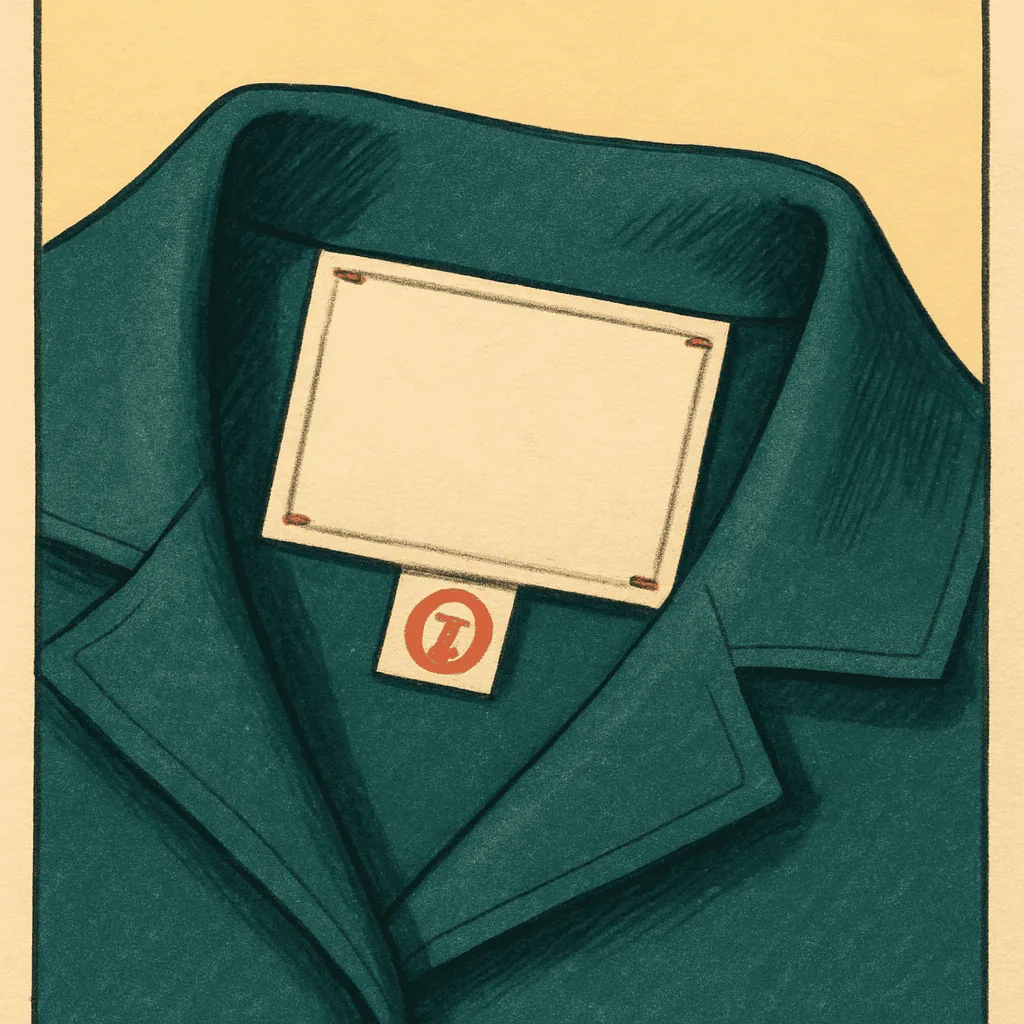
A blouse comes across the table, neck seam turned out, and there it is — a woven rectangle no wider than a thumbnail, red on white, stitched into the join where the collar band meets the body. Not printed. Woven. The letters sit slightly raised, the edges are finished, and the whole thing has the weight of something that was meant to outlast the garment it went into. Before anything else about the blouse gets read — the fibre, the seam finish, the country of origin line — that small rectangle has already fixed the decade to within a decade, and often to within five years.
Most people looking at a tag like this go straight for the language on it. The union name, the local number, the small print underneath. Those matter, and I'll come to them. But the first thing to read is the placement and the colour. The union label sits high on the placket or the neck seam, not down at the side seam or the hem. It is woven, not printed. And it is red-on-white or blue-on-white, in that order of prevalence, and the colour is doing more work than it looks like it's doing.
Two unions account for almost everything you'll see. The ILGWU — the International Ladies' Garment Workers' Union — put its label into women's outerwear, blouses, dresses, skirts. The ACWA, later the ACTWU, handled men's tailoring and, later, a broader range. Both used woven labels. Both used the red-and-white and blue-and-white palettes at different points in their history, and the palette tracks the era.
The rough shape of it: the earlier ILGWU labels, into the fifties, tend to read in a serifed all-caps mark, often blue on white, sitting proud on the collar band. Through the sixties and into the early seventies, the red-on-white becomes the more common face of the label — the one most people picture when they picture a union tag at all. Then in 1974, the ILGWU shifts to a numerical local-identifier system on the label itself; the local number stops being spelled out the old way and starts appearing as a printed or woven numeral. That shift is a hinge. A label without the numerical local, in the older typographic style, reads earlier than 1974. A label with it reads 1974 or after.
And then the ceiling. In 1983 the ACWA and the ILGWU-adjacent textile union merged; the labels changed again, and the older marks stopped being sewn into new production. So a woven ILGWU label in the old palette, in its old placement, on a garment that otherwise reads consistent — the fibre content, the care symbols, the country of origin phrasing all sitting where they should for the era — puts you before 1983 with near-certainty. Not probably. The feature carries it.
Union label, so before eighty-three.
That is the sentence the tag hands you. Everything else in the garment either agrees with it or asks a question. If the care symbols are present in the modern form, you are looking at 1971 or after, so the window narrows to the twelve years between. If the fibre content tag is missing entirely, you are earlier. If the RN number sits alongside the union label in a certain range, that narrows it further still. The union label is not the whole answer. It is the fixed point the rest of the reading rotates around.
One caution, and it is the one worth naming. Union labels were reproduced. Not often, not well, but they were — sewn into later garments to lend an era they didn't come from. The tells are almost always in the weave and the stitching that attaches the label, not in the label itself. A union label sewn in with a modern serged edge running through it is telling you something the label alone cannot. Look at the stitch that holds it, not just the words on it.
So when the blouse comes across the table and the small red-on-white rectangle is there at the neck seam, the reading goes in that order. The weight of the cloth first. The seam finish. Then the label — colour, placement, weave, and whether the local reads in the older spelled form or the post-1974 numeral. One observation at a time; the tag speaks in order, and it is worth letting it. The rectangle is small. What it fixes in time is not.