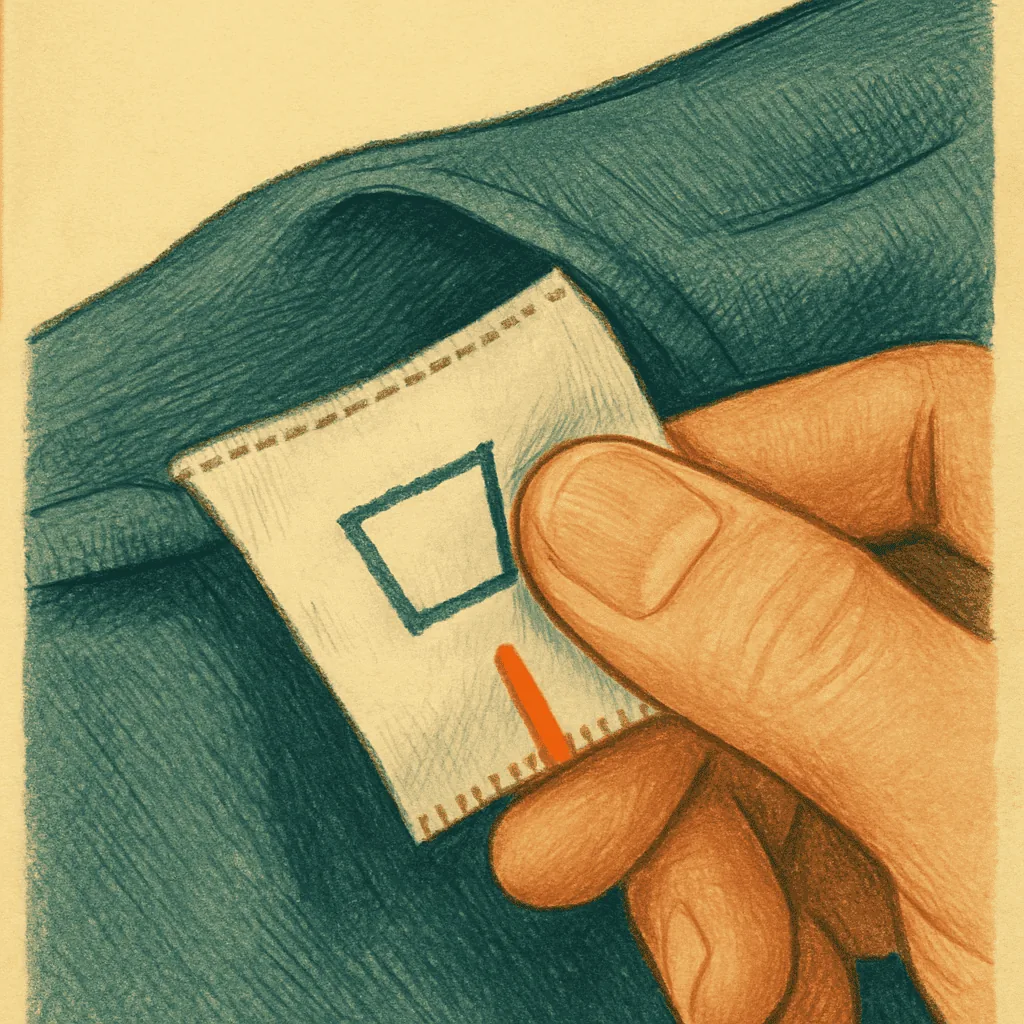
Run a thumbnail across the label at the back of the collar. Not the eye — the thumb. A woven label catches; the raised threads drag against the nail like a very fine file. A printed label slides, smooth as the cotton it sits on. You will feel the difference before you register it. Most people photograph the tag and go straight to the font. The font is doing the talking, yes, but the weave under it has already spoken.
Here is the trouble. A serifed brand mark in all-caps reads earlier than it is. A cursive script reads later than it is. The graphic vocabulary lies, or at least it flatters. What does not lie is how the label was made — whether the letters are threads or ink, and if ink, what the ink is sitting on. That construction shifts across the century in a way the design does not, because the machinery shifted, and the cost calculus shifted, and manufacturers changed what they were willing to spend on the small square at the neck.
Woven-satin brand labels dominate the first half of the twentieth century and hold on well past it for the houses that wanted to hold on. The ground is a fine satin weave, tight and slightly lustrous, and the brand mark is worked in coloured thread directly into the cloth. Run the thumb across a woven-satin label from the forties and you feel the letterforms as ridges. Turn it to the light and the satin catches, silvery. These labels are expensive to make and they were meant to be seen — often stitched high on the placket or the inside collar band, centred, presented. A woven-satin label on a garment tells you the maker was still paying for the label to matter.
Printed cotton labels arrive as a cheaper alternative and spread through the middle decades. The ground is a plain-weave cotton twill or a cotton-blend tape, and the brand mark is stamped or screen-printed on. Early printed cotton labels feel soft and slightly fuzzy, and the ink sits on the fibres rather than in them. Look at the edge of a letter under a loupe: on a printed cotton label from the fifties or sixties, the ink bleeds into the weave a little, feathering. That feathering is a tell. Crisper printed cotton, with sharp letter edges and a slight glaze to the surface, is later — the inks improved, the substrates got denser. A printed cotton label with an RN number and no care symbols is one window; the same label with care symbols added is a narrower one.
Then the substrate changes. Printed polyester and acetate labels take over from roughly the middle of the seventies onward, and by the eighties they are near-universal on ready-to-wear. The feel is unmistakable — slick, almost plasticky, with a hard edge that will scratch the back of your neck if the manufacturer did not fold and finish it properly. The ink sits on top, flat, no feathering, because polyester does not absorb it the way cotton does. If you run a thumbnail across a modern printed polyester label the nail glides and clicks faintly against the edge where the tag is die-cut. That click is a twenty-first-century sound. Woven labels do not make it.
So the sequence, held loosely: woven-satin dominant into mid-century, printed cotton through the middle decades, printed polyester from the later seventies on. Loosely, because the houses overlap. A couture label in nineteen-eighty-two might still be woven-satin because the house wanted it woven-satin. A budget line in nineteen-sixty-two might already be printed cotton because the budget said so. The weave does not date the garment on its own. It narrows the window, and then the union mark narrows it further, and then the care symbols narrow it further, and by the third feature you are inside a decade.
The stitch tells before the label does; the label tells before the font does.
What this means at the collar: photograph the tag flat and in good light, and before you send the image anywhere, put your thumbnail across it. Catch, or slide. Ridged, or flat. If it catches and the ground has a slight sheen, you are earlier than you think. If it slides and clicks at the edge, you are later than the font wants you to believe.
One observation, then you decide. The garment has already told you which century it belongs to, and now the tag is only confirming what your thumb worked out first.