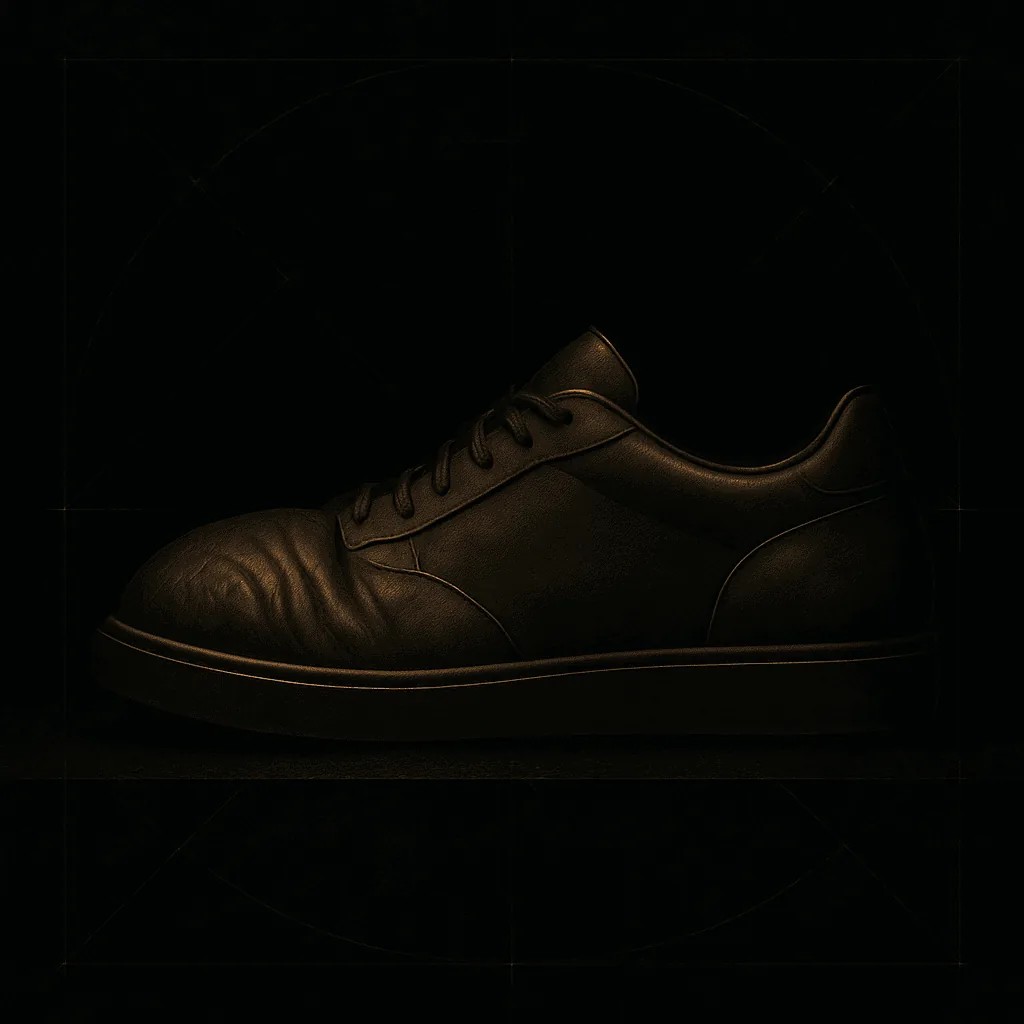
The pair is sitting on the desk under the lamp. Not a new pair. The toe box has that soft downward bend from a thousand steps, the vamp shows two clean crease lines running across the flex point, and the leather at the toe has gone a shade darker than the panel behind it. No cracks. No dry patches. The upper still holds its shape when you press a thumb into the side panel. This is a pair somebody wore. This is also a pair somebody paid attention to.
Most pairs don't age like this. Most pairs come out of the box, get worn hard for a season, then either sit in a closet drying out or get run into the ground until the leather splits at the crease and the toe scuffs down to the substrate. The middle path is rarer than people think. A leather upper that ages the right way isn't a pair that was babied and never worn. It also isn't a pair that got treated like a beater. It's a pair that got worn, and the person wearing it noticed what was happening to the material.
Start with the grain. Full-grain leather, the kind used on the better runs, has a natural texture across the panel. Look at it in raking light from the side. You want to see that texture still legible, not sanded flat by scuffing, not buried under a heavy coat of conditioner someone slathered on to hide neglect. Grain that's still readable means the top layer of the hide is intact. That's the layer doing the work.
Now the creasing. Every worn pair creases. The question is where. On a pair that aged the right way, the creases sit along the natural flex point of the foot, running roughly across the vamp where the toes bend on the push-off. Two lines, maybe three, parallel, clean. Nowhere else. No crease running down the side panel, no bunching around the eyerow, no accordion folds near the tongue. Creases in the wrong places mean the pair was worn with the laces too loose, or worn with a foot the shape didn't fit, or stored crushed under something. Creases in the right place mean the shoe did what it was built to do and the foot inside it moved the way a foot moves.
Then the darkening at the toe. This one people misread. A slightly darker toe on a pale leather upper isn't damage. It's patina. The toe box takes the most contact, the most flex, the most oil from hands adjusting the pair, the most moisture from the ground. Over time the leather there absorbs and reflects light differently than the panel behind it. On a well-kept pair the darkening is even, gradual, a soft gradient from the eyerow down to the toe. On a neglected pair the darkening is patchy, or it turns into an actual stain, or the finish flakes because the leather underneath dried out and the top coat let go.
The midsole tells the truth about how the pair was stored, but the upper tells the truth about how it was worn. Both stories matter. A pair with a yellowed midsole and pristine upper was probably kept in a bag in a warm closet, forgotten. A pair with a bright midsole and a cracked, dry upper was probably wiped down for photos and never conditioned. The pair that ages the right way had somebody who did the small things. Wiped the toe after a wet walk. Loosened the laces before pulling them off. Put shoe trees or paper in during the off weeks. Nothing dramatic. Just attention.
One thing about this pair on the desk. The leather at the flex point, where the crease is deepest, still has give. You can feel it with a thumb. Dry leather resists and then splits. Cared-for leather bends. That's the tell. Not the color, not the shine, not the absence of scuffs. The give.
So when a pair comes across the shelf and the upper looks like this, worth pulling the box for. Not because it's rare, though sometimes it is. Because somebody wore it and paid attention while they wore it, and that's a thing you can't fake with a bottle of cleaner the week before a photo. The leather aged the right way. That's the whole verdict. Sit with it, keep doing the small things, and the next pair on the shelf will read the same way in ten years.