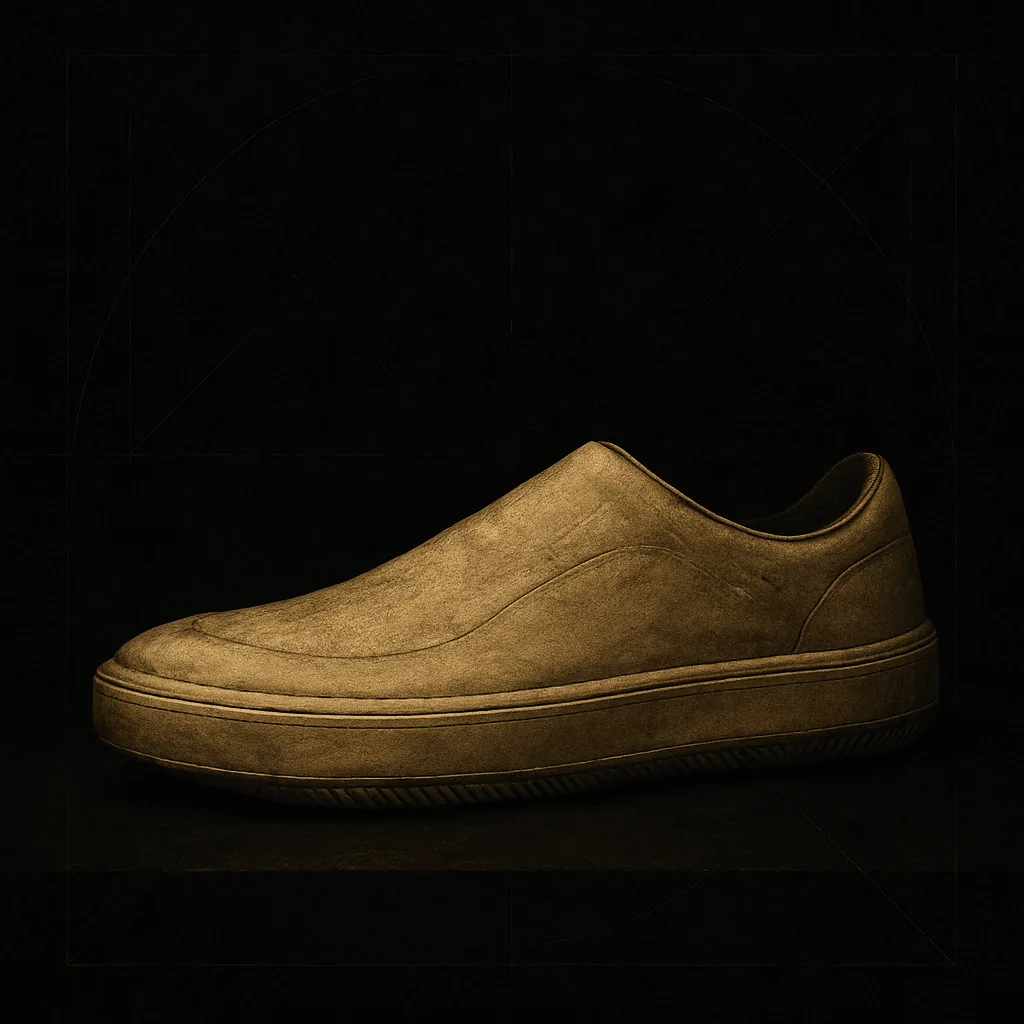
Pull a pair off the shelf that hasn't moved in a decade. The midsole isn't white anymore. It's the color of old paper, or weak tea, uneven across the foam, darker under the arch where the light never reached. You didn't do anything wrong. You just kept them. The box sat where boxes sit. Time did the rest, quietly, the way time does.
Most of what you'll read online treats yellowing like a problem to solve. Ice baths, sun sessions, hydrogen peroxide under cling film, a whole afternoon of scrubbing to chase back a white that isn't coming all the way back. And underneath all of it, the assumption that a yellowed sole is a ruined pair. That's the part I want to sit with. Because it isn't always true, and pretending it is flattens what the archive actually is.
Here's what's happening in the foam. The midsole on most older runners is polyurethane or an EVA blend, and the compounds inside it react with oxygen and UV light over years. That reaction changes how the material reflects light. The foam itself is mostly fine, structurally. It's the surface chemistry that shifted. That's oxidation, and it's the same process that darkens a cut apple or ages the leather on a wallet you've carried since school. It isn't decay in the failure sense. It's the material meeting air, the way materials do.
Some yellowing dates a pair honestly. A cream midsole that's gone soft-yellow across fifteen years of shelf life is telling you the truth about where it's been. The foam met air. The pair is old. You can read that patina the same way you read the crackle on old leather or the fade on indigo denim. The stitch gives it away, the tongue tag gives it away, and the midsole tells the truth about the years. That's information. That's part of the pair's file.
Other yellowing ruins resale, and that's a different conversation. If the pair is a grail on the market, a buyer wants the icebox version, the one that looks the way it looked leaving the factory. A yellowed midsole on that pair drops the number, sometimes hard. Not because the shoe is worse, but because the market prices a specific kind of preservation. You can respect that market without living inside it. Plenty of collectors chase the icebox. Plenty of others don't. Both are real ways to keep pairs.
So the question isn't whether the yellowing is good or bad. The question is which pair you're holding, and what you want it to be. A runner from '89 that you wore in college, that lived in a closet for twenty years, that came back out with a golden midsole and cracked foam under the heel, that's a story pair. Bleaching it back to a false white erases the file. That patina is the pair. Leave it. Write the notes. Keep it on the shelf, not the rotation.
A deadstock pair you paid deadstock money for, still in the box, that's a different pair. If the midsole is turning and you plan to sell in three years, that's a resale decision, and the market will price it accordingly. You can restore, or you can hold and accept the drift. Neither choice is wrong. Both have consequences you can see coming if you look at the foam under a desk lamp for a minute.
One thing about this. The pairs that yellow the most honestly are usually the ones that were worn a little, then rested. The foam breathed, the leather aged the right way, the whole pair settled into itself. A pair that never touched pavement and never left the box can still yellow, because the foam is still meeting air through the tissue. Storage slows it. Nothing stops it. That's the material.
If you want to slow the drift, keep pairs out of direct light, keep the box closed, keep the room cool and dry. That's it. The rest is chasing. The ice-bath restoration trick can pull some yellow back, sometimes, for a while, and then the foam turns again because the chemistry underneath didn't change. You bought yourself a season, maybe two. Worth pulling the box for, on a pair that matters to you that way. Not worth it on a pair whose whole value is the years it's been sitting.
So look at the midsole. Then look at the pair. Ask what you want from it. The archive holds both kinds. The icebox pair and the honest-yellowed pair, side by side on the shelf, each telling its own true thing about where it's been.