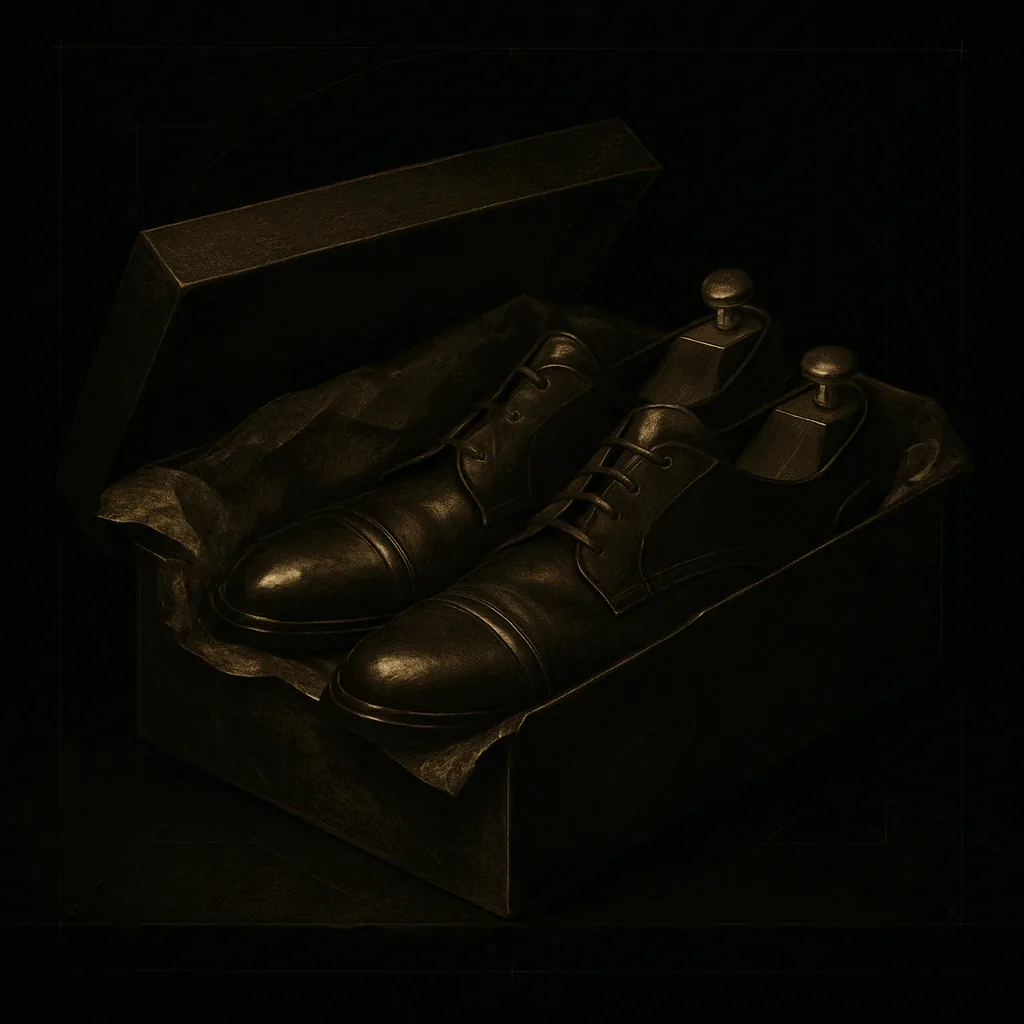
You open the box in year eight. The tissue held its fold. The sole didn't crack. The tongue is still standing up on its own, more or less. You sit with the pair on your lap under the desk lamp and you feel the small relief of a thing that survived. Nothing dramatic. The pair is here. The pair is fine. That is the whole event.
Most of what gets written about long-term storage reads like a checklist. Silica this, temperature that, rotate every so many months. The lists aren't wrong exactly, they just skip the part that matters. A pair on a shelf is not a static object. It is a slow chemistry set. Foam breathes. Leather dries. Glue holds until it doesn't. The question is not how to freeze the pair in place. The question is what you are willing to lose and over what stretch of years.
Start with the foam. Midsoles are mostly air held in a matrix, and the matrix wants to let the air go. That is what crumbling is. It isn't damage from the outside, it's the material finishing what it started the day it left the mold. A pair stored in a cool, dry place slows the exit. A pair stored in a hot attic finishes the job in a couple of summers. You are not preventing the reaction, you are stretching it. The sole unit tells the truth on this, always. Press the midsole with a thumb in year six and you will feel where the pair is on its own timeline.
Leather is the opposite problem. It doesn't want to give up air, it wants to give up moisture. A leather panel that sits eight years in a dry box goes stiff along the flex points, and the first bend after a long sleep is where the cracking wants to start. This is why the pairs that come out of a closet in a coastal apartment often look better than the ones from a desert garage. Not because anyone did anything right. The room did it. The suede on nubuck panels is more forgiving, it doesn't need the moisture the same way, but it holds dust and it will hold the shape it was stored in. Stuff the toe box. Not tight, just enough to keep the shape honest.
The box itself matters more than people give it credit for. An original box does two jobs. It blocks light, which is what fades a colorway from the inside, and it holds the tissue, which keeps the panels off each other. Pairs stored loose on an open shelf under a window fade on the sun side and stay bright on the shadow side, and after a few years you can read which way the shelf faced. The box matters here. The tissue matters. If the tissue crumbles when you touch it in year eight, that's fine, it did its work. Replace it and close the lid.
One thing about the long shelf, the pairs you check on are the pairs that last. Not because checking does anything mechanical. Because the act of pulling the box, lifting the lid, running a thumb along the midsole, that is when you catch the pair that's starting to go. A sole separating at the heel in year seven is a glue job. A sole separating in year ten, discovered when you finally pull the box for a friend, is a pair you retire. Same failure, different outcome, and the only variable was whether anyone looked.
There's a version of collecting that treats storage as the goal. Sealed boxes, deadstock forever, the pair as an object that must not be touched. That's a choice, and the shelf is long enough to hold it. But foam still breathes inside a sealed box. Leather still dries. The pair is aging whether you look at it or not. The sealed pair in year fifteen and the worn-once pair in year fifteen are, more often than people admit, in similar shape. One of them has a story. The leather aged the right way on the one that got worn a little.
So the quiet mechanics come down to this. Cool room. Away from the window. Original box if you have it, a clean one if you don't. Tissue in the toe. Lift the lid once in a while. That's the whole practice. Not a routine, not a system. Just the shelf, and you, and the pairs doing what pairs do when nobody is watching them. Open the box in year eight. See what held. Sit with it.