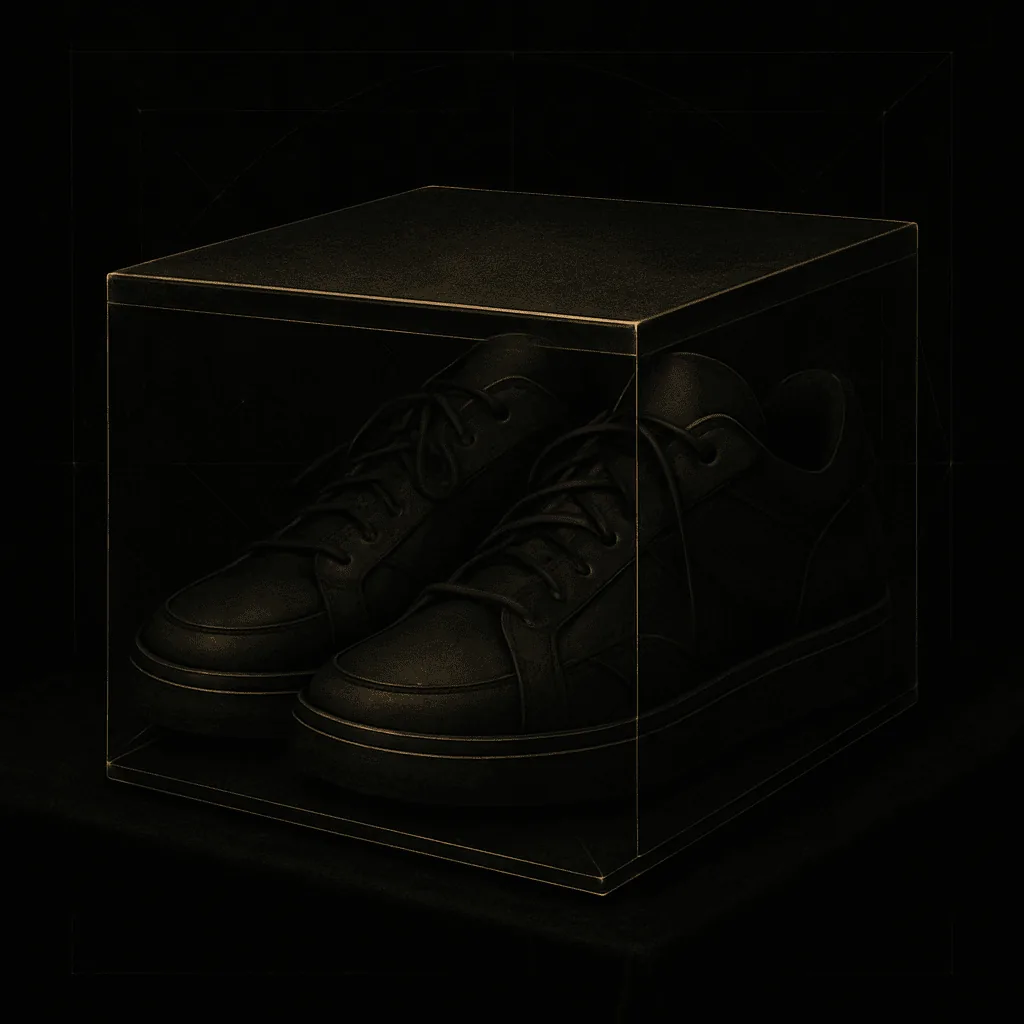
The box is on the top shelf, angled so the label faces out. You know which one. You reached past it this morning to grab the beaters, and you reached past it yesterday, and the day before that. The lid hasn't come off in a while. The tissue paper is still folded the way the factory folded it. One thing about this pair. You'll know by the second time you reach past it.
There's a small guilt that sits with a boxed pair. The feeling that shoes are meant to be worn, that leather wants a foot in it, that a sole unit dries out if it never touches pavement. Some of that is true. Most of it is inherited from people who don't own the pair and don't have to make the call. The archive doesn't work that way. The rotation doesn't work that way either. A shelf can hold both kinds of pair, and the trick is knowing which one you're holding before you lace it.
Start with the pair itself. Pick it up. Read the tongue tag, then the heel from the side. Look at the midsole under the desk lamp. If the sole unit is soft, if the foam is starting to yellow at the edges, if the paint on the midsole is doing what paint does, that's information. That's a pair that has already started its clock, and wearing it once a month is not going to save it. Wearing it will finish it honestly, which is a different thing than saving it. Some pairs deserve that finish. The leather ages the right way when it moves.
Then there are the pairs that don't want the road. The deadstock pair with the box notes still tucked under the tissue. The short-run colorway you tracked for two years and finally placed. The pair a friend gave you the week before something happened, and now the shoe means the week, not the shoe. These are not rotation pairs. They were never rotation pairs. Putting them on the concrete is not honoring them, it's just spending them. The archive is allowed to hold value that isn't measured in wears.
The test I use is quiet. Reach for the pair twice, on two different mornings, when you have somewhere to be. If both times your hand moves past it and lands on something else, the pair is telling you where it lives. It's a shelf pair. Keep this one on the shelf, not the rotation. That isn't failure. That's the pair being read correctly.
The opposite test works too. If you keep pulling a pair out, turning it over, thinking about the fit, planning the outfit, and then putting it back because you're saving it for something, ask what the something is. Sometimes the something is real, a wedding, a trip, a day that hasn't arrived. Sometimes the something is a story you're telling yourself to avoid the small loss of the first crease. The first crease is coming for every pair that gets worn. That's the deal. A pair that never creases is a pair that never gets held by a foot, and that's a fine outcome, but it should be a decision, not a delay.
The archive holds both. That's the part people miss. A shelf of ten pairs might be six rotation, three sealed, one undecided. The undecided one is the interesting one. Sit with it. Read the tongue tag. Check the box. Ask what the pair is for. Sometimes the answer is that you bought it for a version of yourself that hasn't shown up yet, and the pair is waiting on that person. Sometimes the answer is that you bought it because the colorway had a short run and you wanted one on the shelf, and that's the whole reason, and it's enough.
Write the note either way. The box matters here. On the inside of the lid, in pencil, put the date you decided. Rotation, or sealed, or undecided-through-spring. You'll thank yourself in three years when you're standing in front of the shelf again and the pair has aged a little and the decision is still there in your own handwriting. The archive is a conversation with the version of you who comes back to it later.
So the pair you keep boxed is not a failure of the pair or of you. It's a category. It has a place on the shelf, a label on the lid, and a reason that only has to make sense to you. Reach past it as many mornings as you need to. That's the pair doing what it's for. Unbothered pair, honestly. Worth pulling the box for, once in a while, just to look.