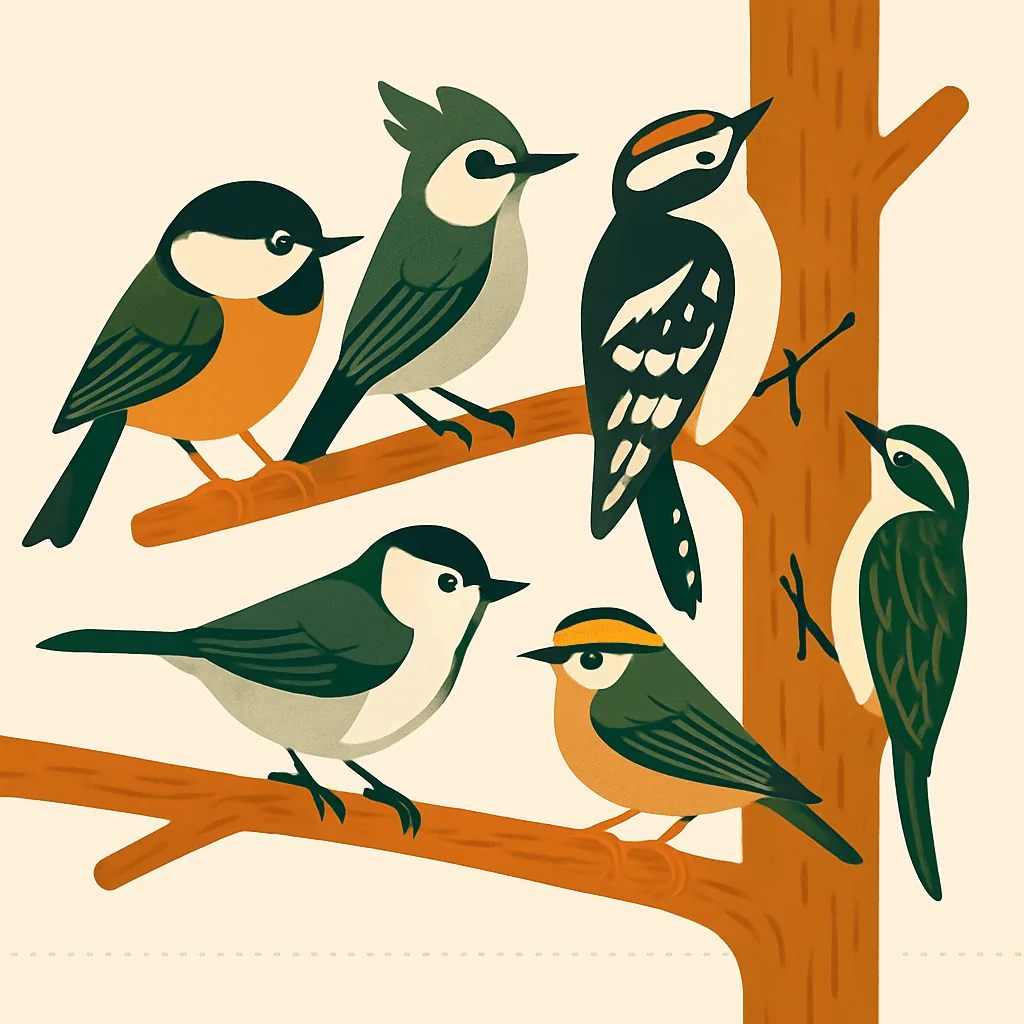
The yard is quiet. Has been for an hour. The suet cage swings a little in the cold and no one comes to it. Then a small dee-dee-dee from somewhere behind the fence, and the branch above the feeder is full. A chickadee, then another. A nuthatch head-down on the trunk. A downy woodpecker landing sideways on the suet. Something tiny and greenish flicking in the cedar that you can't quite pin. Six species in the same tree, and thirty seconds ago there was nothing.
This is the part of winter birding that trips people up. You watch the yard for an hour, see two juncos and a house sparrow, and decide it's a slow day. So you go make tea. And then you come back to a full tree and no idea what just happened. The feeder didn't fill itself. Nothing changed in the yard. What changed is that the flock arrived, and the flock does not run on your schedule. It runs on the chickadee's.
Mixed winter flocks are the way small songbirds get through the cold months. Foraging alone in December is a losing proposition, too many eyes needed for hawks, too much ground to cover for too few insects and seeds. So they band together. Different species, same route, working the neighborhood in a loose traveling group. And the chickadees lead. Almost always. They're the scouts, the ones calling as they move, the ones who decide when the flock stops at your suet and when it moves on to the neighbor's hollies.
Once you know to listen for the chickadee, the whole thing opens up. The dee-dee-dee is the flock's contact call, the thread that keeps everyone stitched together as they hop tree to tree. If you hear it getting closer, put the kettle down. You have about a minute.
Behind the chickadees, in rough order, come the followers. White-breasted nuthatches, working the trunk from the top down. That's the tell, head-first toward the ground, no other bird in the yard does that. Then the downy woodpecker, usually a female first, on the suet within seconds. If it's a good flock day, a hairy woodpecker too, bigger, longer bill, same posture. In the cedars and the thicker cover, kinglets. Ruby-crowned or golden-crowned depending on where you are, both tiny, both restless, both flicking their wings the whole time they forage. The kinglets are the hardest to catch, they never sit. One more frame, from below if you can.
And then the quieter followers. Brown creepers spiraling up the oak, so cryptic you'll miss them unless you're already looking. Titmice, if you're in their range, usually mixed right in with the chickadees. A yellow-rumped warbler in some yards, working the suet with the woodpeckers. Sometimes a single junco tagging along the ground layer, though juncos mostly do their own thing.
The flock doesn't stay. That's the other thing to know. Ten minutes, maybe fifteen at a busy feeder, and the chickadees start calling from the far side of the yard, and everyone follows, and you're alone again. This is normal. They'll be back, probably tomorrow, probably close to the same time, because chickadees remember. They know your suet is there and they've folded your yard into the route.
So the read on a winter flock goes like this. First, listen. The dee-dee-dee is your early warning. Second, when they arrive, scan for the chickadees first and let the followers reveal themselves in order, trunk birds on the trunks, canopy birds in the canopy, cedar birds in the cedars. Third, don't chase. If you move too fast for your camera the kinglet is already gone. Fourth, note who's leading and who's tagging along, because next week the composition will shift a little. A new species joins. Someone's missing. That's your book filling in.
Keep the suet stocked through the cold weeks. The chickadees are the ones deciding whether your yard is on the route, and they decide with their memory, not their appetite in the moment. A yard that's reliable in November is a yard the flock keeps threading through in February. Empty feeders drop off the map.
An hour of nothing, then six species at once. That's winter. Listen for the two-note whistle at dawn, and the dee-dee-dee in the afternoon, and you'll start to hear the flock before you see it. Worth another look.