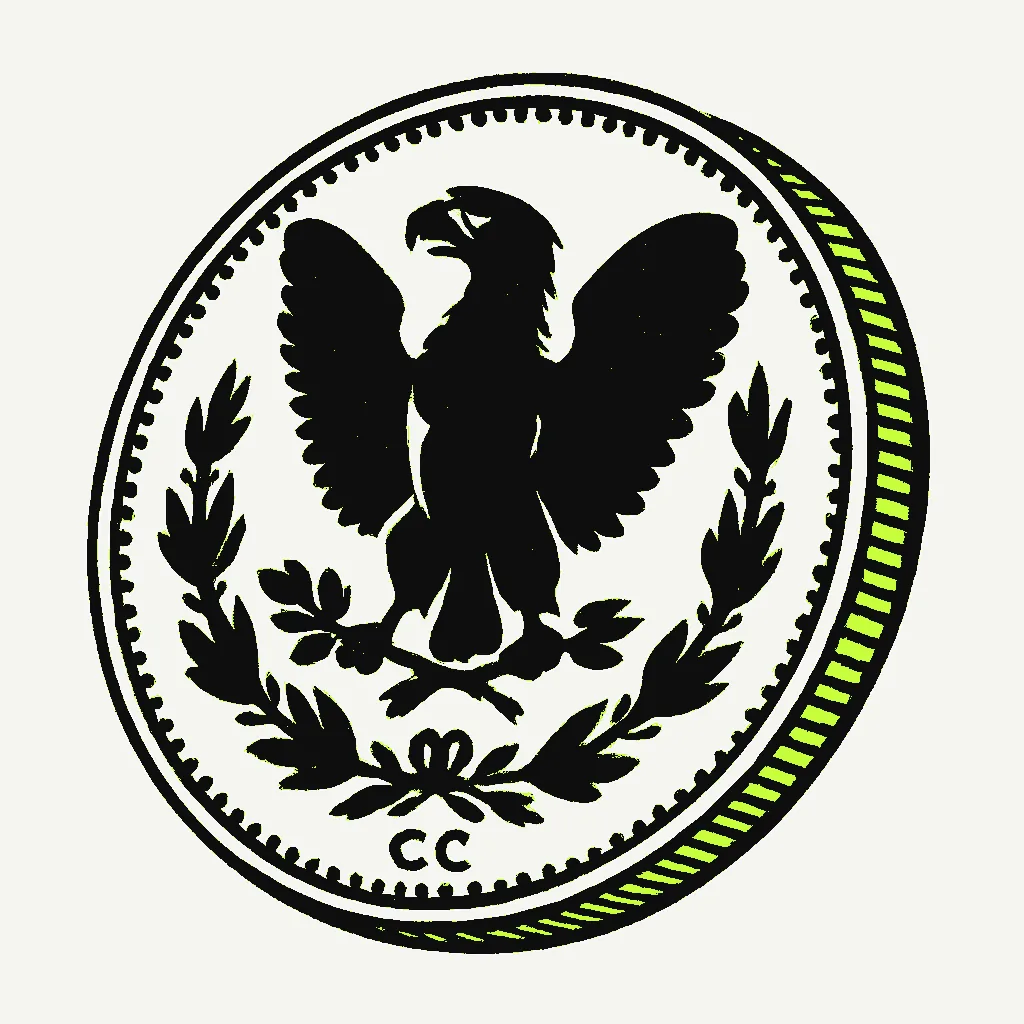
The Morgan is sitting on the felt, obverse up, Liberty looking left. That's the side everyone reads first. Turn it over. The eagle, the wreath, and just below the wreath, tucked in tight, one or two small letters. Sometimes nothing at all. That's the mint mark, and on a Morgan, that little space is where the coin tells you where it was born. The rest of the design is the same coast to coast. The mint mark is the tell.
Most people bring me a Morgan and ask about the date. Fair enough, the date matters. But two Morgans with the same date can be a hundred dollars apart, sometimes more, and the date isn't why. It's those letters under the wreath. Or the absence of them. Folks look at the year and stop looking. The rest of the coin is still talking.
Five mints struck the Morgan between 1878 and 1921, with a gap in the middle. Philadelphia is the plain one. No letter under the wreath, just the wreath sitting quiet. Philadelphia was the mother mint, the default, and it struck Morgans by the millions. A blank space under the wreath is not a mistake and not a rarity. It's just Philadelphia doing what Philadelphia did.
New Orleans put an O there. A single round letter, sometimes crisp, often soft. The New Orleans strikes tend to run a little weaker in the centers, the hair over Liberty's ear especially. That's the die and the pressure, not the coin's fault. An O Morgan in honest circulated shape is common enough, and pleasant to hold. The strike tells the story on those, and the story is usually a tired die doing steady work.
San Francisco used an S. West coast silver, and it shows. The S coins often came out sharp, well struck, the eagle's breast feathers standing up the way the engraver meant them to. If you find a Morgan where the details look almost too clean for the wear, check under the wreath. An S will explain it.
Denver only struck the Morgan in one year, 1921, the last year of the series. A D under the wreath on a Morgan means 1921, always. The 1921 Morgans are their own conversation, a redesign, a shallower relief, a different feel in the hand. Not the same coin as the ones from the 1880s, though the portrait is close. A D Morgan is the tail end of the run, not the heart of it.
And then there's CC.
Two letters, close together, under the wreath. Carson City. The mint that sat up in the Nevada silver country, near the Comstock, striking coins from the ore that came out of the ground a few miles away. Carson City ran from 1870 to 1893, and it never struck the kind of numbers Philadelphia or New Orleans did. The mintages are small by Morgan standards, some years very small. When you find a CC on the reverse of a silver dollar, that coin travelled a long way to reach your hand, in every sense. It came out of the frontier, it survived the melts, it made it through a hundred and forty years of pockets and drawers and coffee cans, and it landed on the felt in front of you.
That's the frontier premium. It's part scarcity and part story. Collectors have wanted the CC Morgans for as long as there have been Morgan collectors, and the Treasury even released hoards of them in the 1970s in little plastic holders, which is where a lot of the nicer ones you see today came from. A CC Morgan in a GSA holder is its own small category. But even a plain circulated CC, worn honest, is worth more than the face suggests, and worth more than its Philadelphia sister of the same year by a good margin.
So when a Morgan lands in front of me, I do the same thing every time. Obverse first, just to confirm it's a Morgan and read the date. Then over to the reverse. Eagle, wreath, and down to that small space underneath. Blank, O, S, D, or CC. Five possibilities, and each one is a different coin with a different history, even when the date matches.
If yours is a CC, put it in a flip, not a pocket. Don't clean it. The toning did you a favor, whatever it looks like. Let me get the loupe on that when you can, but you already know most of what you need to know. It came from Carson City. Somebody carried it a long way. Hold onto that one.