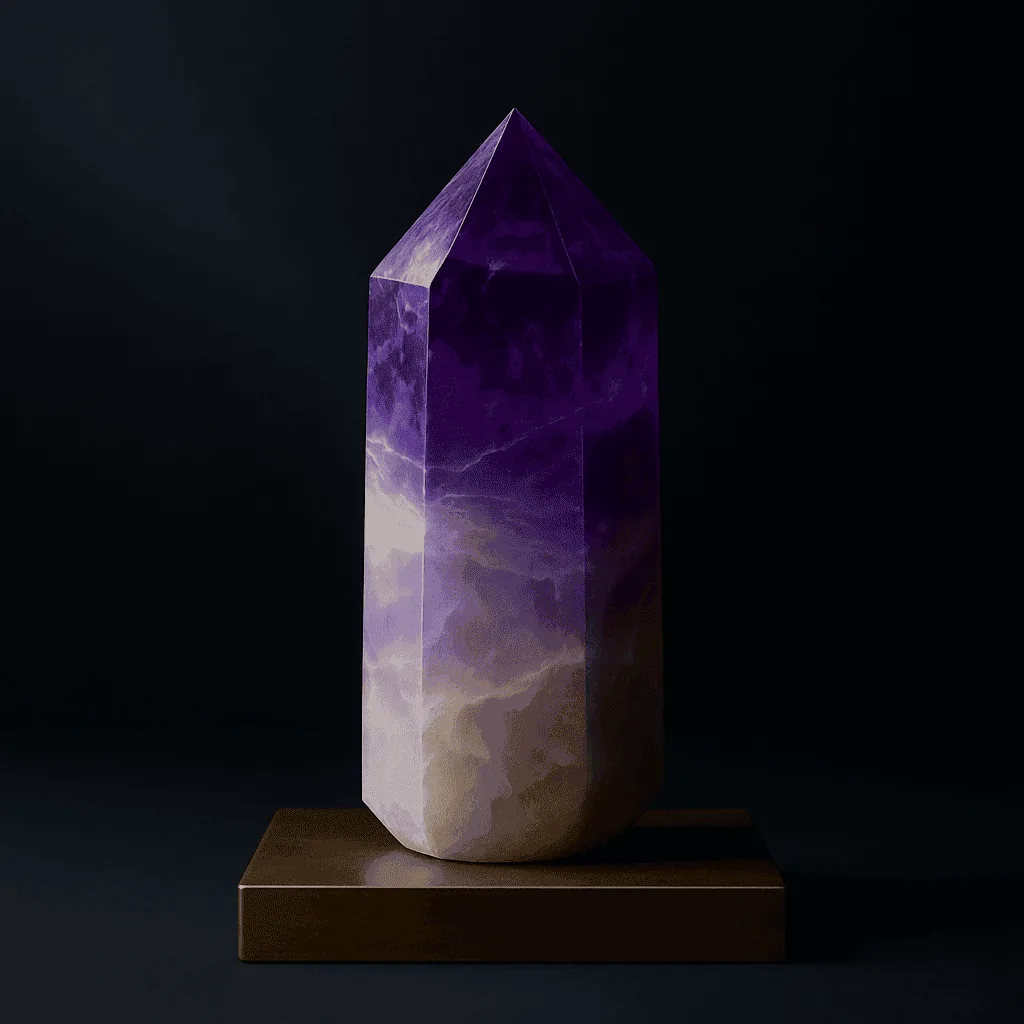
The cluster sits on the desk under the lamp. Purple, evenly purple, the kind of purple that does not waver from one point to the next. It came from a gift shop near a national park, or a roadside stall, or the back shelf of a shop that also sold incense and small brass bowls. It has been in the drawer for years. You have always loved it. You have also, somewhere under the loving, suspected it.
That suspicion is worth listening to. Amethyst is the most-faked stone in a beginner's drawer, and the fakes are not always cruel — sometimes a shop owner does not know, sometimes the supplier did not say. Dyed quartz passes through the trade by the kilo. Glass castings, poured in moulds shaped like clusters, sit in baskets at the till. The eye learns to spot them, but the eye needs to be taught. Three tests will teach it. Bring the cluster to the lamp. We will go through them slowly.
The first test is colour zoning. Real amethyst is unevenly purple. Hold it to the light first, and look along the length of a single point, from the base where it meets the matrix up to the termination at the tip. The colour does not stay the same. It pools near the tip, sometimes only in the last few millimetres, and fades toward the base into pale lavender or near-clear quartz. That fade is not a flaw. It is how the stone grew — purple from trace iron, settled in layers as the crystal pushed up through its pocket. A point that is the same purple from base to tip, edge to edge, with no shift at all, is telling you something. Dyed quartz takes colour in a single bath. The whole point comes out one shade. Glass is poured already coloured and has no zoning to fade through.
Look at the inclusions before the colour, too. Real amethyst carries small veils, small fractures, a faint internal cloudiness in places. Glass is too clean. Dyed quartz keeps the inclusions of its parent stone but the dye sometimes pools in the cracks, making them darker than the body — the opposite of how a real point grades.
The second test is temperature. Press the side of the cluster to your cheek, the cool side, the flat one where a point has broken away. Real quartz is cold. It stays cold for several seconds, longer than you expect, and warms slowly under skin. Glass warms almost at once. Within a breath it is the temperature of your face, because glass holds heat poorly compared to crystalline quartz. Dyed quartz, being quartz, will pass this test — it is real stone, only its colour is lent. So temperature alone will not catch a dye. It will catch a glass casting every time.
The third test is the one the loupe was made for. Look at the way light moves through the termination. Tilt the point so a lamp or a window catches the tip, and watch the light enter. In real amethyst the light disperses through layered growth zones, sometimes throwing a faint phantom — a ghost of an earlier crystal locked inside the later one. The light is not uniform. It travels through structure. Glass passes light cleanly, with no internal architecture, like looking through a marble. Dyed quartz keeps the structure but the colour sits on top of it, a film, sometimes visible as a faint rind just under the polished surface. Turn the point in your fingers. A real amethyst termination has weight in the hand and depth in the light. A glass cluster feels light, almost hollow, and the light passes straight through.
One test alone is not enough. A dyed quartz cluster will fail the colour zoning test and pass the temperature test. A glass cluster will fail temperature and fail the termination test but might, at a glance, fool colour. Run all three. The stone that fails one and passes two deserves a closer look under the loupe. The stone that fails all three is what it is, and that is also fine to know.
This is the work — naming what is in front of you before deciding what to feel about it. The gift-shop cluster might be amethyst, grown unevenly in a pocket somewhere, brought down a long supply chain, sold cheaply. Or it might be glass, poured in a mould, painted with the idea of a stone. Either way, you can know now. Bring it back to the lamp tomorrow in first light and run the three tests again. The stone knows what it is. The light will show you.
Already in motion.