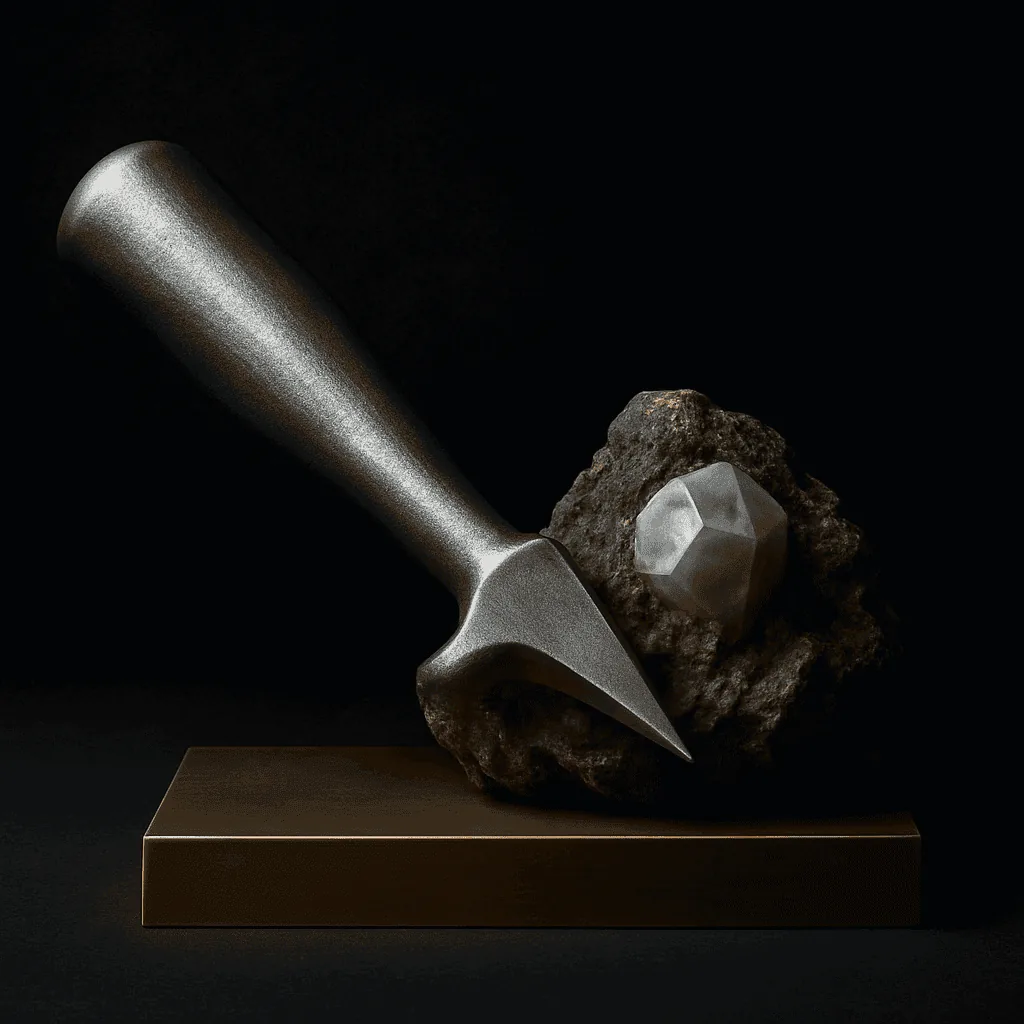
The stone is on the table between you and the lamp. You paid for it an hour ago. The seller called it aquamarine, and on the walk home the doubt arrived the way doubt always arrives — quietly, after the receipt. Now the light catches it and you cannot tell. The colour is right. The weight is right. But glass is also right, sometimes, in the colour and the weight. The lamp is patient. The stone is patient. You are the one who needs to know.
Most collectors meet this small panic three or four times before they learn what to do with it. The instinct is to scratch. The instinct is wrong, or at least wrong in the order it arrives. A scratch on the face of a showpiece cannot be taken back. The Mohs scale is the right tool, but used the way a jeweler uses it, not the way a textbook describes it. Hold it to the light first. The test comes after, and the test is almost never run on the part of the stone you love.
The scale itself is older than most of what sits in your cabinet. Ten minerals, from talc at one to diamond at ten, each one capable of scratching the one below it. You do not need the whole ladder. You need three rungs, and you already own them. A fingernail. A copper coin. A steel blade. Each one sits at a known place on the scale, and each one answers a specific question.
The fingernail is about two and a half. Anything softer will take a mark from it. Selenite gives. Gypsum gives. Talc gives without resistance. If the stone in front of you is being sold as quartz and the nail leaves a line, the stone is not quartz. That is the whole sentence. Run the nail on the underside, near the base, on a corner the eye will not return to.
The copper coin is about three. It will mark calcite. It will not mark fluorite, most days, though fluorite is close enough that a hard press can lie. If the seller said fluorite and the copper draws nothing, the answer is consistent. If the copper draws a clear pale line, sit with that.
The steel blade is about five and a half. This is the one that settles the aquamarine question, and most of the glass questions. Glass sits near five and a half itself. Quartz and beryl sit at seven and eight. A steel blade drawn across true beryl will skate. Drawn across glass, it bites — a small, definite bite, the kind you feel in the wrist before you see in the surface. That bite is the answer you walked home wanting.
The cleave tells the truth, and so does the scratch, when you let it.
Notice what is missing from all of this. No one has touched the face of the stone. The tests live on the underside, the base, the place where a bezel will sit, the corner the cabinet light will never find. A collector does not prove a stone by ruining it. A collector proves it by asking one quiet question on one hidden plane. One question, one place. If the first test answers, the second test is not needed. If the first test is ambiguous, the next rung up the ladder, still on the underside, still on the cool side.
There is a softer one underneath, almost always — a softer place on the stone, a softer test to run first, a softer answer than the one your worry wanted. Hardness is not the only thing a stone will tell you. The weight in the hand is part of it. The temperature against the lip is part of it. The way an inclusion catches the lamp from one angle and vanishes from another is part of it. The scratch is the last word, not the first. By the time you reach for the blade, the stone has usually already told you what it is.
So the aquamarine on the table. Turn it once. Look at the inclusions before the colour. Find the underside. Set the steel against a corner no one will see. Draw it, lightly, once. If it skates, the seller was honest and the doubt was the walk home talking. If it bites, you have learned something about that seller and something about your own eye, and both are worth the price of the lesson. The stone knows what it is. The scale only helps you hear it. Set it down on the cloth. The lamp will keep.
Already in motion.