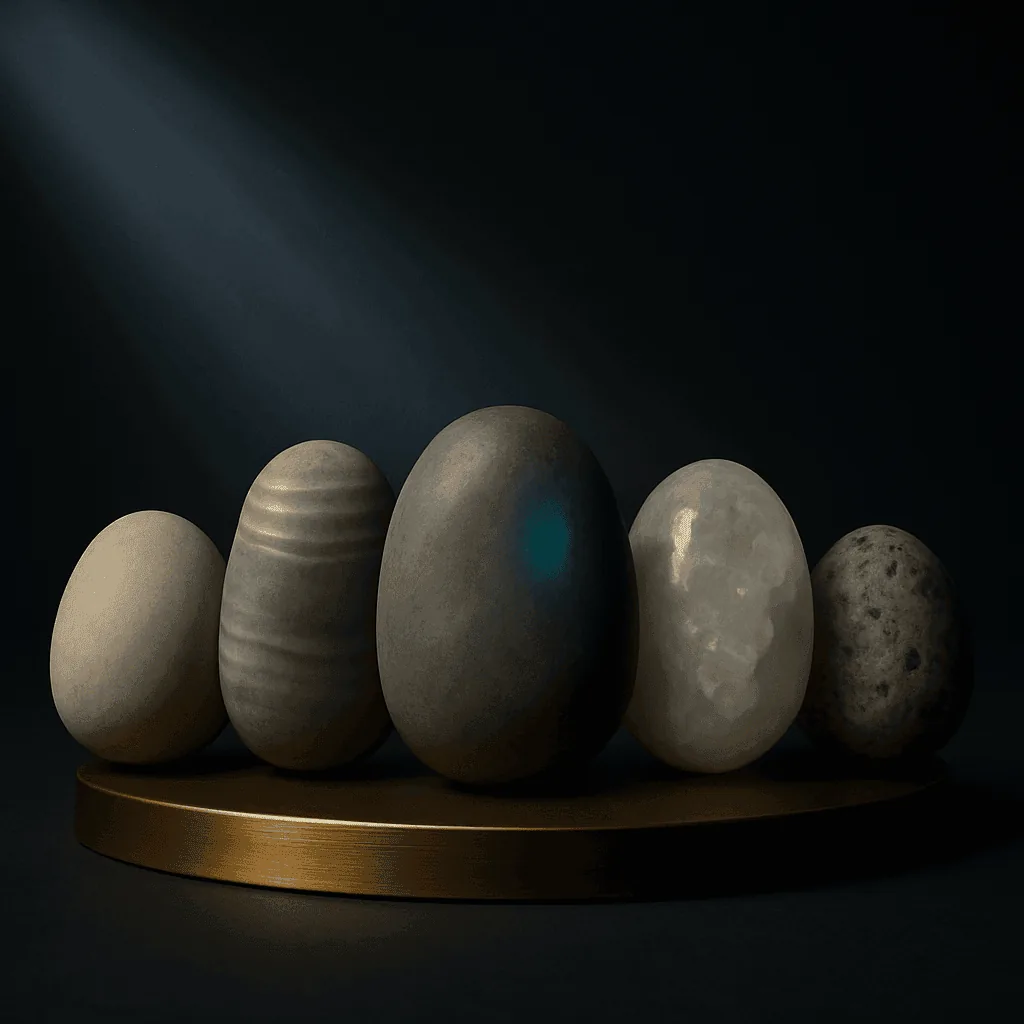
The moon comes up full and the stones move to the windowsill before you have quite decided to move them. The cloth bowl by the bed empties itself. The labradorite goes first, then the clear quartz, then the small piece of selenite that hardly needs the asking. Your hand has done this before the thought has caught up. The sill is cool. The light is the colour of nothing in particular. You stand there a moment, looking at the small row of stones, and the night settles around them.
There is a calendar inside this. Older than the one on the wall. Full moon for clearing. New moon for setting. The waning half for releasing what the stone has been holding. The waxing half for letting it grow into whatever it is becoming. People will tell you these timings as if they were instructions printed on the box. They are not instructions. They are a rhythm older keepers noticed and passed along, the way a fisherman passes along the tide.
The question is not whether the calendar is true. The question is whether you want to keep it.
A stone does not need the moon to be a stone. The fluorite on your shelf is fluorite at noon on a Tuesday in a closed drawer. Its hardness is what it is. Its cleave is what it is. The inclusions inside the quartz were set there long before any of us learned to name the phases. The mineral does not wait for permission. It simply continues.
And yet. There is something the full moon does to a room of stones that the overhead bulb cannot. The light is indirect, slow, the same temperature on every surface. A piece of moonstone on the sill at full moon looks like what it was named for. The same stone under the kitchen lamp looks like a pebble. You are not changing the mineral. You are changing the light you are looking at it under. That is its own kind of care.
So when the tradition says full moon for clearing, what it is really saying is this. Bring the stones into a soft, even light. Set them where the night can see them. Notice them. Look at the inclusions before the colour. Turn each one once. Lay them on the cloth, not the bare sill. This is not a ritual the stone requires. It is a ritual you require, to keep the cabinet honest. The clearing is mostly yours.
New moon asks a quieter thing. The dark half of the month is for setting down, not picking up. If there is a stone you have been carrying and you no longer remember why, the new moon is a reasonable night to lay it back in the bowl and let it be a stone again, unaccompanied. A waning stone, this. Nothing demanded of it. Nothing demanded of you.
The waxing half is the gentlest. A stone you brought home recently, still unfamiliar in the hand, will spend the waxing nights learning the shelf. Keep it near the others. It learns. By the time the moon is round again, the new one will have found its neighbour. You will not have arranged this. It will simply have happened, the way a new book finds its place among the older ones on the same shelf.
The moon will tell us when.
What the calendar offers, in the end, is not magic. It is attention, distributed across a month. Without it, a collection sits in a drawer and is forgotten. With it, the stones are visited. Turned. Looked at under different light. Set down and picked up again. That is what care actually is. The phase is only the excuse.
If you keep the calendar, keep it lightly. The full moon does not always fall on a clear night. The new moon does not always fall on a night you are home. A stone that misses its window misses nothing. The cabinet is patient. So is the sky. The next full moon is already on its way, and the selenite, which never seems to mind, will be on the sill when it arrives.
And if you do not keep the calendar at all — if you simply set a stone down when it asks to be set down, and pick it up when it asks to be picked up — that is also a way. The stone knows what it is. Your hand knew to move the labradorite to the sill tonight without consulting any chart. Trust the hand. The moon was only confirming.
The sill is cool. The stones are where they belong. Already in motion.