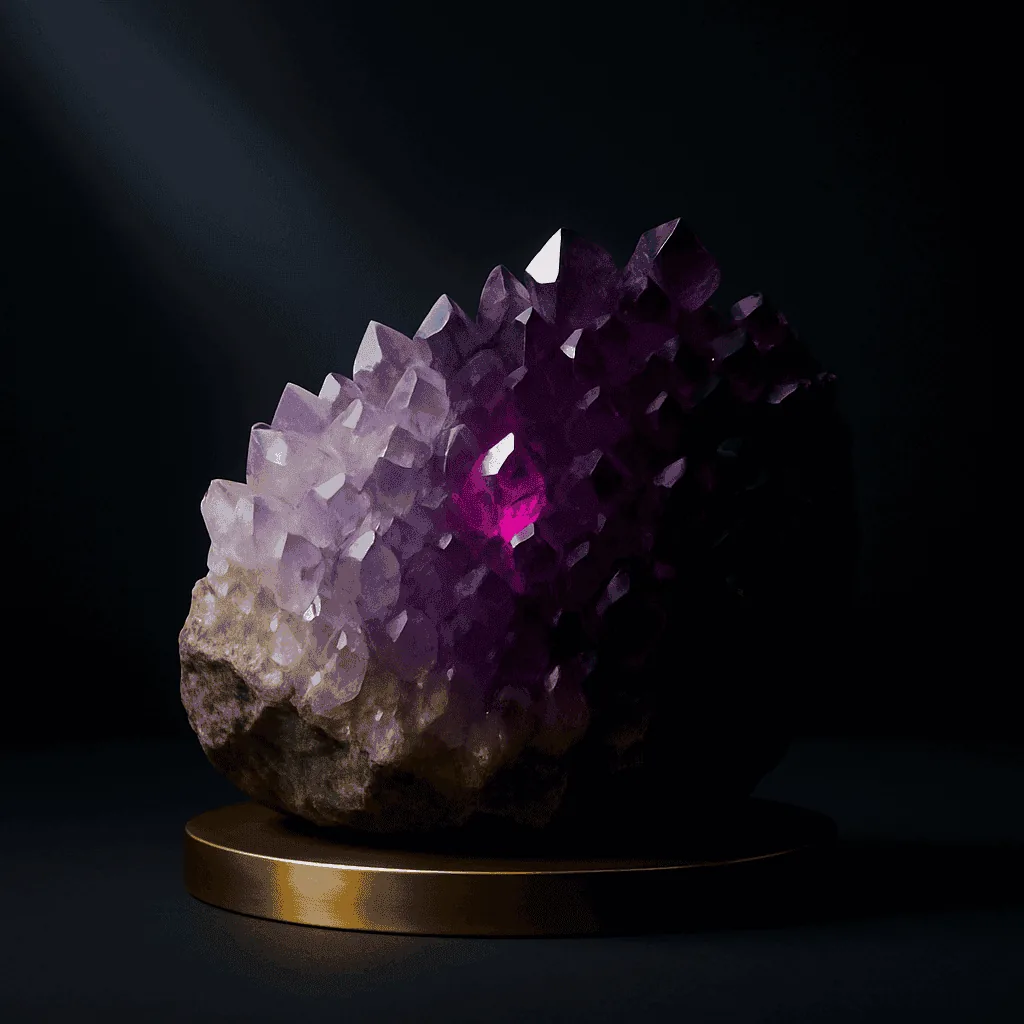
The amethyst on the sill is paler than it was. Not all at once. Not in any week you could point to. But hold it to the light now and the violet at the terminations has gone the colour of weak tea. Three years in the same spot. The same south light every afternoon. The stone has been giving up its colour the whole time, a little each day, and nobody saw because nobody was looking for a thing that slow.
This is the loss almost no one notices. Stones do not chip in sunlight. They do not crack or weep or warn. They fade. The fade is gradual enough that the eye recalibrates to the new colour and forgets the old one. You only see it when you set the cluster next to another piece from the same vein, kept in a drawer, and the drawer-piece is suddenly a stranger. Deeper. Truer. The one on the sill has been bleaching in plain sight for years.
Amethyst is the famous case. The violet comes from iron held inside the quartz in a particular oxidation state, and ultraviolet light, given enough months, persuades the iron to let go. Once the colour leaves it does not come back. You can heat-treat, you can scold the windowsill, you can move the cluster to a shelf — the pale stays pale. The fade is one-way.
It is not only amethyst. Rose quartz softens to a milky pink and then to almost nothing. Fluorite, which arrives in those astonishing bands of green and violet and water-blue, gives up the purple first and the green last. Kunzite is the most fragile of them — a windowsill can lighten kunzite in weeks, not years. Citrine, the natural kind especially, drifts toward straw. These are the five the sill quietly takes. There are others, but these are the ones a collector loses most often, and almost always without knowing.
What makes it cruel is that the sill is where we want them. The light catches the inclusions. The cluster sparks in the morning. The rose quartz glows from across the room at dusk. The whole reason the stone ended up there is the light, and the light is the thing dismantling it. A stone that loves to be seen in sun is a stone that should not live in sun.
The cool side of the room is where the colour keeps.
So the rule, soft as it is: the fade-prone stones live away from direct sun. North-facing sills are kinder than south. A shelf two steps back from the window keeps the glow without the bleach. A wooden box, opened in the evenings, holds colour for decades. If a piece must be displayed in bright light, it can be — for the hours you are in the room with it, then set down again on the cool side, under the cloth, in the bowl. The stone does not need to be hidden. It needs to be rotated.
The moon helps with the rhythm of this. A waning gibbous is a good night to walk the shelves and notice which pieces have been sitting too long in the same light. The dark of the month is when the fade-prone ones go back into the drawer and rest. The waxing days are when they come out again, briefly, to the sill, to be looked at and turned and set down. This one has been waiting, you will think, lifting the rose quartz out of its cloth. The colour is still there because you let it be.
If you have an amethyst that has already gone pale, there is nothing to be done about the colour. But the cluster is not ruined. Hold it to the light first. Look at the terminations, at the inclusions, at the way the quartz still catches and throws. The stone knows what it is. It has simply spent some of itself being beautiful in a window, and that is not the worst use of a stone. Set it deeper in the room now. Let the next piece take the sill, briefly, in turn.
The loss is slow enough to be invisible, which means the keeping is slow enough to be invisible too. A stone moved one foot back from the glass this evening will, in three years, still be the colour it is tonight. That is the whole practice. Already in motion.