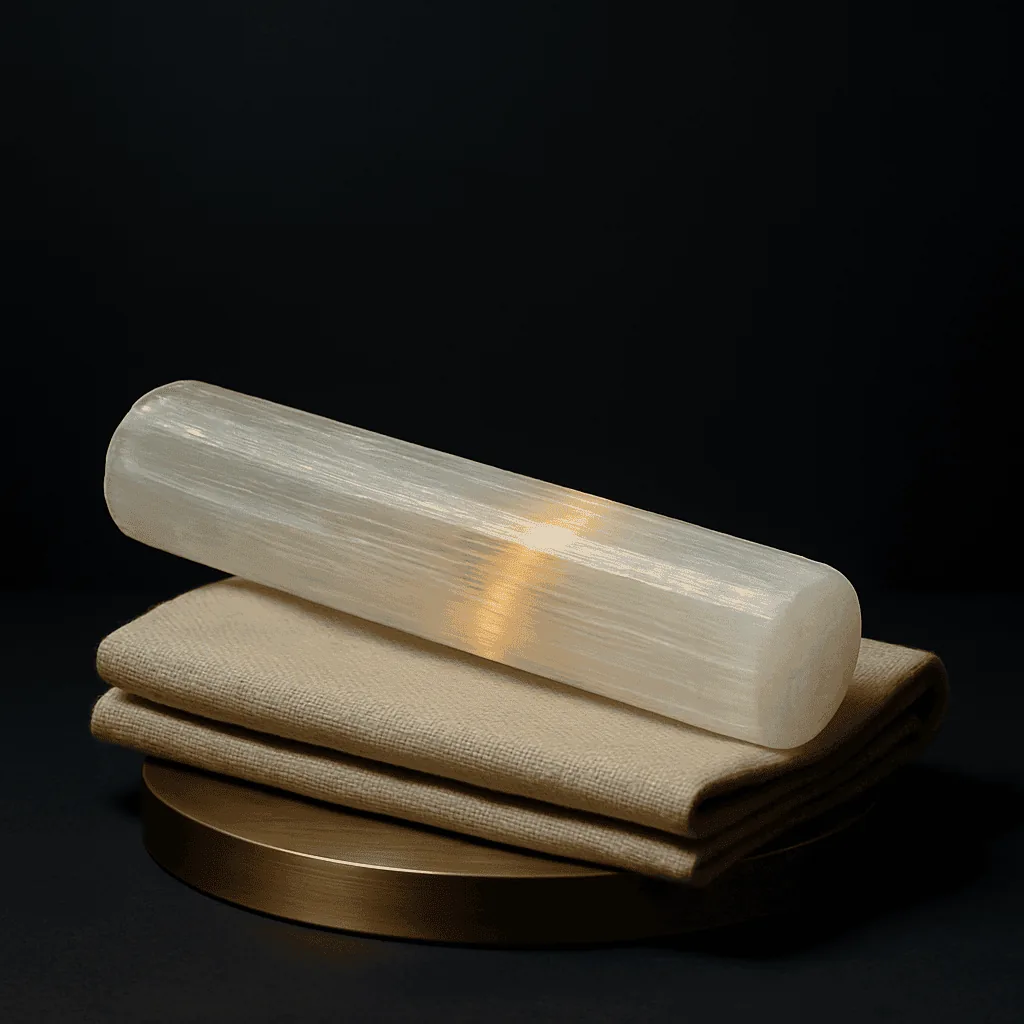
The tap is running. The selenite wand is in your other hand, halfway to the stream. You stop. You do not know why you stop, but you stop. Something in the weight of it, or the way the surface catches the kitchen light. A wand that looked solid an hour ago suddenly looks like a thing made of pressed snow. You set it down on the cloth instead. The water keeps running for a moment without you. Already the stone is telling you something.
Most of what gets said about cleansing a stone assumes the stone can take it. Running water, a bowl in the moonlight, a quick rinse before it goes back on the shelf. For a great many minerals, that is fine. Quartz does not mind. Agate does not mind. But there is a smaller list, and the smaller list matters more, because the stones on it are often the ones a new keeper reaches for first. Soft stones. Soluble stones. Stones that look like they will survive anything because they are beautiful, and beauty reads as durability to the eye. The eye is wrong about this.
Selenite is the first to know. Hold it to the light first and you can see what it is — a stone built in layers, water-born to begin with, water-soluble still. A bowl of warm water will cloud its surface in minutes. A long soak will dissolve it outright. The wand goes hazy, then chalky, then it gives up its edges. Selenite belongs on the sill, on a cloth, in dry moonlight. Never in the bowl.
Malachite is the second. The green is copper. The copper is what makes the bands sing under the loupe, and the copper is also what makes the dust unfriendly to skin and lungs when the stone is wet and worked. A polished malachite tumbled smooth will tolerate a fingertip wipe with a dry cloth. It will not tolerate a soak. The polish dulls. The bands lose their depth. Set malachite down dry, and do not rinse it after handling — wash your hands instead.
Halite is salt. The stone is salt, grown into cubes and pinks and clear glass-like faces that look like quartz at a glance and are nothing of the sort. Halite in water is halite gone. Lay it in a closed box with a sachet of dry rice if the air in the room is heavy. Never on the sill in summer, where the humidity can find it. Halite asks for the cool side of the shelf and a closed lid.
Kyanite does not dissolve, but it cleaves. One direction soft, the other harder, and water finds the soft direction first. A wet kyanite blade will split along its length given long enough, and the split does not heal. The hardness will tell you the rest. Wipe it dry. Lay it flat. Do not let it sit at the bottom of a bowl with other stones — its neighbours will scratch the soft face without knowing.
Lepidolite is the lithium mica. Layered, flaky, soft enough that a fingernail leaves a mark on the wrong edge. Water lifts the layers. The purple goes grey. The book-like structure begins to part. Lepidolite is happiest left alone on a cloth, brushed once a month with a soft brush meant for a camera lens. Nothing more.
So what does cleansing look like, then, for the ones who cannot meet the tap. The sill, for a start — set it on the sill tonight, on the cool side of the glass, and let the moon do what the moon does. Dry salt around the stone, not touching it, in a small dish. A bed of tumbled hematite or clear quartz in a shallow bowl, the soft stone laid on top. A pass through the smoke of a dry herb, brief, not lingering. A night in a closed drawer with the others, learning by neighbour. None of this is mystical. It is what jewelers have done for two hundred years with stones that cannot be wet.
The waning moon is the right time for this kind of tending. The pull is outward. Dust lifts. The shelf settles. Take the soft ones down one at a time. Hold each to the light first. Wipe what can be wiped. Brush what should be brushed. Set them back in their places — pair, nest, neighbour — and close the cabinet.
The tap is still running in the next room. Go and turn it off. The selenite is already where it needs to be. The stone knows what it is. You have only to remember.