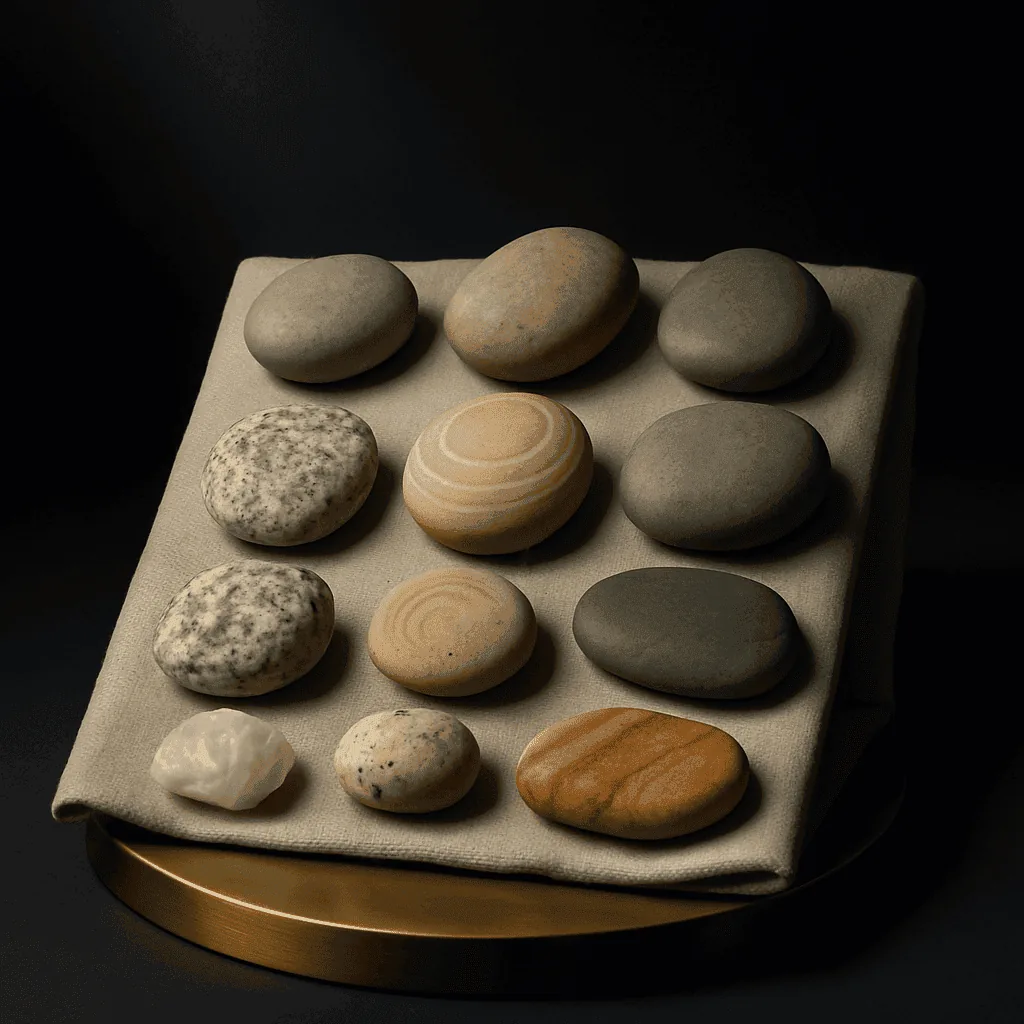
Take them down from the shelf. All of them. The ones in the bowl, the one wrapped in the linen, the small one that lives in the drawer because you keep forgetting it. Lay them on the cloth in a single layer. Step back. The room is quiet. The lamp is on. Look at what you have actually been buying.
Most collections begin without a plan. A stone at a fair. A stone from a friend. A stone bought late at night because it caught the light a certain way. You tell yourself each choice was its own choice. And then one evening, with twenty of them out at once, the pattern arrives without being invited.
The pattern is not what the books would have predicted. It rarely matches the meanings printed on the little cards at the shop. The hand chooses before the mind does. The hand has been choosing for months, maybe years, and the hand has a preference it never told you about.
Look at the inclusions before the colour. Or look at the colour first, if that is what your eye keeps going to. There is no order to this. You are not diagnosing. You are noticing.
Maybe they are all rough. Every one. Not a tumbled stone among them, or only one, bought early before you knew what you wanted. The rough ones have something the polished ones do not — the cleave is honest, the termination is intact, the matrix is still attached at the back. You have been choosing stones that were not finished for you. That is its own statement.
Maybe they are all blue. Celestite, kyanite, sodalite, a small chip of aquamarine. You did not set out to build a blue shelf. You just kept reaching for blue. The eye knows what the eye wants. The blue ones gather to themselves.
Maybe they are all stones with an inclusion. A garden inside the quartz. A phantom. A rutile thread. A bubble of water trapped at the heart. You have been buying interiors. You have been buying stones that are doing something on the inside, that have a small private weather. The clear ones do not call to you. The busy ones do.
Or maybe the pattern is heavier than that. Maybe they are all stones you found in difficult years. Maybe the rough one came home the week of the funeral, and the celestite came home the month the work changed, and the small one in the drawer arrived in a season you do not talk about. Held together on the cloth, they make a calendar. Not of dates. Of weather.
This is the part most collectors miss. The collection is not a list of acquisitions. It is a portrait, drawn slowly, by a hand that did not know it was drawing. Each stone is a small decision the body made about what it needed to keep near it. Stacked together, the decisions tell you who you have been.
Hold the oldest one to the light first. The one that started it. Notice that it already contained the rule. The blue was there, or the inclusion was there, or the rough edge was there. The collection has been faithful to that first stone in ways you did not arrange.
Now look at the most recent one. The one still warm from the shop bag, or the one that arrived last week wrapped in tissue. Set it next to the first. The same hand chose both. The years between them did not change what the hand wants. They only deepened it.
This is a good night to make a small note. Not a catalogue. A sentence. The thing they all share. Write it on the cloth-side of a card and tuck it under the bowl. Rough, mostly. Or blue, almost all. Or each one is doing something on the inside. The note is for later, when a new stone is offered to you and you are unsure. The note will tell you whether this one belongs.
A collection that knows its own pattern starts to choose more deliberately. Not more narrowly — deliberately. You can break the pattern on purpose, once you can see it. You can also lean into it, and let the shelf become a single quiet sentence said in twenty voices.
Leave them out tonight, if the cloth is somewhere safe. Let them sit together. In the morning, in first light, the pattern will be even clearer than it is now. The stone knows what it is. The collection, it turns out, has been knowing what it is for a long time.
Already in motion.