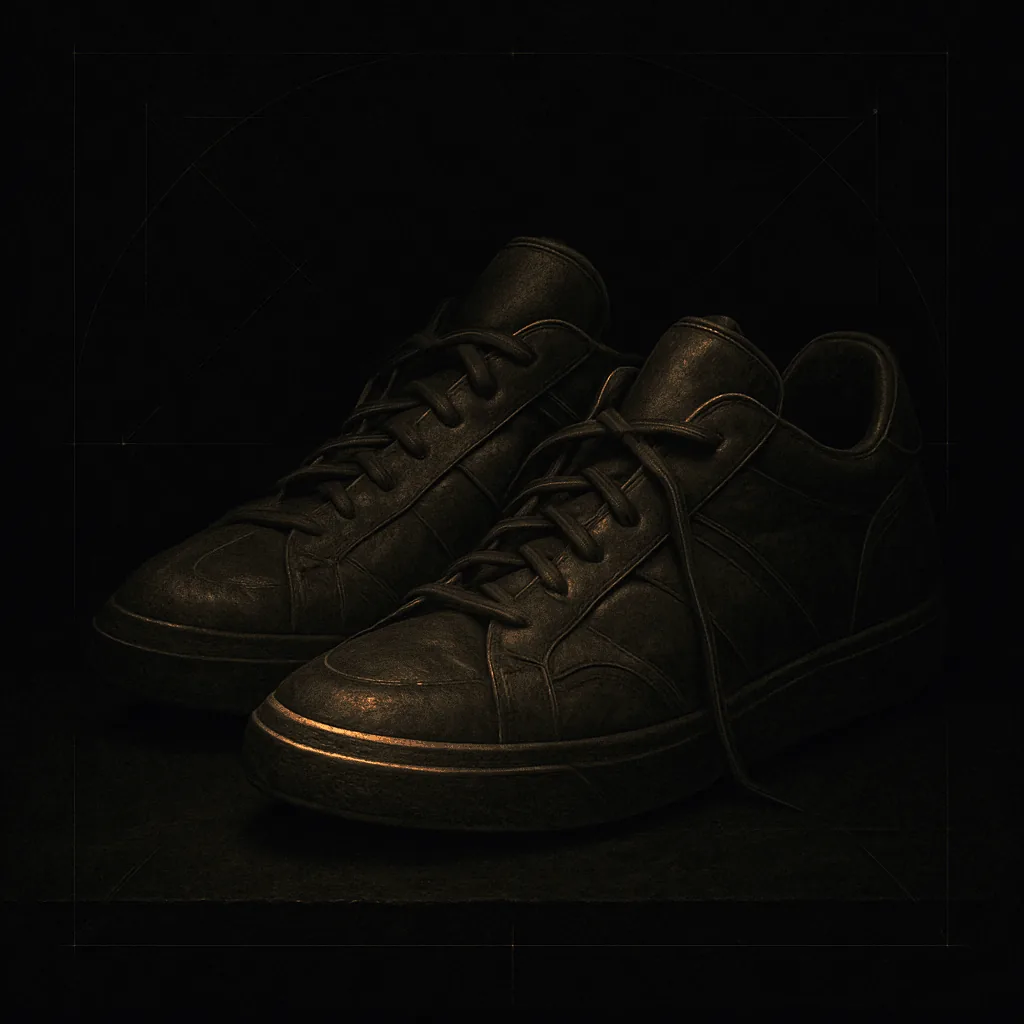
Estate sale, Saturday morning, folding table under a garage light. Somebody's uncle passed and the boxes came down from the attic. You pick up a pair before the seller finishes his coffee. The tongue is still folded under, the laces still knotted from the last time he wore them. You haven't seen a logo. You haven't read a tag. You already know the decade. The toe box did that for you, in the two seconds between the table and your hand.
Most people flip the tongue first. That's the tell that you're new to this, or that you're in a hurry. The tongue tag is where the year lives, sure, but the tongue tag can be missing, faded, restitched, swapped in from a parts pair. The toe box can't lie the same way. The toe box is molded, stitched, and shaped by the last it was built on, and the last is the year. Change the last, you change the silhouette. Nobody changes the last quietly.
So. What is the toe box actually telling you.
Start with the height. A tall, round toe box, the kind that sits proud off the sole unit and rides up over your big toe like a small dome, that's a runner shape from the late seventies through the middle eighties. The foot needed room, the last was built generous, the panel above the toe curves up in a way modern lasts don't bother with. A low, flat toe box, close to the ground, almost squared at the front, that's court. Basketball, tennis, the kind of pair built to plant and pivot. The shape had a job.
Then the stitch. Look at the seam where the toe panel meets the vamp. On an older pair the stitch is closer to the tip, sometimes only a finger's width back from the front, and the thread is thicker, often contrasting. On a nineties pair the seam pulls back, sits further up the shoe, and the thread starts matching the leather. By the two thousands the seam might be gone entirely, replaced by a bonded overlay or a single molded piece. No stitch at all is its own date stamp. The absence tells you as much as the presence.
The material at the tip matters too. Full grain leather that's creased into deep, soft folds across the toe, that's a pair that was worn and stored, worn and stored, and the leather aged the right way. Suede or nubuck at the toe, worn down to a bald patch, tells you a skater had this pair, or somebody who walked the same route for a year. Synthetic mesh with a rubber toe cap bonded over it, running silhouette, mid nineties forward. A hard shell toe, no give at all when you press it, that's a skate reinforcement or a very early basketball build. Press the toe. The give is information.
Perforations are another read. Three neat rows of round vents in a diamond pattern, older running. A scatter of pin holes with no order to them, a decorative choice from a lifestyle release, late nineties or after. No perforations at all, court pair, or a runner that was never meant to breathe.
One thing about this pair on the table. The toe box is tall, the stitch sits close to the tip in a thick cream thread, the leather has creased into four deep folds across the vamp, and there's a single row of vent holes above the seam. You haven't touched the tongue. You already know it's a runner from the mid eighties, you already know the last, you already have three silhouettes in mind and you're about to pick between them by looking at the heel. The seller finishes his coffee. You pay what he's asking.
The archivist's first glance isn't a trick. It's just knowing which surface holds the most information for the least effort. The toe box is where the shoe meets the ground first, where the foot flexes hardest, where the maker had to commit to a shape. Everything downstream, the logo, the colorway, the tongue tag, all of that can be swapped, faded, or lied about. The toe box was decided at the factory and it doesn't get to change its mind.
So the next time a pair comes across the table, don't flip the tongue. Hold the shoe at eye level, look at the front, feel the give, count the stitches. The shape of that toe box, I know it. You will too, after enough pairs. Clean pair, sit with it.