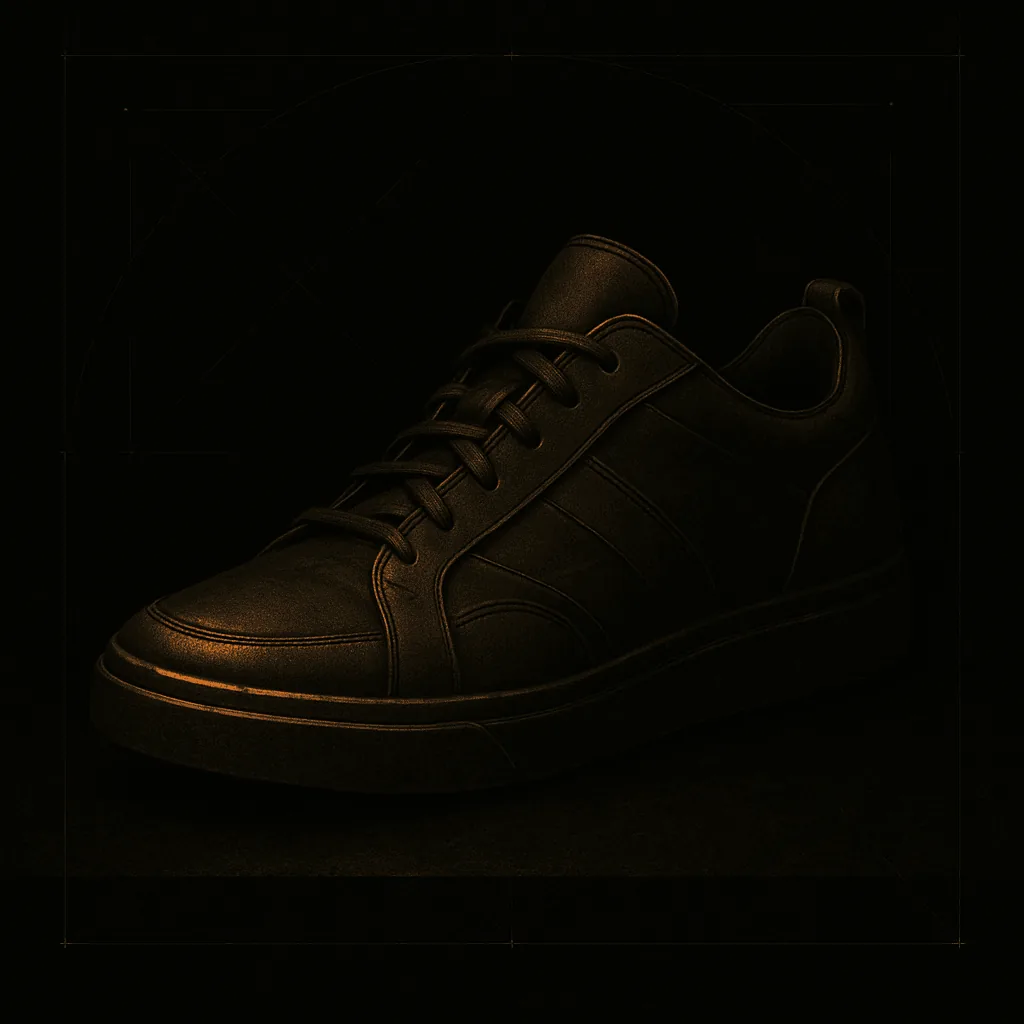
A pair sits on a bench across the room. The logo is turned away. The colorway is muted enough that it doesn't announce itself. And still, you know. Something in the stance. The way the toe box rises off the ground at a specific angle, the way the heel sits down into itself. You haven't read a single letter of branding and you've already placed the silhouette. That's not a trick. That's a thing the eye learns, quietly, over years of holding pairs and setting them back down.
Most people think identification starts with the swoosh, the three stripes, the wordmark on the heel. It doesn't. Branding is the last thing the eye needs, and often the least reliable, because paint fades and stitching gets replaced and tongue tags get swapped by a previous owner who didn't know what they had. The proportion of the shoe stays. The proportion is the fingerprint. And if you can't read the proportion, the logo will only tell you what somebody wanted you to think you were looking at.
So what is the eye actually reading, across a room, in the second before the brain catches up.
Start with the stance. Every silhouette sits on the ground differently. Some sit forward, weight over the ball of the foot, the heel lifted just enough to lean the whole shape toward the toe. Some sit back, planted, the heel wide and low, the toe box lifting off the floor at a lazy angle. That base posture is set by the sole unit, and the sole unit is the thing that dates a pair more honestly than anything on the upper. The midsole tells the truth. A wedge from one era doesn't sit the way a wedge from a later era sits, even when the upper looks identical.
Then the toe box. The shape of that toe box, I know it. Round, blunt, squared, tapered, pinched at the tip, wide across the vamp. Every silhouette has a signature curve from the toe cap down to where the outsole starts, and the eye picks that curve up faster than it picks up color. Two pairs can share a colorway and read as completely different shoes because their toe boxes have different personalities. And one silhouette can wear a hundred colorways and still be recognizable at forty feet, because the toe box hasn't moved.
After that, the panel work. Where does the swoosh sit, if there is one. Where does the eyestay break. How high does the collar run at the ankle. How does the tongue sit against the laces, thick or thin, padded or flat. These are proportions, not details. The eye reads them as a pattern before it reads them as parts. The pattern is what you recognize.
And then the leather, or the suede, or the mesh. Material comes last in the read, but it matters because material ages, and how a pair ages is another kind of signature. The leather aged the right way, or it didn't. Suede goes soft in the vamp and dark at the toe. Mesh yellows around the eyelets. Painted midsoles crack in the same three places on every pair, because the flex points don't change. A pair that's aged honestly looks different from a pair that's been kept sealed in the box, and different again from a pair that's been restored. The eye learns all three.
None of this is magic. It's trained looking. It's the sum of every pair you've ever held under a desk lamp trying to place a year, every side profile you've studied on a shelf, every time you turned a pair over to check the sole unit before you turned it back. The eye is a slow instrument. It gets better by a very small amount each time you use it well. But it does get better.
One thing about this. The trained eye doesn't make you certain. It makes you curious. You see the stance from across the room and you think, that's the second version, not the OG, and then you walk over to check. Sometimes you're right. Sometimes the tongue tag says something you didn't expect and you learn that the toe box you thought you knew had a variant you'd never held. That's the good part. The eye keeps learning as long as you keep pulling the box.
So the pair sits across the room. You read the stance, then the toe box, then the panel work, then the material. The logo, if you look for it at all, is confirmation. Not evidence. The silhouette was already telling you what it was. You were just paying attention.
Clean pair, sit with it.