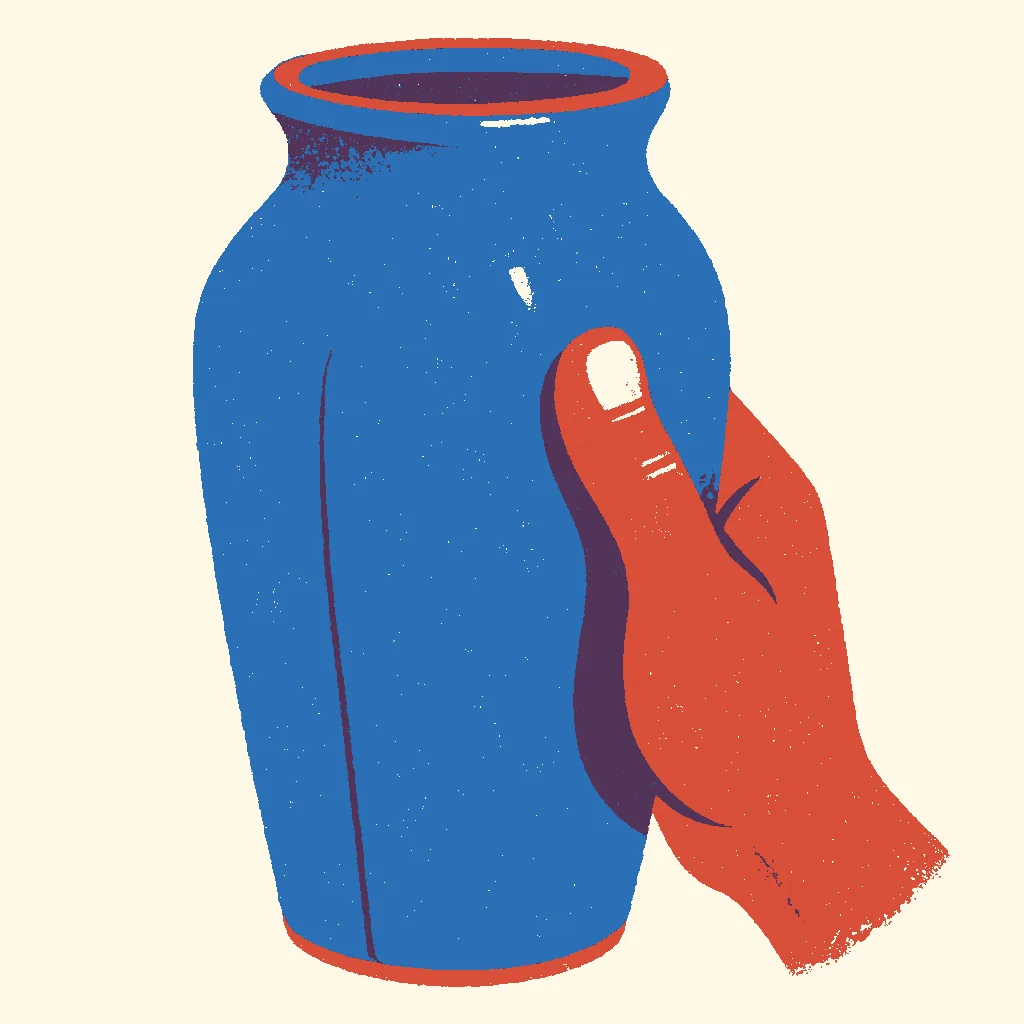
An old bottle off a barn-sale table, crusted and honest. Before the color gets a vote, run a thumb up the side and find the mold seam — where it stops is the whole conversation. A seam that dies below the lip means a person finished it by hand, a seam that runs clean over the top means a machine did the work. Machines took over in the 1910s, give or take — one raised line splits your find into two worlds. Where does yours quit?
Flip it over — the story's usually on the bottom. A rough ring-shaped scar centered on the base is a pontil mark, the print of the iron rod that held the bottle while a glassblower shaped its lip. That's early hand work, most of it mid-1800s or before. A pontil scar in a dollar bin makes a slow morning worth the gas.
The lip itself tells a finer story. An applied lip — a separate ring of hot glass laid onto the neck and shaped there, often uneven at the join — is the earlier method. A tooled lip came after: reheated, smoothed, the seam fading just beneath it, still handwork but later handwork. Rough at the join reads earlier, tidy reads later — that's the short version I carry in my pocket.
Machine glass has fingerprints of its own. Seams through the lip, sure — but also an evenness, walls the same thickness the whole way around, sometimes a feathered circular scar on the base where the machine gathered its glass. Common as gravel, that's exactly why the hand-finished ones glow on a shelf.
Screw tops ask for a slower read. On an ordinary bottle, molded external threads lean machine-era, more common as the twentieth century rolls on. But canning jars break that rule — Mason patented his screw-thread jar in 1858, and mouth-blown jars carried those threads, ground lips and all, into the early 1900s. On a jar the lip settles it — ground flat and gritty says hand work, smooth says machine. An odd color on an old ground-lip jar — now that's a lucky shelf.
One caution — the trade knows these tells too. Reproductions turn up with faked pontil scars and period airs, a seam is easier to copy than a lifetime of wear. Don't lean on bubbles — repro glass gets seeded with them on purpose, so bubbly proves nothing. The honest miles are duller: base scuffing from a hundred shelves, a lip worn smooth where corks came and went. When one tell argues with all the others, trust the crowd over the loner.
Check the seam, then we'll talk price — glass can't lie about how it was born.
So the ritual, same every time: seam first, base second, lip third, cap last. Four looks, ten seconds, and the bottle sorts itself before the seller looks up from the cash box. The ones with the low seam and the honest scar are worth turning in the light — somebody blew that glass with their own breath. What's the oldest thing on that table?