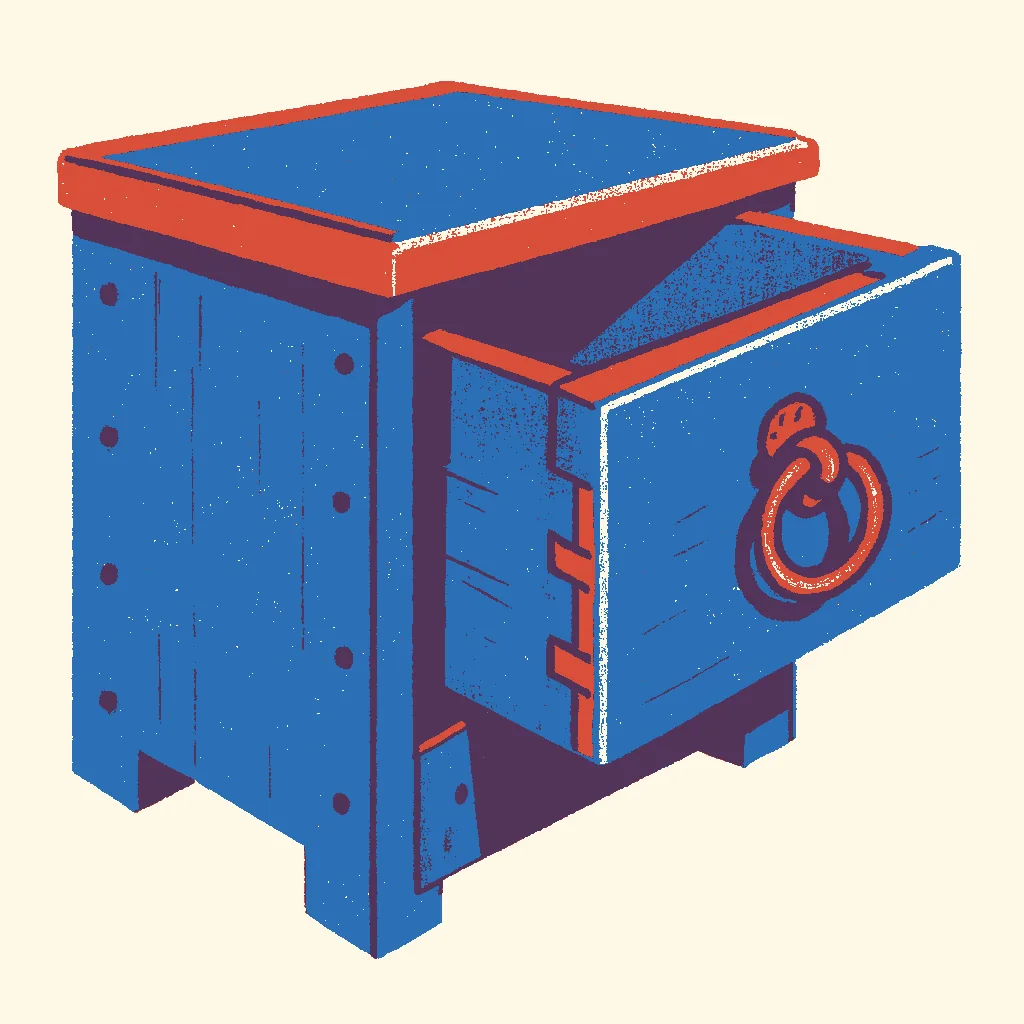
A dresser at the back of the barn sale — paint like a bad decision, drawers that still glide. The wood lies easily, the hardware mostly can't. Nails and screws were made differently era by era, and the differences survive under a century of grime. Pull a drawer, tip it to the light, and read what's holding the piece together. What's the metal saying?
Nails first. A hand-forged nail is charmingly irregular — a hammered head like a rose, a shaft tapering on all four sides — and it points to genuinely early work. Square-cut nails, sheared from iron plate and tapered on just two sides, carried most of the 1800s. Round wire nails, the kind in every hardware store today, had taken over by about 1900. Square reads old, round reads newer, that's the fast sort.
Screws tell it finer. An early hand-cut screw looks like a person made it on a long afternoon — the slot wanders off center, the threads run uneven, the tip sits blunt. Machine-made screws with crisp threads and centered slots take over through the mid-1800s. A drawer full of perfect, identical screws in a piece that claims to be colonial means somebody's been in there since.
The Phillips head is the loudest witness in the room. That cross-shaped slot didn't exist until the mid-1930s, so a Phillips screw in a "Victorian" washstand is a repair or a costume. One odd screw doesn't sink a piece — old furniture gets fixed, that's its job — but Phillips heads at every joint means the whole thing is younger than it's dressed. Repair, or reproduction?
Saw marks are the bonus round. On the unfinished faces underneath, look for the tool's handwriting — straight, parallel scars mean a hand saw or a pit saw, slow work from the early days. Curved, arcing marks mean a circular saw, which puts that board in the mid-1800s or later. The back of a piece never got sanded for company, that's exactly why it talks.
Somebody loved this once — and somebody nailed it together, and the nails remember exactly when.
So before the price tag gets a vote: one nail, one screw, one look underneath. Hardware that matches the story means the story holds, hardware that argues with it means the price walks down or I do. Ten seconds with a drawer bottom beats an hour squinting at the finish, partner. Old bones, or a good costume?