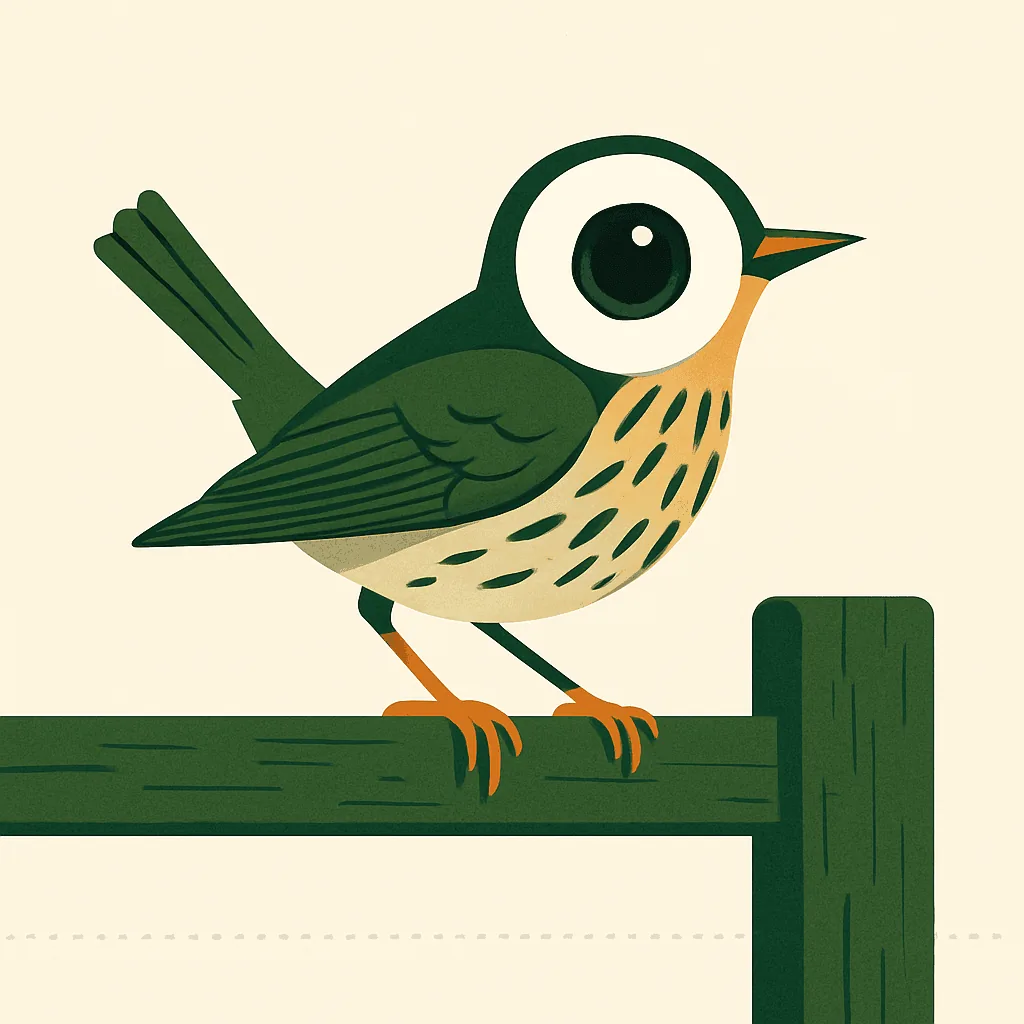
The bird was on the top rail of the fence, and then it wasn't. A blur, a color, a shape that looked like three other shapes. You lower the camera. You try to hold the picture in your head before it fades, which it is already doing. Was the belly streaked, or plain. Was there a bar on the wing. Did the tail have a white edge, or did you imagine that on the way to the kitchen. The bird has gone into the hedge, and you are trying to catch a specific fish in a bucket of water.
Here is the trouble with the way most of us start. We look at the whole bird. Small brown thing. Medium brown thing. A finch, maybe, or a sparrow, or that other one. Shape is a beginning, but shape has cousins. Half the birds at your feeder in October are, in silhouette, roughly the same little football with a beak. If you stop at the outline, you will spend the rest of the afternoon flipping pages and second-guessing. The whole bird is too much bird. You need one thing.
That one thing is the field mark. It is the small, specific detail that only a few birds carry, and it is the reason an experienced eye lands on a name in under a second. Not the vibe of the bird. Not the general brownness. A ring around the eye. A stripe across the wing. A flash of white at the outer tail. Learn to look for the mark, and the guessing collapses into a short list, sometimes into one bird.
Start with the eye. A ruby-crowned kinglet is a fidgety olive scrap of a thing, and there are a dozen olive scraps at any given hedge. But the kinglet has a bold white eye ring, broken at the top, like someone drew a spectacle and forgot to close it. See the eye ring, and half the field guide falls away. A yellow-rumped warbler in fall confusion plumage looks like almost anything, until you catch the little yellow patch at the base of the tail. That is the tell. The bird can be facing away, half in shadow, and the patch still gives it up.
Wings next. A house finch and a purple finch will both land on your feeder, and beginners spend years trading them back and forth. Look at the wing bars. The purple finch has softer, less contrasting bars, and a heavier bill, and a wash of raspberry down the back rather than just on the head. Downy and hairy woodpeckers, same problem. Same black and white pattern, same red spot on the boys. But the downy has small black spots on the white outer tail feathers, and the hairy's tail is clean white. Two birds, one mark, done.
Tails carry more than people notice. A dark-eyed junco flushes off the ground and you see the white outer tail feathers open like a fan. That is the mark, and it is unmistakable, and it works even when the light is bad. Eastern phoebes wag their tails down and up on the perch. Not a field mark exactly, but a behavior that acts like one. Behavior counts. If a small brown bird is walking headfirst down the trunk of your oak, you are looking at a nuthatch. No other backyard bird does that. The behavior is the mark.
So when the bird lands, and you have three seconds, do not try to see everything. Pick one region. Eye, wing, tail, rump. Look hard at that one region. Say it out loud if it helps. Broken white eye ring. Two thin wing bars. White outer tail. Whatever you catch, that is the piece that lets you name it later, or ask a better question. A blurry photo with a clear eye ring is worth more than a sharp photo of a shape.
Keep your book. Write the mark down before you write the guess. Broken eye ring, olive body, tiny bird, hedge. You will find yourself, a season in, naming birds off the mark alone, the way you know a friend by their walk before you see their face. Kinglet. Yellow-rump. Junco. Downy. The list gets short fast.
The bird on the fence will come back, or a cousin will. Have the camera ready, and pick your one thing to look at before it lands. Eye, wing, tail. That's the whole game. Worth another look.