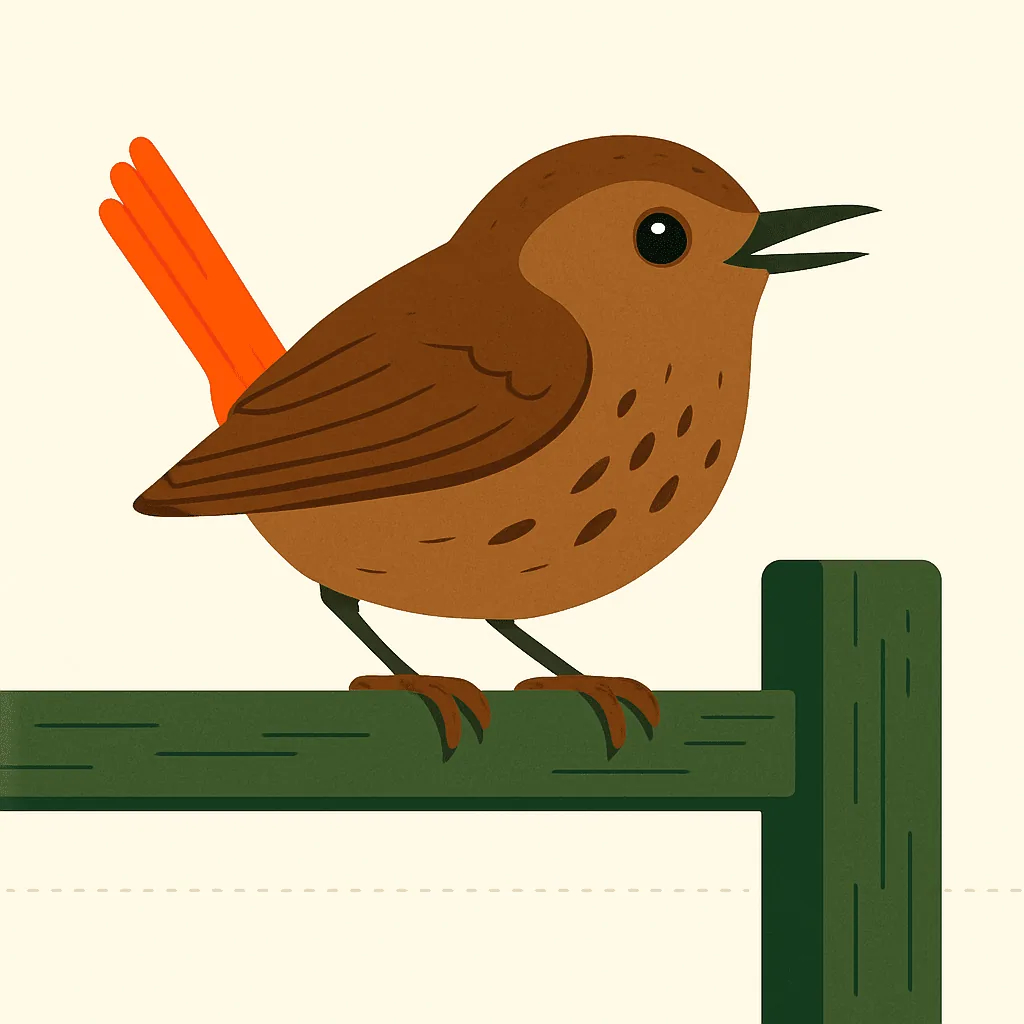
A round brown bird on the railing, tail flicked straight up like a little flag. You saw it for half a second before it dropped into the yew. You're already halfway to the name. The tail did most of the work, you just haven't given it credit yet.
Most of us learn to look at the front of a bird first. The face, the bill, the bit of color at the throat. That makes sense, faces are where we look for everything else in our lives. But the front of a small brown bird is often the least useful part. Five species share the same streaky chest. Three more share the same pale eye ring. The back end, though, the tail, that's where the bird stops trying to blend in and starts telling you what it is.
Start with carriage. How the bird holds the tail, not its shape. A wren carries hers up. Sometimes straight up, cocked over her back like she's balancing a pencil. No sparrow does that. No finch, no junco. If the tail is up, you are looking at a wren, and the rest is just choosing between the two or three wrens that might be in your yard. That's the tell, before you notice a single field mark.
A junco does the opposite. Long tail held level or a little low, and when she flushes off the ground, two bright white outer tail feathers flare open like a fan. That flash of white on the sides, that's a junco flying away from you, every time. The Carolina wren going into the yew won't show you white. The song sparrow won't either. Only the junco.
Now shape. A house finch has a notched tail, a soft little dip at the tip, like someone pressed a thumbnail into it. A goldfinch has the same notch, deeper. A cedar waxwing's tail is squared off and dipped in yellow at the end, bright as a highlighter. A barn swallow's is forked so far it looks like two long streamers. Once you start sorting by tail shape, a lot of the confusing middle-sized brown birds sort themselves.
Sparrows are the tricky ones, I know. They mostly have plain, medium-length tails, held level. Not much shape to work with. But look at what the tail does when the bird moves. A song sparrow pumps hers, a slow downward flick, over and over, especially when she's nervous. A chipping sparrow doesn't. A white-throat doesn't either. That pump is diagnostic, and it's a movement, so it works even in bad light.
Here's the thing about tails, they show up even when the rest of the bird doesn't. Bird ducks behind a branch, you still see the tail. Bird is backlit against a bright sky, the silhouette of the tail is still readable. Bird flushes and you get one second, the shape and the flash tell you what left. Faces need light and stillness. Tails work in the half-second you actually get.
So the next time something lands and lifts off before you can get the camera up, don't grieve the face you missed. Ask yourself, was the tail up or down? Long or short? Notched, squared, forked, fanned? Any white on the edges when it flew? You'll be surprised how often those four questions get you to a name, or at least to a family, which is most of the work.
A small drill, if you want one. Sit at the window for ten minutes with no camera, no book, and just watch tails. Don't try to identify anything, just notice. The chickadee's tail is longer than you thought. The nuthatch barely has one, she's all head and shoulders. The mourning dove's tail is a long pointed wedge with white corners that show when she takes off. After ten minutes of only watching tails, you'll start to see the yard sorted differently, and the next time a round brown bird lands on the railing with her tail cocked straight up, you won't even reach for the app. You'll just say her name.
That's a Carolina wren, by the way. The one on the railing. Round, warm brown, tail straight up, probably a white stripe over the eye if you had another second. Loud singer for such a small bird, listen for the three-note whistle at dawn, teakettle teakettle teakettle. She'll be back tomorrow, they hold territory year round.
Add her. That's a new one for your book.