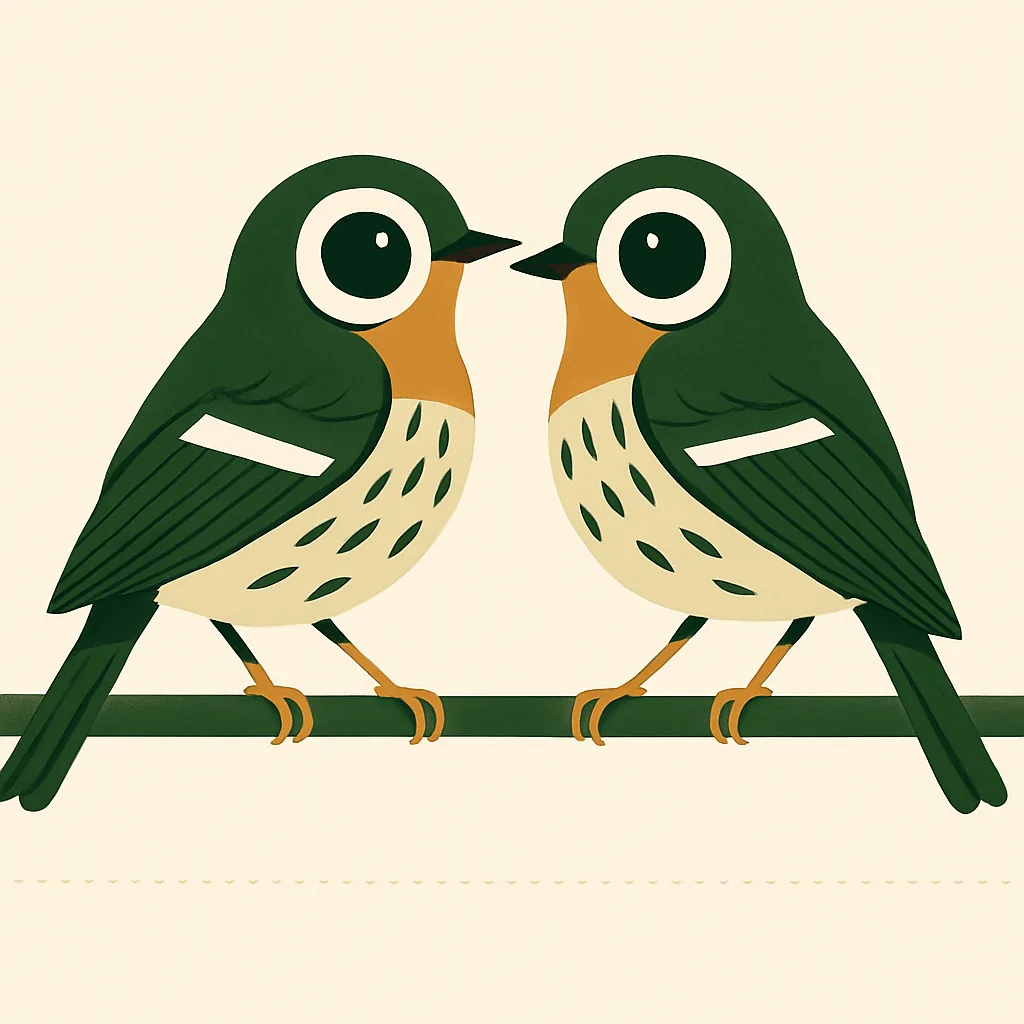
Two little birds on the same branch. Same size, same soft olive back, same restless hop from twig to twig. One flicks its tail and the other doesn't, but you missed which was which. And now they've swapped places. This is the moment most books close and most people give up. Look again. Look at the shoulder.
There. A pale stripe crossing the folded wing, thin as a pencil line. On the other bird, two stripes, and the lower one bolder than the upper. You almost didn't see them. But those little marks are the whole answer, and once you know how to read them, a whole shelf of confusing small birds starts sorting itself into names.
Wing bars are the birder's quiet trick. They're the field mark that keeps working when the light is bad, when the bird won't sit still, when the belly is hidden and the face is turned. A warbler in September, gone drab, stripped of every bright feather that made spring easy, will still show you its wing bars. So will a flycatcher in any month, because most flycatchers refuse to be helpful in any other way.
Start with the count. Zero, one, or two. That alone rules out huge portions of the book. A small greenish bird with no wing bars at all is telling you something. It's probably a warbler in the unbarred group, a Tennessee, an Orange-crowned, a Warbling Vireo if the bill looks a little heavier. A small greenish bird with two crisp white bars? Different shelf entirely. Now you're looking at a Blackpoll, a Bay-breasted in fall, a Black-and-white if the back is stripey. The count is the first cut.
Then look at the boldness. Are the bars sharp, like someone drew them with a fine brush, or are they soft, more of a smudge? Sharp bars usually mean an adult, and often a bird that wants to be seen. Soft, blurry bars often mean a juvenile, feathers not quite finished. A young bird trying on its field marks for size. Worth logging, that one. Juveniles are how you learn a species properly, because they force you off the easy adult plumage and into the actual shape of the bird.
Now the trickier part. Are both bars the same? On a lot of small birds, they aren't. The lower bar is often bolder, the upper one thinner or nearly gone. That's normal, and it's useful. An Empidonax flycatcher, one of those maddening little grey-green birds that all look alike, will sometimes give you an uneven pair of bars that hints at which Empidonax. A Least has bold, clean bars. A Willow's are softer, greyer, less contrasty. Neither bird will sing for you on the day you want it to. But the shoulder will talk.
Color of the bar matters too, though less than people think. Most wing bars are white or off-white. When they aren't, notice. A yellow-tinged bar on a small greenish bird in fall is a clue toward Pine Warbler. A buffy, warm-toned bar can push you toward Bay-breasted over Blackpoll when everything else has gone ambiguous. These aren't tricks, they're just the bird wearing its name in small print.
And then the thing nobody tells you. Wing bars are made by the tips of the greater and median coverts, the small feathers that cover the base of the flight feathers. Which means a worn bird, late in the season, can lose its bars. Frayed tips, faded pigment, and suddenly a bird that ought to have two bold bars shows one and a half. Don't panic. Look at the rest, look at behavior, and remember that August and September birds are wearing last year's coat. Bars fade. Birds don't stop being themselves.
One more thing. When you're stuck between two lookalikes and the wing bars aren't cooperating, try to get the bird from below. The wing bars are the top of the wing, but the underside of the wing often has its own story, sometimes a wash of color, sometimes a contrasting patch. Wait, tilt the camera a hair. One more frame, from below if you can. That angle has saved me more IDs than I can count.
So the next time two little birds land on the same branch and refuse to make it easy, don't chase the face. Don't wait for a song that isn't coming. Look at the shoulder. Count the bars, judge the boldness, notice if they match. That's the tell, most of the time. Add it to your book. Your book's getting good.