The kettle's on. The window is grey with early light. Somewhere in the yew by the fence, a small voice says its own name, twice, slow. You've heard it for years. You've poured coffee to it, taken calls over it, opened the back door into it without looking up. You don't know whose it is. That's the funny part. The song is already yours. The name isn't yet.
Most of what people call learning birdsong is really this. Not memorizing, not studying. Just fitting a name to a voice you've been living with. The song has been doing all the work. It's arrived at your window every morning, patient, waiting to be recognized. And here's the tension, gentle as it is. Once you know four, you can't un-know them. The yard starts talking. The commute starts talking. The park bench, the school pickup, the walk to the shed. It's a small door, and it only opens one way.
So. Four voices. That's all this is.
The first one, the one saying its own name in the yew. Chickadee. Two notes, the second lower, like someone calling a cat from two houses down. Sometimes she adds the longer version, a scratchy dee-dee-dee that sounds like a tiny complaint. She isn't complaining. That's just how she talks. Small grey bird, black cap, white cheeks, softer than she sounds. Once you've got her, you'll notice she's the one at the feeder in the worst weather, when the finches have gone quiet.
Second. The clear whistle that carries three gardens over, the one that sounds almost too musical to be a wild bird. Cardinal. Listen for a slurred rise and then a run of sharp, even notes, birdy-birdy-birdy or what-cheer, what-cheer. He sings from a high perch, usually the top of something. The red is the tell, if you get eyes on him. If you don't, the whistle is enough. Females sing too, which surprises people. Same tune, softer edge.
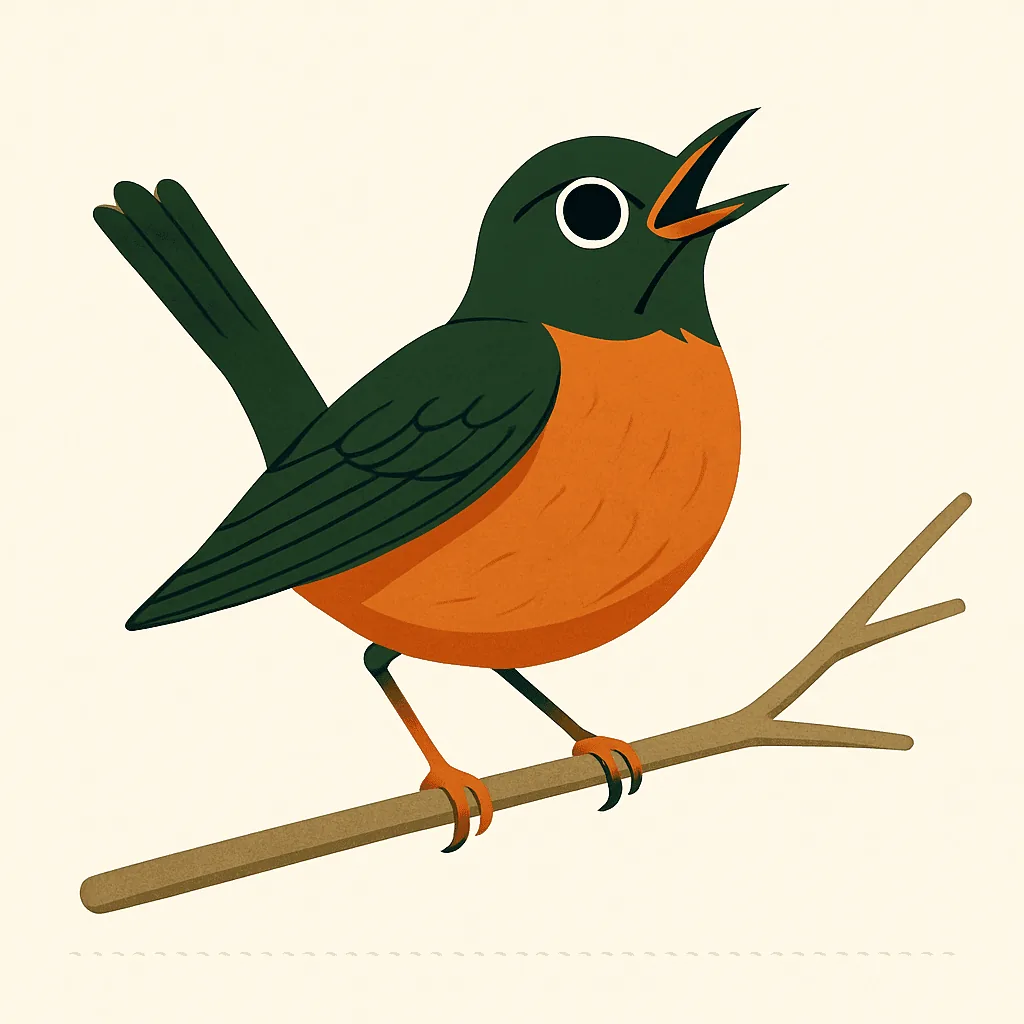
Third. The one you've been calling a song without knowing it's a song. Long, rambling, cheerful, like the bird is thinking out loud and can't quite land the sentence. Robin. Phrases in twos and threes, cheerily cheer-up cheerio, over and over with tiny variations. He starts before it's properly light. If a bird is singing at four in the morning in spring and you're annoyed about it, statistically, robin. Orange belly, dark head, the shape you already know from the lawn.
Fourth, and this one's my favorite to hand over. The soft, low, mournful hoo, hoo-hoo, hoo, hoo that people mistake for an owl for years. Mourning dove. Four or five notes, breathy, like someone sighing through a wooden flute. The bird is a pale, long-tailed thing, usually on a wire or a low branch, calm as anything. Once a friend told me she'd been listening to an owl every summer since she was a child. It was a mourning dove. She wasn't disappointed. She said the yard just got a little more honest.
That's the whole trick. Four names. Chickadee, cardinal, robin, mourning dove. Read them again. Say them out loud if no one's around. The next time you hear one, some part of you will reach for the name before you've asked yourself to. It feels a bit like a magic trick the first week. It isn't. It's just that the song has been waiting.
Here's what tends to happen next, and I say this so you're not surprised. You'll start noticing which one shows up when. The chickadee is a year-round neighbor. The robin gets loud in spring and quiets by high summer. The cardinal sings earliest and latest in the day, bookending things. The mourning dove is around a lot but calls less in winter. You'll build a small private calendar without meaning to. That's the beginning of a book, whether or not you write it down.
One thing, though. Don't try to learn a fifth today. Four is the right number for a first morning. Give them a week. Let the yard say them back to you. If a voice shows up that isn't one of the four, that's fine, tell me where you heard it, and we'll take a look together. A song you can't place is just a bird waiting for its name.
So tomorrow, when the kettle's on and the window is grey, you'll hear the yew talking. And this time you'll know. Two notes, the second lower. That's her. Oh, look who came to the feeder.