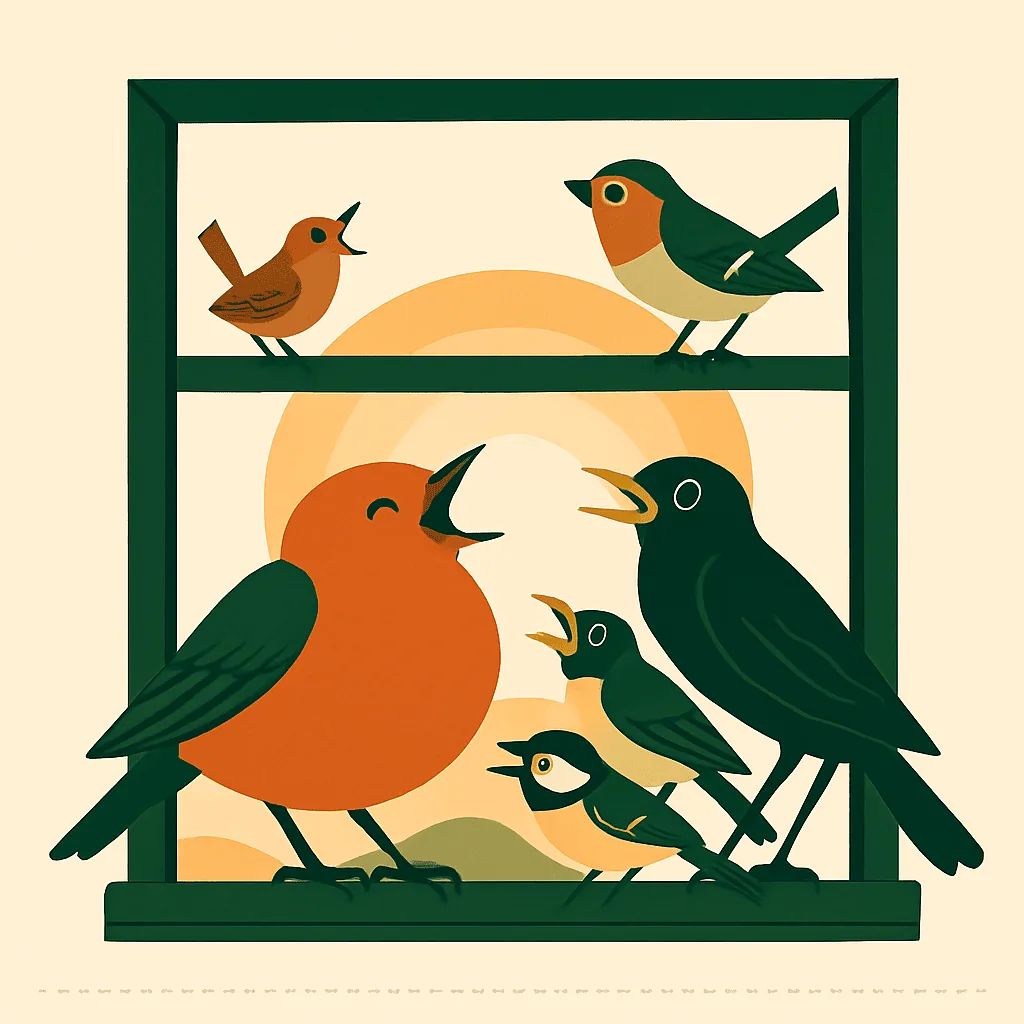
Five in the morning. The window is open a finger's width and the whole yard is talking at once. It sounds like weather. A wall of sound that isn't quite rain and isn't quite wind, pressing in from every direction. You lie there half-awake and try to pick out a single voice, and the wall closes over it. Then another voice, and the wall closes again. It's beautiful, and it's a little maddening. You know there are birds in there. You just can't hold one long enough to name it.
Most mornings, this is where a person gives up and rolls over. The chorus is treated as a texture, a nice background for coffee, something to gesture at when a guest is visiting. But there is a shape inside it. The birds don't all start together. They arrive in a rough order, one voice at a time, and if you catch the order, the wall becomes a room. You can walk around in it.
Robin, first. Almost always. Before the sky has any real color, the robin starts up from somewhere high, a fencepost or a phone wire, and sings that long rolling phrase, up and down, up and down, like someone practicing scales who never quite lands. Cheerily, cheer-up, cheerily. That's the one they teach you as a kid, and it's true. If you're outside at four-thirty and something is singing and nothing else is, it's a robin. Learn that shape first. Once you have it, you can subtract it. The rest of the chorus is what's left when you take the robin out.
Cardinal comes in next, usually before the light does. A clear whistle, two notes, then a whole run of them, sharper than the robin and more forward, like someone across the yard calling a name. What-cheer, what-cheer, birdy-birdy-birdy, if you want the old mnemonic. He sings from a high perch, the top of a tree, the peak of a roof. If you hear the robin's slur and then a bright whistle cut across it, that's your cardinal arriving. Two voices now. The room has walls.
Then the little ones. Wrens and titmice come in as the light starts to lift, and this is where the chorus fills out and gets confusing. The Carolina wren is louder than a bird her size has any right to be, a ringing three-note phrase repeated three or four times, teakettle-teakettle-teakettle. The tufted titmouse does peter-peter-peter, higher and thinner, more insistent, less musical. They overlap. They answer each other across the yard. If you're new to it, they blur together, and that's fine. Just notice that the small voices have arrived, and the chorus has thickened. You don't have to separate them yet.
Here's the trick, and it's a small one. Don't try to hear everything. Pick one bird before you go to the window. Say it out loud. Robin. Then listen only for robin. Let everything else go by. Your ear will resist at first, it wants to catch all of it, but hold to the one bird. After a minute, the robin will lift out of the wall and sit on top of it, and you'll wonder how you ever missed it. Then let robin go, and pick cardinal. Same thing. One at a time, five minutes each. In a week, you'll have four or five voices you can find at will, and the wall will be a room with furniture in it.
Some mornings the order shifts. A mockingbird will start before the robin and confuse everyone, including me. A house wren will crash in from a brush pile and take over the middle register. Somebody's rooster, two streets away, will insist. That's fine. The order is a starting frame, not a law. What matters is that you stop hearing weather and start hearing individuals. Once that switch flips, it doesn't flip back.
The chorus peaks for maybe forty minutes and then thins out fast. By full daylight most of the singers have moved on to the business of the day, eating, chasing, feeding whoever is waiting in the nest. So the window for this is narrow. If you're going to try it, try it tomorrow. Set an alarm ten minutes before sunrise, open the window, and listen for the robin first. Just the robin. Tell me where you heard it.
A cup of coffee helps. So does not turning on any lights. The chorus is happening whether you're in it or not, but it's better with a witness. Worth another look. Or another listen, in this case.