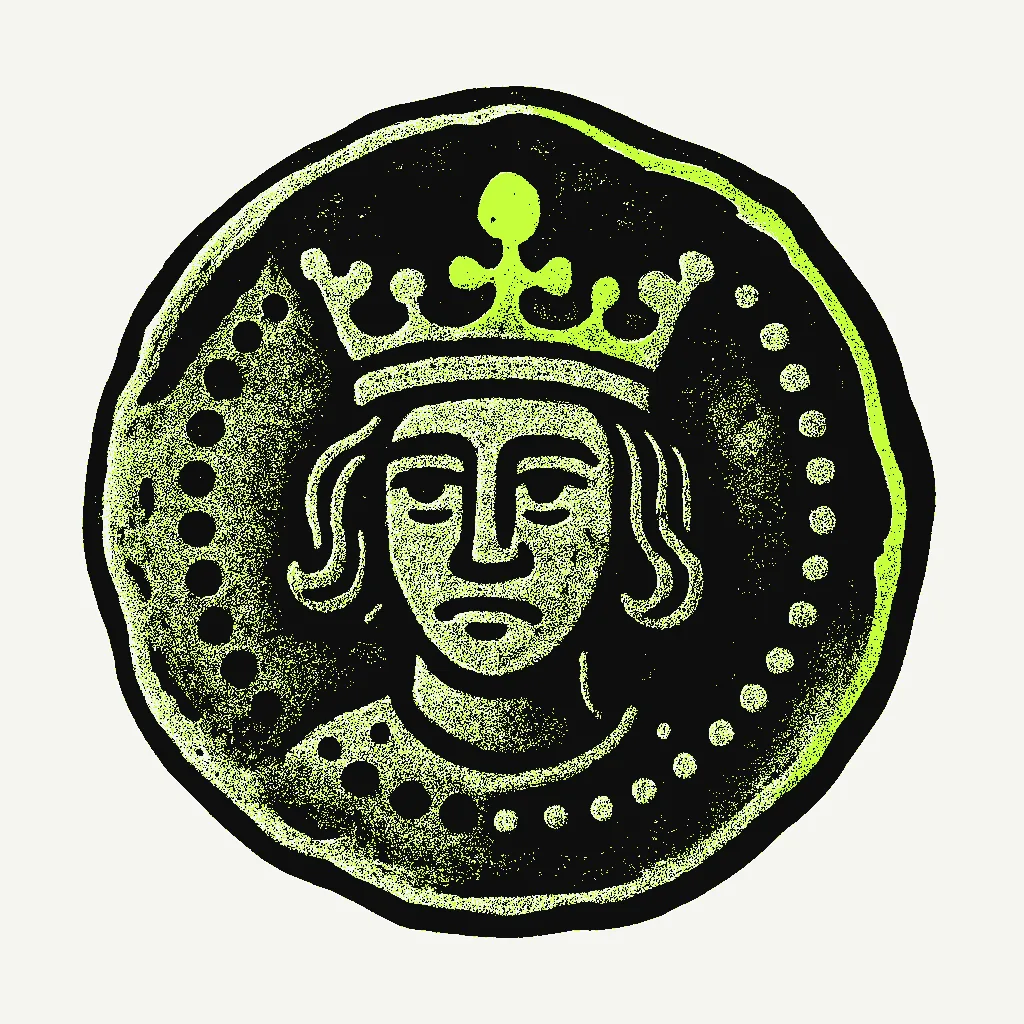
The coin is sitting on the felt, oval, off-kilter, the design pushed a little to one side and the edge notched where somebody's shears came down at a bad angle. The saint on the reverse is missing part of his shoulder because the flan wasn't quite wide enough to catch the whole die. The lettering trails off into nothing on the west side. And the person who brought it in wants to know if it's been damaged.
It hasn't been damaged. It was made this way. A man with a hammer, on a Tuesday, seven hundred years ago, put a blank disc of silver between two dies and hit the top one with a mallet. That's the whole process. The wobble you're looking at is the record of that Tuesday.
People come to hammered coinage from milled coinage, and milled coinage has trained the eye to expect a perfect circle. Round rim, sharp edge, everything centered, the same weight to a fraction of a gram. That's a machine talking. A press, a collar, a planchet cut to spec. When you look at a hammered piece with that eye, the piece looks broken. It isn't. It's from before the machine.
Here's what actually happened. A sheet of silver, hammered thin by hand, got cut into rough discs with shears. Nobody weighed each one to the tenth of a grain. They aimed for the right weight across a batch and moved on. The disc, the flan, went into the shop irregular from the start, thicker on one side, oval more often than round, sometimes with a nick from the shears still on the rim. That's before the dies ever touched it.
Then the striking. The lower die sat in an anvil. The moneyer set the flan on it, held the upper die on top with tongs or a stick, and swung the hammer. One blow, sometimes two. If the flan slid a hair, the design landed off-center and half the legend walked off the edge. If the flan was smaller than the die, the outer ring of the design never made it onto the coin at all. If the die was tired, worn from ten thousand strikes already that week, the details came up soft. All of that is on the coin in front of you.
And this is the part that matters. None of that is a defect. That is the coin. A hammered penny that came out perfectly round, perfectly centered, full legend, sharp strike, is the exception, and it's the exception because everything had to go right in a shop where most things went a little wrong. Most of them came out like the one on the felt. Oval, off-center, clipped, honest.
The clipping is worth its own minute. Some of it happened at the mint, from the shears. Some of it happened later, in circulation, when people trimmed small slivers of silver off the edges to keep for themselves and passed the lighter coin along. That's why milled coinage eventually got a reeded edge, to make clipping visible. On a hammered piece, a clipped edge is just part of the life the coin had. It was money. People used it the way people use money, which is to say, not gently.
The wear pattern's honest. The high points, the king's cheek, the cross at the center of the reverse, are the first to go, because those are what a thumb touches when a thumb counts out change. Somebody carried this a long way. Seven hundred years of pockets and purses and coffee cans and a drawer in somebody's grandmother's kitchen. The coin doesn't owe anybody a perfect circle after all that.
So when the loupe comes out on a hammered piece, the rim and the centering aren't what I'm reading. I'm reading the strike. Is the portrait crisp where the metal took the die, even if half of it walked off the flan. Is the legend legible where it landed. Is the silver still the color silver goes when nobody's tried to shine it up. The toning did it a favor, most of the time. Leave it.
What you're holding isn't a coin that failed to be round. It's a coin that was never trying to be. The oval, the notch, the shoulder that isn't there, those are the marks of the hand that made it, and the hands that used it, and the seven hundred years in between. The strike tells the story. Hold onto that one.