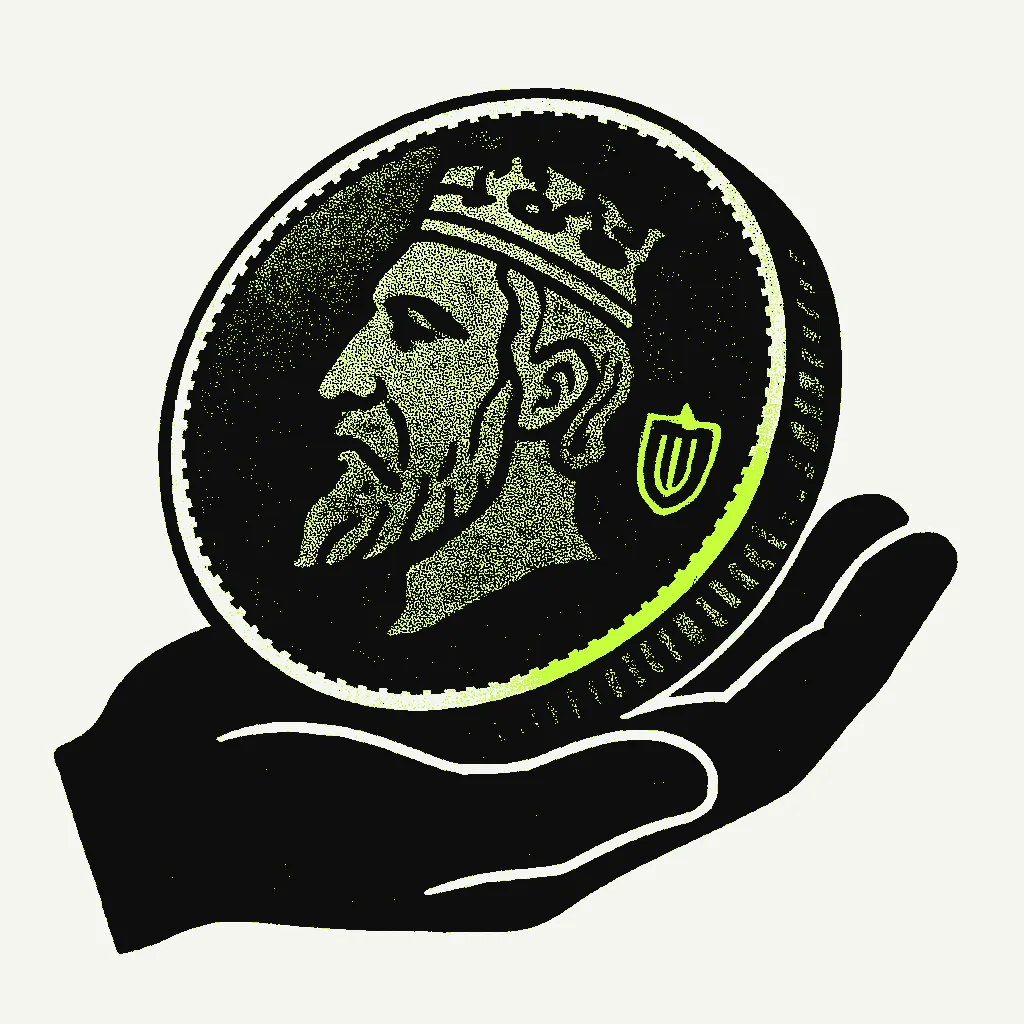
The first time you set a thaler on the felt, the felt does something the felt doesn't usually do. It settles. The coin sinks a hair into the wool and stays there, and you notice you are holding your wrist different than you were a minute ago. Twenty-eight grams of silver, sometimes more, wider across than a modern half dollar, thick at the rim. You can feel the edge before you look at it. Somebody once handed one of these across a counter for a horse. The counter is gone. The horse is gone. The coin is on your felt.
Most people who walk in with old European silver walk in apologizing for it. They think because it isn't American, it isn't collected. Or they think because the portrait is worn soft and the legend is in a Latin they can't read, it isn't worth the trouble. Neither one is right. The trouble is the point. A thaler is a piece of the argument Europe was having with itself for four hundred years about what a coin should weigh, whose face went on it, and whose mint got to strike it. The wear is the argument. The portrait is the argument. You are holding a very slow conversation.
Start with the weight. The Joachimsthaler, struck in Bohemia in the 1520s, set the standard the rest of the continent quarreled with for centuries. Austria kept the tradition alive under the Habsburgs, and the Maria Theresa thaler of 1780 got struck and restruck so many times, in so many places, that you can still buy one today that looks like it was made last Tuesday. It wasn't. It was made from the same dies, to the same weight, because the trade routes down through the Levant would only take that coin and no other. That is a specific fact worth sitting with. A design so trusted that the mints kept making it a hundred and fifty years after the queen was in the ground.
Saxony's are different. The electors put their own faces on their silver, and they put them on with a bluntness that reads almost modern. Heavy jaw, cropped hair, no flattery. Look at the reverse and you'll usually find the arms of the house, quartered and quartered again, every marriage and inheritance stamped into the field. The strike on a good Saxon thaler is deep. The die-cutters knew they were making something that would be handled by ministers and bankers, not by farm boys with pockets, and they cut for that room.
Then the low countries. The leeuwendaalder, the lion daalder, the rijksdaalder. Different weights, different fineness, different politics. The Dutch struck for trade, and their coins went everywhere trade went, which is to say the coasts of Africa, the ports of New York before it was New York, the wharves of Batavia. When you get a lion daalder in the shop with honest wear on the rampant lion, you're not looking at a European coin anymore. You're looking at a coin that saw the world and came back.
What you learn, handling enough of them, is that condition means something different here than it does with American silver. A Morgan dollar with heavy wear is a coin somebody spent. A thaler with heavy wear is a coin that did its job for two hundred years and survived being melted. Half the silver in Europe went into cannon at some point, or into somebody's newer coinage. The ones that sit on the felt now are the ones that hid in a drawer, or a wall, or a churchyard jar, while the rest went into the fire. Circulated, but circulated well. The wear pattern's honest.
Portraiture is where I'd send you next. Not the ruler's name, the ruler's face. A young Maria Theresa is a different coin than a widowed Maria Theresa, and the die-cutters didn't soften her. Look at the jawline. Look at what the engraver put around the eyes. The best of these coins were cut by men whose names you can still find, and the worst were cut by men whose names nobody bothered to write down, and both kinds ended up in the same trade. You can tell them apart with the loupe. You can tell them apart, after a while, with your thumb.
So bring me the heavy silver. The ones from the box at the estate sale, the ones somebody's grandfather brought back, the ones with Latin around the rim and a face you don't recognize. We'll set it on the felt. We'll weigh it. The strike tells the story, and the story here is longer than most. The value can wait. Put it in a flip when we're done.