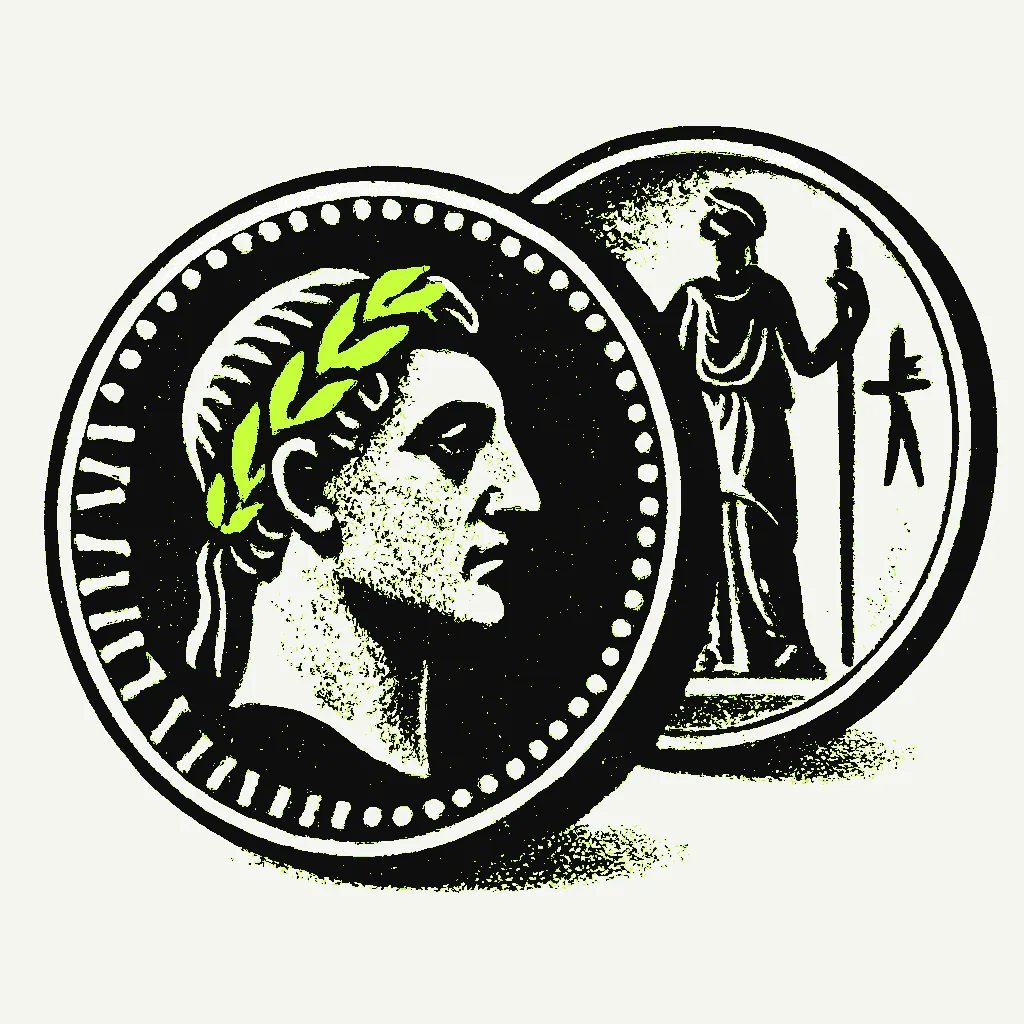
The coin comes across the felt smaller than people expect. About the size of a modern dime, a little thicker, the silver gone soft grey the way old silver goes when nobody has touched it in a long time. On one side, a man's face in profile. Around him, letters running the curve of the rim, worn where the high points sat against cloth and hands and other coins for centuries. Turn it over. A figure standing, holding something, maybe a scale, maybe a spear. That is a denarius. Two thousand years old, give or take a Caesar.
Most people who bring one in want to know what it is worth before they know what it is. I understand the impulse, but it gets the coin backward. A denarius is not one thing. It is three things stacked on a disc of silver about three and a half grams heavy. The portrait is one story. The legend around the rim is a second. The figure on the reverse is a third. If you read them in that order, the coin tells you almost everything before you ever look up a price.
Start with the face. The portrait side is called the obverse, and on a denarius the obverse almost always carries an emperor, or a member of his family, or in the older republican coins a god or a personification. The engravers cut these portraits from life, or from a bust in the mint, and the faces are specific. A heavy jaw, a hooked nose, curls pressed flat against the temple. You can look at a Vespasian and know it is a Vespasian before you read a single letter. The wear pattern is honest here. The cheek and the brow go first, because those are the highest points, and those are the parts a thumb rubs against in a purse. A portrait that is soft in the cheek but sharp in the hair has been carried, not polished. That matters.
Now the letters. The legend runs around the portrait, and it is Latin, and it is abbreviated to fit. IMP for imperator. CAES for Caesar. AVG for Augustus. The name of the man, then his titles, then sometimes the year of his tribunician power, which is how you date the thing to within twelve months if you can read the numerals. The letters are cut small and the die was often tired when it hit the flan, so half of them are ghosts. You read what you can and you infer the rest. This is where a loupe earns its keep. Look at the rim before the field, because the last letter on the legend is usually the one that tells you which emperor you have, and it is usually the one closest to the edge, where the strike is weakest.
Then turn it. The reverse is where it lives. The obverse tells you who was in charge. The reverse tells you what he wanted people to think about. A goddess of victory means a war was won, or was being sold as won. A figure of Concordia means the family was fighting and the mint was denying it. An eagle on a thunderbolt, a temple, a curule chair, a captive under a trophy. Every one of those images was a message pressed into silver and handed out to soldiers and merchants across three continents. The reverse is propaganda, and it is also the only piece of mass communication that survives from that year of that reign. Read it slowly. The figure is holding something in each hand. Name the objects. Then read the legend around the reverse, because it names the figure, and once you have the name, you have the message.
Three stories, one coin. Portrait, legend, reverse. Do that in order and you will know more about the piece in five minutes than most catalog entries will tell you in a paragraph. Then, and only then, look up what it tends to bring. A common Trajan in worn silver runs less than people hope. A scarce reverse type on a sharp flan of the same emperor can run into serious money. The strike tells the story, the reverse tells you which story, and the price catches up last.
One last thing. Do not clean it. The grey is not dirt, it is the surface the last twenty centuries gave the coin, and it is the reason a collector will pay for it at all. Put it in a flip. Handle it by the edge. The wear on that cheek is somebody's thumb from a very long time ago, and the coin is better for it. Hold onto that one.