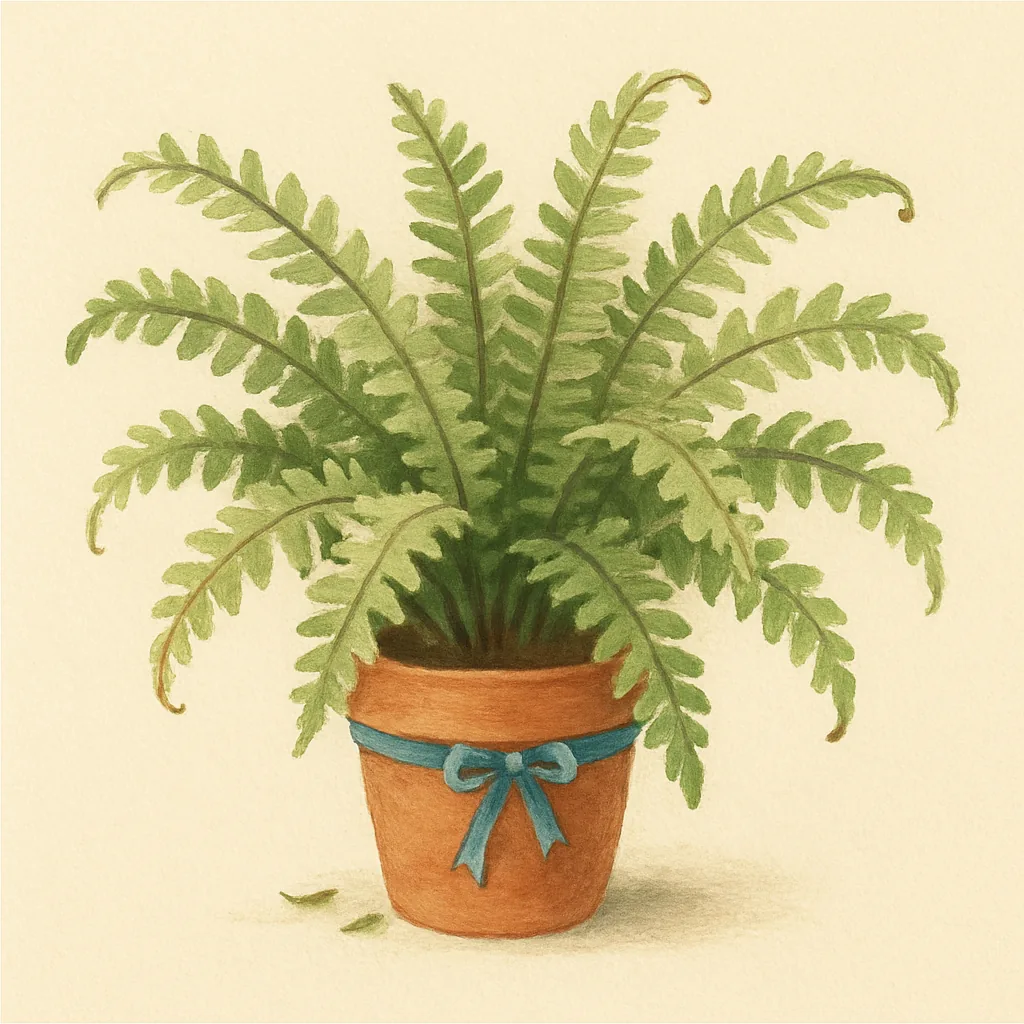
You walk past it in the morning and a little scatter of tiny green leaflets is on the floor beneath the pot. Not a disaster. Just a small handful, like crumbs from a loaf. You bend down, sweep them into your palm, and the fern above looks the same as it did yesterday, arching and soft and full. This is how a Boston fern says something to you. Not in wilted collapse, not in dramatic yellowing, but in a quiet, daily shedding that tells you exactly where you stand.
I have kept one in a bathroom and one on a shaded porch, and the two of them behaved like different plants entirely. The bathroom one thickened up, fronds heavy and cool to the touch, happy in the steam of every shower. The porch one lived in bright, indirect summer air and needed water almost the moment I turned my back. Same species. Same care instincts. Two very different rooms, two very different rhythms.
This is the thing about Boston ferns that I wish someone had told me earlier. They are not fussy in the way people say. They are honest. They will show you what your room is actually like, humidity and light and air movement, more accurately than any little gadget. If the tips of the fronds are turning brown and crisp, the air is drier than you thought. If the whole plant looks pale and sparse, the light is lower than you thought. If leaflets are falling in that small daily rain, it is usually thirst, sometimes only a day behind.
A Boston fern is a room's honest mirror, if you're willing to look.
Water is where most of us get into trouble, and I include myself. The soil should feel like a wrung-out sponge, cool and dark but not soggy. When I lift the pot and it feels suddenly light, the way a paper lantern feels light, I know I have waited too long. When I lift it and it feels dense and heavy, I put it back down and check tomorrow. The roots feel it before the fronds do. A fern that has dried all the way through will drop a startling amount of green in a single afternoon, and it can take weeks to look full again, so the trick is small, steady drinks rather than a rescue flood.
Humidity is the other half of the conversation. In a dry apartment in winter, a Boston fern will crisp at the edges no matter how carefully you water. A tray of pebbles with a little water beneath the pot helps some. A nearby humidifier helps more. Grouping it with other leafy plants helps too, because plants raise the humidity around each other just by breathing. None of this needs to be precise. You are not trying to hit a number. You are trying to make the air feel a little less like a heated car and a little more like a shaded morning.
Light wants to be bright but filtered. A north window, an east window, or a spot a few steps back from a brighter one. Direct afternoon sun will scorch the fronds pale and papery, and you will see it happen within days. If your fern is reaching, thinning, sending long sparse fronds toward the window, it is asking for a little more light, not a lot more. Move it half a step closer and wait a week.
When you groom it, and you will want to, just reach in with clean fingers and pull out the fronds that have gone fully brown at the base. Do not trim tips cosmetically; new growth comes from the crown, not from the cut. The plant sheds what it no longer needs. Your job is mostly to let it.
A Boston fern is not the plant for a person who wants a schedule taped to the fridge. It is the plant for a person who is willing to walk past it every morning and actually look. The dropped leaflets on the floor are not a failure. They are a note left for you overnight. Sweep them up, lift the pot, feel its weight, glance at the tips of the fronds, and you will know what today needs.
One day at a time.