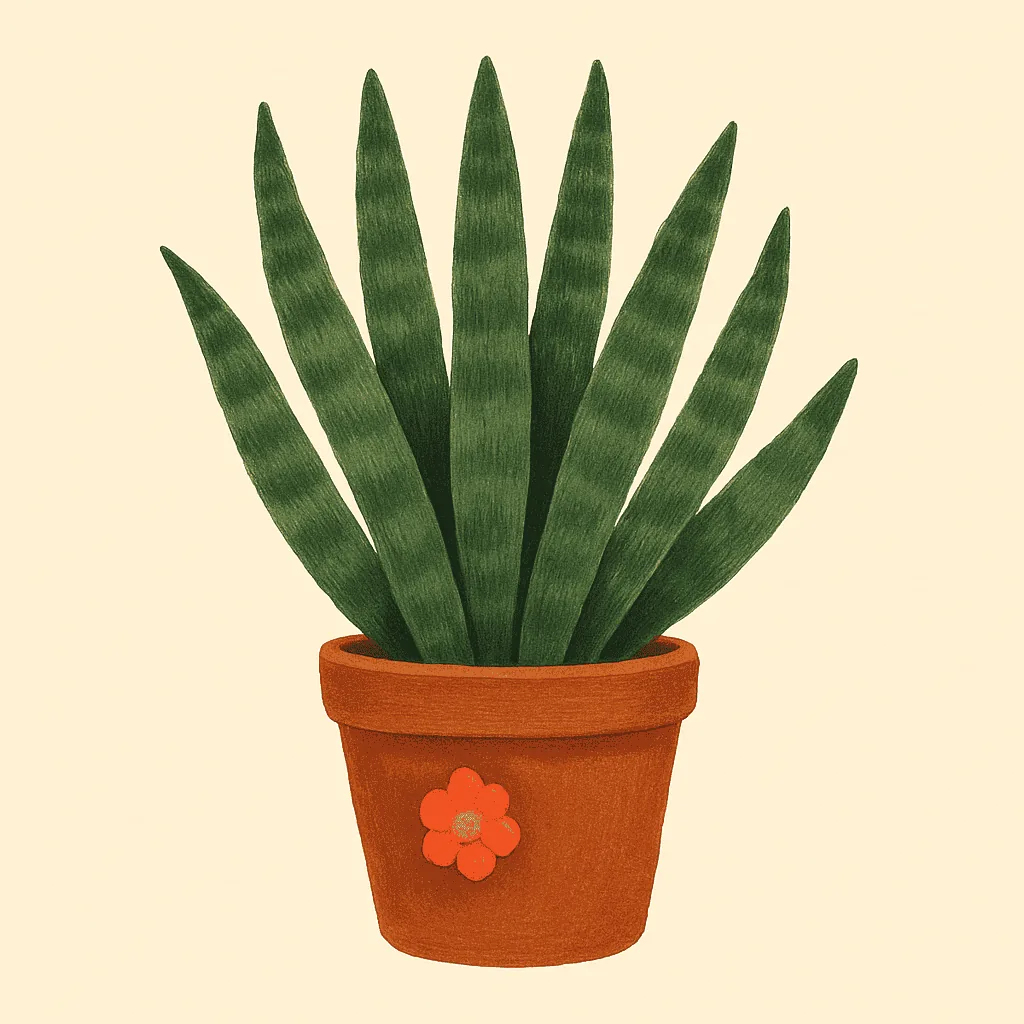
The snake plant on the shelf has not moved in three weeks. Same upright blades, same faint matte sheen, same small lean toward whatever light it can find. You walk past it on the way to the kettle. You walk past it on the way to bed. Nothing about it looks thirsty, or hungry, or unhappy. Nothing about it looks anything. And somewhere in the back of your mind, a small worry begins to form: maybe it needs something, and you are missing it.
This is the quiet trouble with snake plants. They do not perform their needs the way a peace lily faints across the pot, the way a calathea folds its leaves shut at sundown. They just stand there. So the keeper, wanting to be a good keeper, fills the watering can. Then fills it again next week. Then again. The plant says nothing. It is, after all, very hard to kill.
Until it isn't.
Most snake plants that die in homes die from love. The thick rhizome under the soil is already a reservoir, holding water for weeks, sometimes longer. When you add more on top of that store, the roots sit in wet soil they did not ask for. They soften. They turn. By the time a blade yellows at the base and tips over with a soft thud, the trouble has been brewing underground for a long time. Patience reads like neglect, until it doesn't.
So the first thing to know about this plant is also the only thing you really have to remember. Wait until the soil is dry all the way through the pot. Not just the top inch — the whole thing, dry enough that the pot feels noticeably lighter when you lift it. Then water deeply, until it runs from the bottom. Then let it dry again. In summer, that gap might be two or three weeks. In winter, it can stretch to a month, sometimes more. The plant is teaching you the schedule. Not the calendar, not the app, not the watering can on the counter looking eager.
Light is the long answer for almost everything else. A snake plant will take full sun by a bright south window, and it will take a dim hallway with only borrowed light from the next room. It will grow faster in the bright spot and slower in the dim one, but it will not panic in either. If you have a corner that other plants refused, this is the plant for that corner. Closer to the window, not the glass. A shade pocket is fine. A sunny shelf is fine. The blades may pale a little in low light or blush bronze in strong sun, and both are the plant adjusting, not the plant suffering.
The other thing worth saying is about pace. Snake plants grow slowly indoors. A new blade might take a season to push up from the rhizome, unfurling tight at first, then opening as it lengthens. This is not a plant that doubles in a year. The one you bring home is, more or less, the one you will live with twelve months from now, with maybe one or two new leaves to mark the season. So when you choose, choose the shape you actually want on the shelf. The squat round-leaf kind, the tall sword kind, the variegated kind with yellow margins. Each stays close to itself. New growth, no rush.
Some leaves are meant to go.
If an outer blade yellows or softens after a year or two on the shelf, it isn't always a warning. Older leaves do finish, slowly, and the plant lets them. You can trim one at the base with clean scissors and the rhizome will, in its own time, send up another. The plant keeps a long memory of itself underground. What you see above the soil is only the part it's currently showing.
Field note for the notebook: lift the pot before you water. If it feels heavy, set it back down. Wait one more day. If it feels surprisingly light, give it a deep drink and let the excess drain. Two lines, repeated. That is most of what a snake plant asks for across a year.
The shelf has not changed today. The blades are where they were yesterday. Nothing is thirsty. Nothing is urgent. The plant is doing what it does, which is mostly nothing visible, and underneath, slowly, becoming a little more of itself. You can let it. One day at a time.