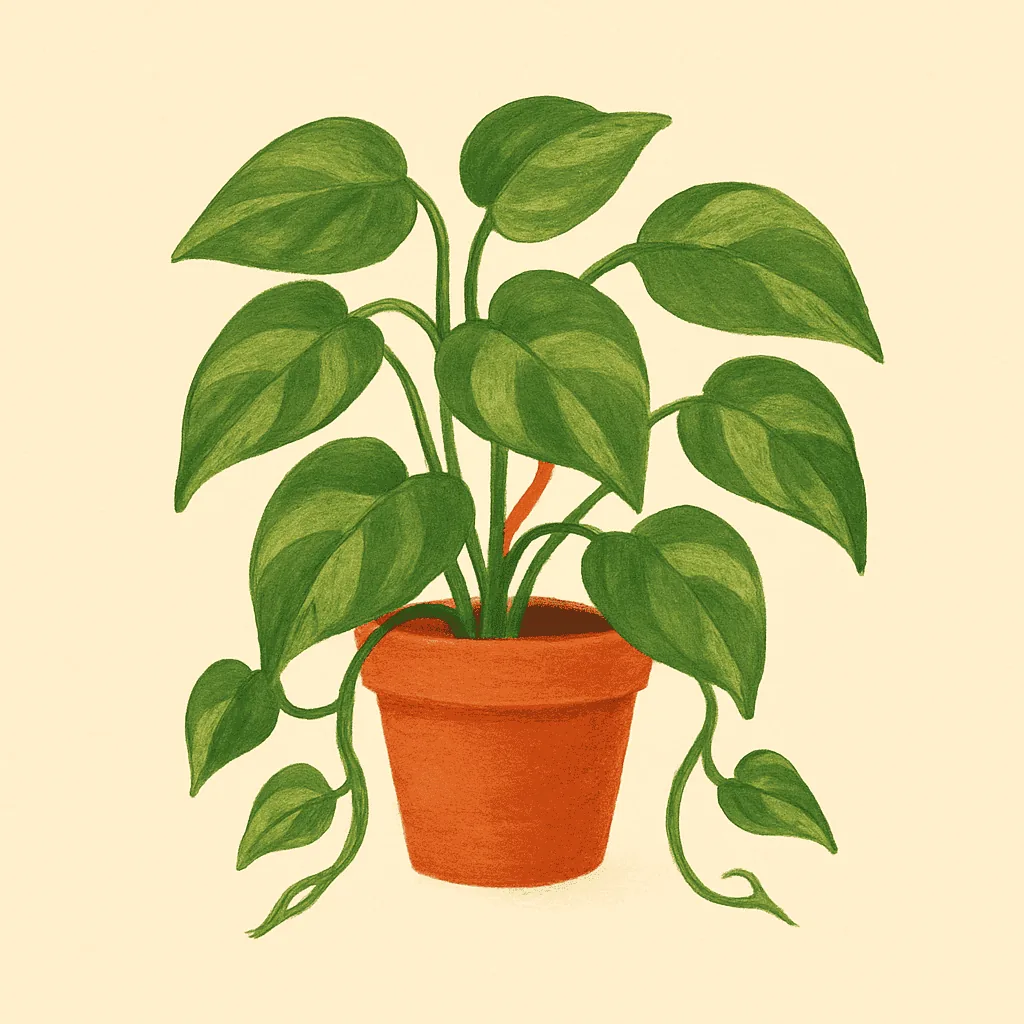
The vine has been on the bookshelf for a year now. A long stem reaches toward the lamp. Two of its leaves have a pale yellow marbling, like light caught in glass. The others are plain green. You haven't watered it in twelve days, maybe fourteen. The top inch of soil is dry to the knuckle. The plant is fine. It is, in fact, the one plant on the shelf that has never given you a reason to worry.
Which is exactly why most people end up unsure what to do with a pothos. The internet has long lists of rules for fussier plants — the calatheas that brown if you breathe wrong, the fiddle leafs that drop a leaf the moment you move them. A pothos asks for none of that. So we start to wonder if we are doing it right. We start watering it on a schedule because we feel guilty. We move it three times in a month, searching for a better corner. We fuss. And then the leaves curl, and we panic, and we have done the one thing this plant cannot quite forgive: too much attention, applied too anxiously.
So here is the small truth of the golden pothos. It is the apartment plant. The one that survives the windowless bathroom, the office with the dim fluorescents, the week you forgot you owned a watering can. It tolerates a lot, and it tolerates it quietly. The top inch of soil is your only real instrument. When it is dry, a thorough drink. When it is still damp, wait one more day. That is most of the relationship.
Light is the long answer, as it always is. In bright indirect light — a few feet back from a window that gets sun, or beside one that gets none but stays bright — the variegation stays crisp. Those pale streaks and splashes are the photogenic part, the reason the plant ended up on your shelf in the first place. In a dimmer corner the new leaves come in more uniformly green. Not a problem. Not a failure. Just the plant adjusting to what it has, making more chlorophyll where there is less light to catch. Some keepers prefer the steady green of a low-light pothos to the show-off variegation of a bright one. Both are the same plant, doing the same quiet work.
The one signal worth watching for is the leaves themselves. If they curl inward, or the vine looks limp and the stems lose their spring, the soil has been dry a beat too long. Water it slowly and thoroughly until it drains. Within a few hours, often less, the leaves lift again. The pothos is theatrical about thirst, which is a gift — it tells you clearly, and it forgives you immediately.
Some leaves are meant to go.
Older leaves at the base will yellow over time. This is not a crisis. This is the plant retiring an older worker. Pinch it off near the stem and move on.
And then, the part that turns one plant into many. A pothos vine has small bumps along its length, just below each leaf — those are nodes. Snip a piece of vine with a node and a leaf or two, drop the cut end into a jar of water on the windowsill, and within about two weeks small white roots appear. In another couple of weeks you have a rooted cutting, ready to pot up in soil or pass to a friend who just moved into a new apartment with one good window. A long trailing vine looks dramatic across a shelf. A pruned plant, with the cuttings tucked back into the original pot, grows fuller and bushier. Either shape is the right shape. The plant doesn't mind which you choose.
If you are new to keeping plants, this is the one I would put on your shelf first. Not because it is the most beautiful — though it is, in its quiet way — but because it teaches the rhythm without punishing the mistakes. You check the top inch. You water when it is dry. You notice when a new leaf unfurls, small and tight, then opens flat over a week. You learn what attention feels like, before you graduate to a plant that demands more of it.
The pothos on the bookshelf is doing what it does. The top inch will tell you when it is time. Until then, you can let it be. Slow water, steady light. One day at a time.