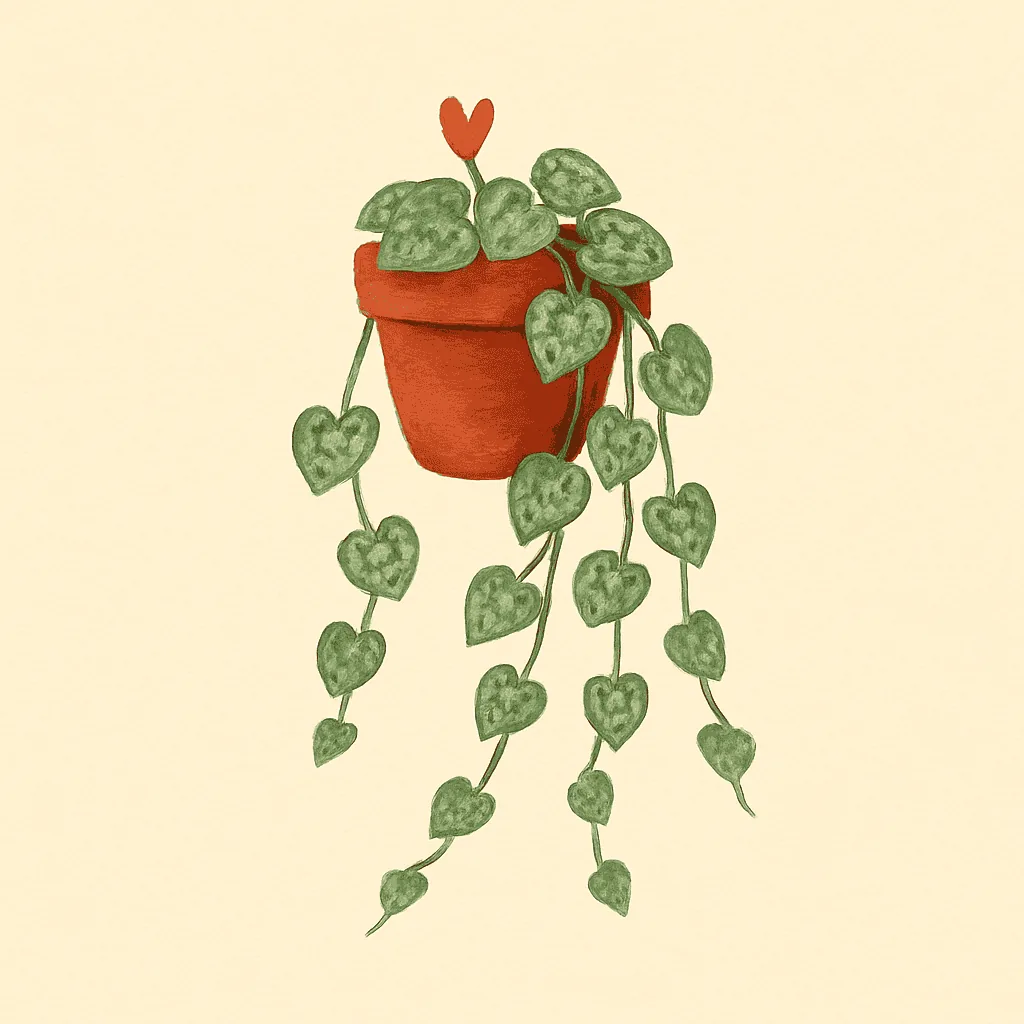
The vine drops from the shelf in a long thin chain. Small green hearts, paired along the stem, spaced like beads on a thread. The light catches the silver marbling on the upper side of each leaf. Some hearts sit close together near the pot. Further down the curtain, the spacing widens, and the vine looks a little more bare than it did a month ago. You touch a leaf. It is firmer than you expected. Almost waxy. Almost a small succulent, which is exactly what it is.
Most people meet string of hearts as a gift. A cutting in a jar from a friend, or a small pot at a shop, already trailing a foot or two over the rim. And then they bring it home and try to be kind to it. The kindness is usually water. A small drink every few days, because the vines look so delicate, because the hearts seem so thin. And the plant, which would have been happy on a quiet schedule, begins to tell you something is wrong. The hearts turn translucent. A whole section of vine drops its leaves between one Sunday and the next.
This is the part worth slowing down for. String of hearts is a succulent, even though it does not look like one. The leaves are storing water the way a small jade leaf stores water. When you give it a drink before the soil has dried, you are stacking water on water, and the roots cannot keep up. The top inch will tell you. Push a finger in. If it is still cool and dark down there, wait one more day. If it is dry and crumbles a little, a small drink is fine. The plant is teaching you the schedule.
Light is the other half of the conversation, and the slower half to read. A string of hearts in bright indirect light keeps its hearts close together along the vine. The spacing stays tight. The marbling stays bold. A plant that is too far from the window does something quieter. It does not die. It stretches. The hearts move apart on the vine, the silver fades a little, and the curtain begins to look skeletal where it used to look full. This can take months to notice, which is part of why it is easy to miss.
Closer to the window, not the glass.
That is usually the fix. Not a grow light, not a new pot. A shelf moved a foot. A hook relocated to the brighter wall. The plant will not thank you in a week. It will thank you in the new growth, two months on, where the hearts come in close together again and you can see the difference between the old sparse vine and the new dense one. Light is the long answer.
The generous thing about this plant, the thing that makes it travel through friend groups, is how willing it is to become more of itself. A vine snipped below a node will root in a small jar of water within a few weeks. The little bead-like tubers that appear along the older vines, those small woody marbles, will sprout when pressed into soil. One pot becomes two. Two become a windowsill. A friend mentions they have always wanted one, and you cut a length without thinking twice, because you know another length will grow in behind it.
There is something steadying about a plant that propagates this easily. It changes how you hold the parent. You stop being precious about every leaf. Some hearts are meant to go. A vine gets leggy at the top and you cut it back, and the cutting becomes the next plant, and the parent fills back in. Nothing is lost. The plant is always in the middle of becoming the next plant.
So if the curtain on your shelf looks a little sparse this season, notice before you act. Check the top inch. Check the distance to the window. Most of the time the answer is not more water. It is a little more light, and a little more patience, and the willingness to let the soil dry a little longer than feels kind. The hearts will come back in close along the new growth. We'll watch for it.
Roots first, then leaves.