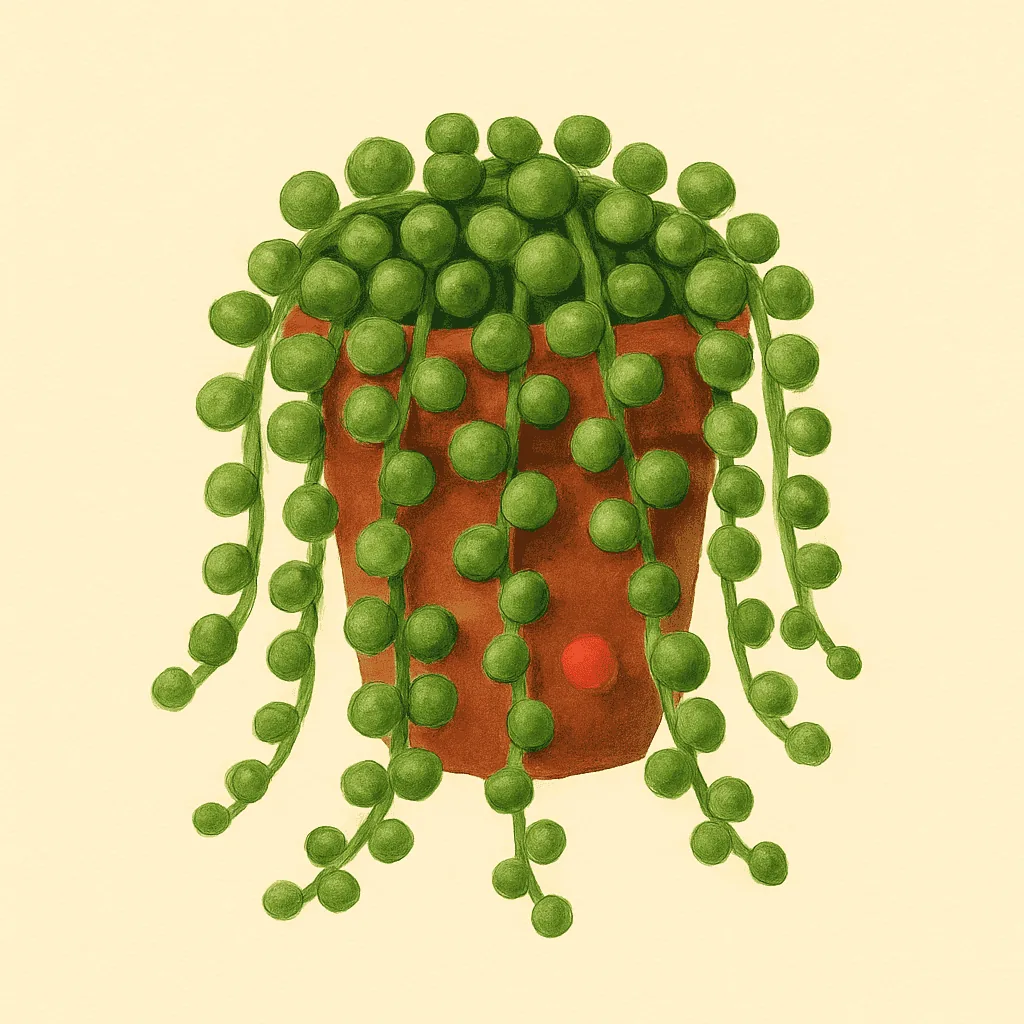
The pearls catch the late light first. Small green beads, strung along a thin stem, draping over the lip of the pot like a curtain that forgot to close. From across the room they almost look wet. Up close, each pearl is firm and round, sitting along the strand at its own quiet interval. Some strands reach for the floor. Some curl back on themselves. The plant is doing nothing in particular, and somehow it is the most interesting thing on the shelf.
Most people who lose a string of pearls lose it the same way. Not from forgetting. From caring too much, too often. The strands start to look a little soft, a little less plump, and the watering can comes out. A week later the pearls are bigger, glossier, and then one morning they split along the side and drop. A keeper who would never overwater a cactus will pour two cups into a string of pearls because the strands seemed to be asking. They were asking. Just not for that.
The pearls are the plant's water cabinet. Each little bead holds enough to carry the strand through a long dry stretch — longer than a thin-leaved succulent could manage, longer than most of us would guess by looking. So when the strands start to look slightly underplump, that is the plant using what it stored. That is the signal to water. Not before. The top inch will tell you, and so will the pearls themselves.
The other failure is quieter. A string of pearls in dim light doesn't drop pearls all at once. It just stops making new ones. The strand you have is the strand you keep, and slowly the existing pearls shrink, and the plant gets thinner and thinner across a season until one day you notice it looks like a few bare ropes with beads spaced too far apart. That is a light problem, not a water problem. More water will only hurry it along.
Bright indirect for most of the day. A couple of hours of direct sun if your window can offer them — a south or west exposure, or a spot near the glass but not pressed against it. The plant will tell you it is happy by making new pearls at the growing tip. Small ones at first, then catching up to the rest. That is the leaf to watch. Not the old strands, which are doing fine. The newest pearl on the newest strand is your weather report.
Notice before you act.
When a strand thins out — and one usually does, especially the ones that hang longest and farthest from the light — there is a small kindness you can do. Take scissors. Cut the strand back to a node, which is just the little bump where a pearl meets the stem. Lay the cut tip flat on top of fresh soil, right there in the same pot. Press it gently so it makes contact. Do not bury it. Within a few weeks, new pearls form along the buried length of stem, and roots reach down into the soil, and what was one long bare rope becomes a denser, fuller plant.
This is the part most care guides skip. A string of pearls gets better with a haircut. Not worse. The plant you have in year three can be bushier than the plant you bought in year one, if you have been laying cuttings back into the pot each time a strand goes thin. Most of the fullest string of pearls you have ever seen were not bought that way. They were grown that way, one tip at a time, by someone who was patient enough to let a strand finish its life and start the next one.
So. Hanging pot, near a bright window, not pressed to the glass. Water only when the pearls themselves look a little soft, and then a real drink, not a sip. Let it dry well between. Watch the newest pearl on the newest strand — if it is forming and plumping, the light is right and the schedule is right and there is nothing to change. If a strand goes thin, cut, lay, wait. The plant will do the rest.
A string of pearls rewards the keeper who is willing to do less. The strands grow on their own time, the pearls fill on their own time, and the plant asks only that you stop trying to help on the days it doesn't need help. Some weeks you will pass it on the shelf and do nothing at all. Those are good weeks. Slow water, steady light.