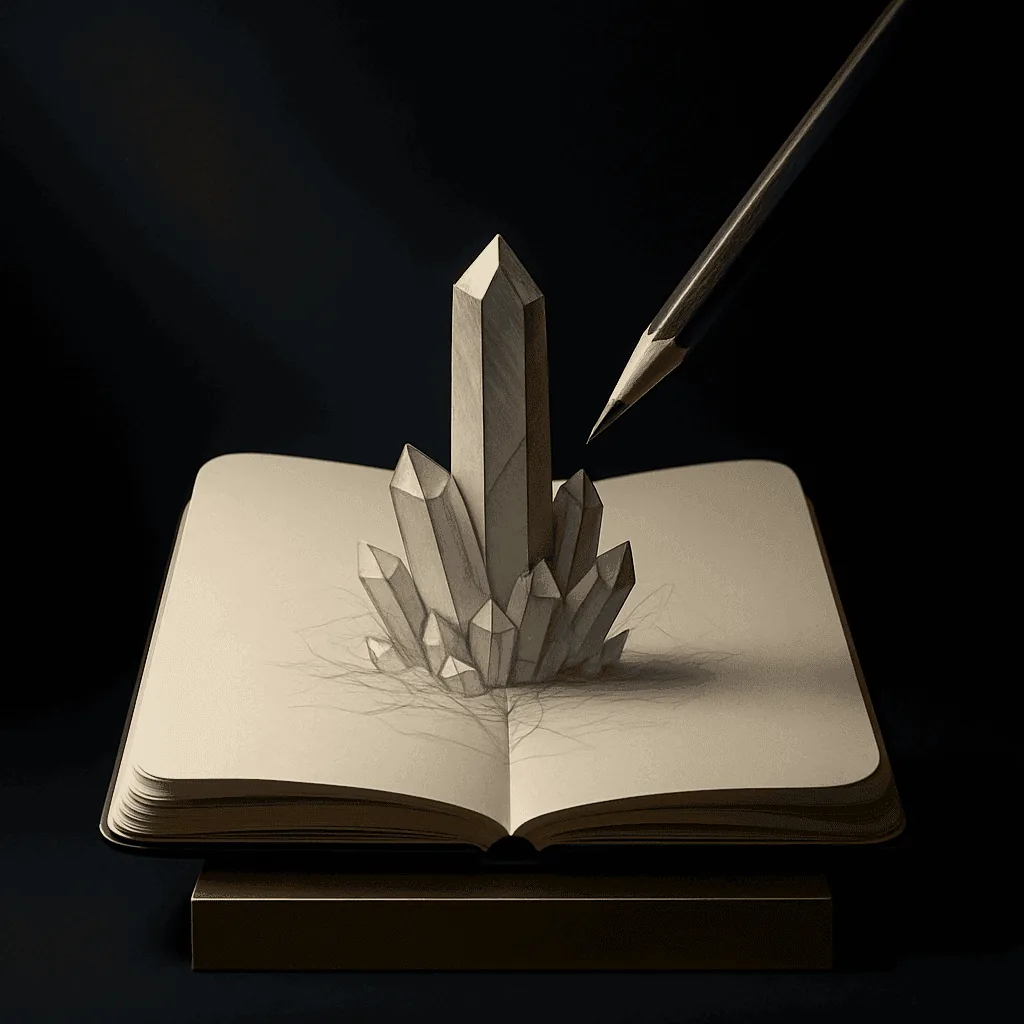
The cluster has been on the table for three days now. You have picked it up. You have set it down. You have turned it under the lamp and under the window, and still, when someone asks what it is, the words stall behind your teeth. There is a milky bridge near the base. A point that leans. A face that catches the light wrong. You know all of this and you cannot say it.
This is the third time. The first time, you thought you would come back to it. The second time, you almost reached for a guidebook and then did not. Now the stone sits where it has been sitting, and the not-knowing has begun to feel like a small, private failure. It is not.
The eye is a quick instrument. It is built for survival, not for mineralogy. It takes a stone in at a glance and gives you back a colour, a shape, a vague family. Pale. Cluster. Pointy. Useful, once. Useless now. The eye glosses. It rounds the edges of what it sees so the brain can move on to the next thing. A stone you do not yet understand is a stone the eye has already decided it has finished with.
The hand has not finished with it.
Pick up a pencil. Not a good one. Any pencil. A scrap of paper, the back of an envelope, the margin of something you were going to recycle. Set the cluster in front of you on a dark cloth so the terminations show. Hold it to the light first, then put it down, and begin to draw it.
You will be bad at this. That is part of the method. The point is not the drawing. The point is what the hand has to do to make the drawing — which is to look, in a way the eye on its own will not. The pencil cannot gloss. It has to commit to a line. To commit to a line, you have to decide where the termination ends and where the next face begins. You have to choose whether that edge is sharp or worn. You have to count the points, actually count them, because the pencil will not let you write several.
Watch what happens. Halfway through the second sketch you will notice something you did not notice in three days of looking. A small step in the crystal face. A second generation of growth riding on top of the first. A fracture that runs across two points and tells you they grew together, not separately. A zone of cloudier material along one axis. The hand has been finding these the whole time. It only needed the pencil to report them.
Draw it again from another angle. Then once more from underneath. The underside is often where the truth lives. The matrix it grew on, the scar where it broke from its neighbour, the trace of a different mineral nesting in a corner. A stone has six sides at minimum and most collectors only ever see two.
Write next to your sketch what your fingertips tell you. Cool or warm to the touch. Heavy for its size or light. Smooth on one face, stepped on another. Does it cleave cleanly along a plane, or does it fracture in shells. The cleave tells the truth. Hardness, if you have a way to test it, but only if you have a way that will not harm the stone. The loupe last, not first. The loupe is for confirming what the hand has already begun to suspect.
By the third sketch the cluster will not be a vague pale pointy thing. It will be this cluster. The one with the leaning termination and the bridge of milkier growth and the small rust-coloured inclusion two-thirds of the way up the tallest point. You will be able to describe it to someone. You may even be able to name it. If you cannot, you will at least know what to look up, because the questions will have become specific.
The waning moon is a good time for this kind of work. The light is patient. The night does not hurry. Set the cluster on the sill with your sketches beside it and leave them there until morning. Tomorrow you will see something new in the drawing that you did not see in the stone, and something new in the stone that you did not put in the drawing. This is how it goes.
The stone knows what it is. The sketching is only how you catch up. Already in motion.