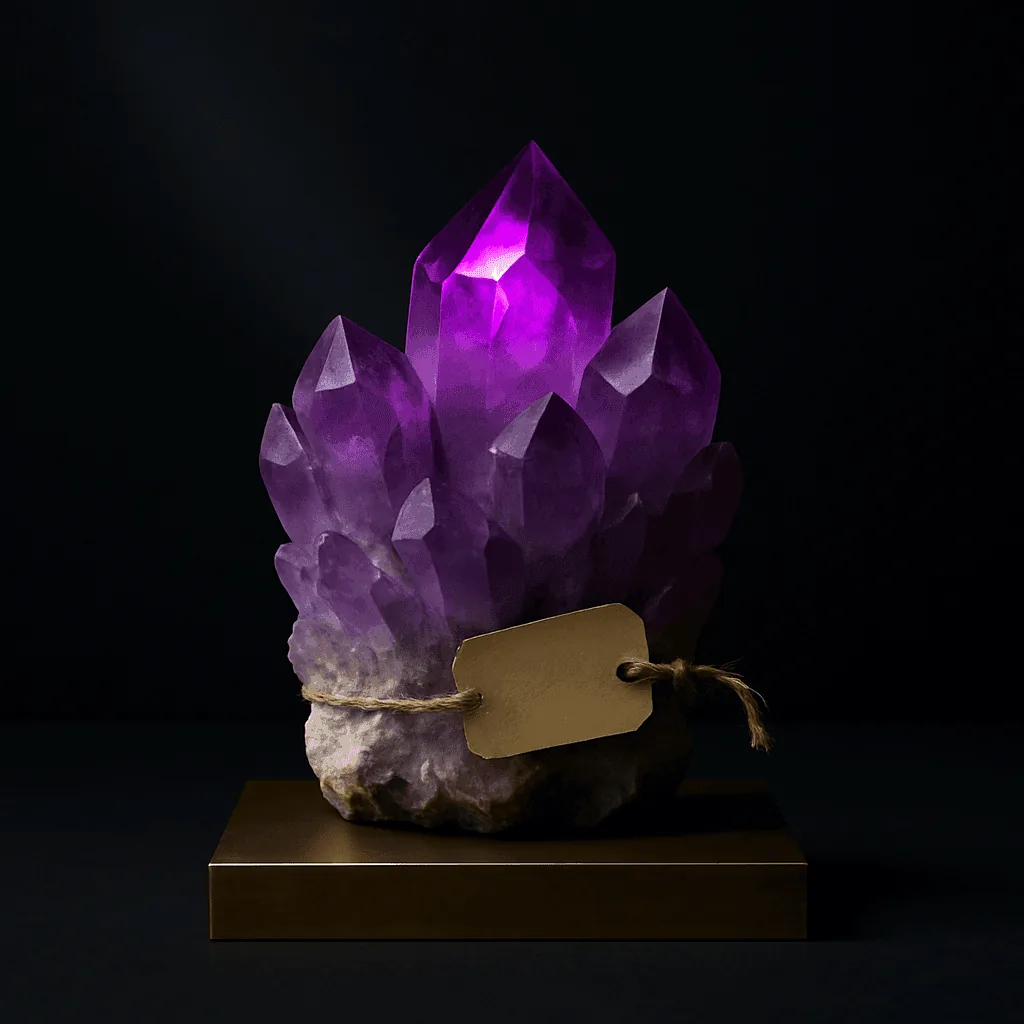
Two amethysts sit on the cloth tonight. One is from Artigas, in Uruguay. The other came up out of a quartz vein in Vermont. They share a name. They share almost nothing else.
The Uruguayan piece is deep, almost ink at the tip. The colour gathers at the termination and bleeds backward into a cool grey. Hold it to the light first. The light bends, slows, comes through reluctant. The Vermont piece is paler, softer in hue, with a smoky cast at the base. Put them side by side and the eye refuses to call them the same mineral. The loupe agrees. Different inclusions. Different growth. Different stories.
This is what provenance does. The name on the label says amethyst. The place tells you what kind of amethyst, and that changes the reading.
Most collectors learn the name first and the place much later. The shop tag says rose quartz, or citrine, or amethyst, and that feels like enough. The stone goes on the sill. The sill does not know where the stone is from. The journal page, if there is one, says the name and the date and nothing else. A year later the colour seems off, or the next piece bought under the same name looks like a different mineral entirely, and there is no way to know why. The information was there at the gem show. It went home with someone else.
Locality is not a flourish. It is part of identification. Brazilian amethyst tends to grow in great geodes, the crystals long and clear, the purple even through the body. Uruguayan amethyst grows in tighter pockets, darker, the colour saturated near the points. Madagascan rose quartz holds a softer pink than the Brazilian, and the inclusions read differently under the loupe — wispier, less defined. Maine tourmaline is its own dialect: watermelon zoning, particular greens, a history that runs through specific quarries. The same species, in two countries, can show two hardness behaviours at the edges. The same species, in two formations, can fluoresce or stay dark under the lamp.
The stone knows what it is. The place tells you why it is that way.
There is a second thing the place tells you, and it is slower to arrive. The dark Uruguayan amethyst was formed under conditions the Vermont piece never met. Heat, pressure, the chemistry of the host rock, the iron that gave the purple its depth. When the stone is read later — turned in the hand, set near a neighbour, brought out under a particular moon — the formation is part of what you are holding. A waxing stone from one country answers differently from a waxing stone from another. Not because the moon cares about borders. Because the stone is not the same stone.
The cleave tells the truth, and the country tells the cleave.
This is why the journal page wants a third line. Name. Date. Place. If the place is not known, write that down too — origin uncertain, purchased at the Tucson show, March. Even the not-knowing is information. The next piece of the same name, from the same seller, will either match or it will not. Both answers teach something.
There is a small practice for this. When a new stone arrives, before it goes to the sill, before it goes anywhere, set it on the cloth and ask one question. Where. The seller will usually know, or know roughly, or know who would know. Write what they say. If the answer is a country, write the country. If the answer is a mine, write the mine. If the answer is somewhere in southern Brazil, I think, write that, exactly. The exactness of the not-knowing matters as much as the exactness of the knowing.
A year from now, the cabinet will hold three amethysts, or seven, or twelve. They will not look alike. The eye will want a reason. The journal will have the reason, in one word, on the third line of each page.
The two on the cloth tonight will go back to their places. The Uruguayan piece to the cool side of the shelf, the Vermont piece nearer the others from the same vein. Each labelled. Each placed. Each known by more than its name.
This one has been waiting to be written down properly. Set it on the sill tonight, with its country beside it. The next stone will arrive knowing the practice is here.
Already in motion.