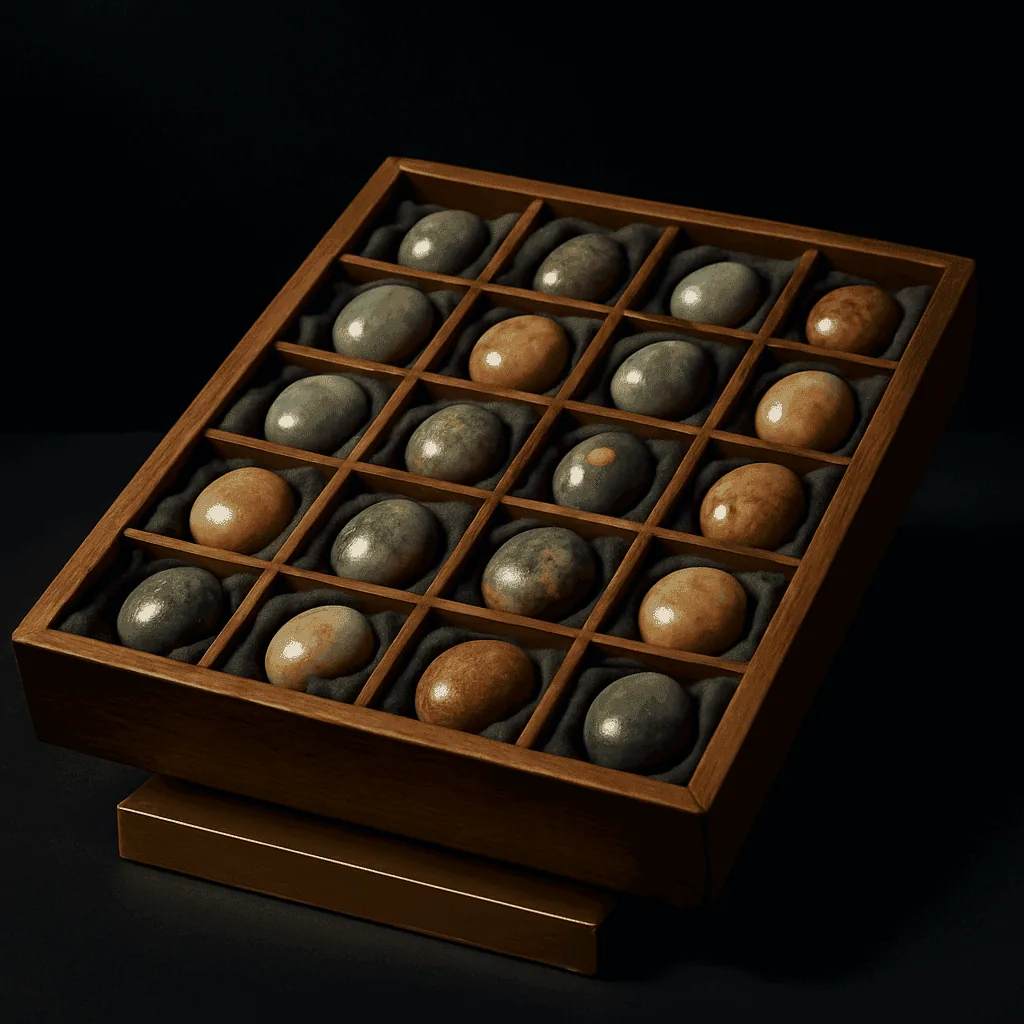
There is a drawer. You know the one. Top of the dresser, or the second shelf down, or the wooden box that was meant for something else. Four pieces are inside, wrapped in tissue. One of the wrappings has a pencil mark on it that you cannot now read. Another has nothing. You opened the drawer last week looking for the small clear one with the rainbow inside, and you held three pieces to the lamp before you found it.
Most writing about storing stones treats the drawer as a problem to solve. Buy the divided tray. Label the compartments. Photograph the lot. Done. But the drawer is not a problem. The drawer is where the collection actually lives between the times you visit it. What happens inside that drawer — the wrapping, the unwrapping, the forgetting which is which — is part of the journal, whether you write it down or not. The practical layer is real, and we will get to it. First, the honest thing: the drawer has been keeping the stones the whole time. It has only been keeping them badly.
Start with the cloth. Soft, undyed if you can find it. Cotton flannel, an old shirt cut into squares, a piece of chamois set aside from something else. The cloth is between the stone and everything that is not the stone — the wood of the drawer, the edge of its neighbour, the side of the tray. A stone in a square of cloth is a stone that arrives at next month the way it left last month. Tissue paper works for a season. It does not work for a year. It tears, it goes acidic, it forgets which stone was which.
Then the tray. Divided, shallow, the compartments no larger than the stone that sits in them. The small ones especially want their own square. A tumbled piece set loose in a wide bowl will travel. It will find the other tumbled pieces. It will rub. Fluorite is soft. Selenite is softer. Calcite scratches itself if you let it. One compartment per stone, lined with the cloth. The tray slides into the drawer. The drawer closes. The stone is held.
Now the two enemies. Sun and damp. Some stones fade — amethyst will go pale on a sunlit sill, rose quartz will lose its blush, kunzite gives up almost at once. The drawer protects them, which is part of why the drawer exists. But if you keep a piece out on the windowsill because you love it there, know what you are spending. Light is a slow tax. Set that stone on the sill in the evening if you like. Bring it back to the cloth by morning.
Damp is the other one. Some stones are soluble — halite will dissolve outright in a humid bathroom, selenite will cloud and crumble at the edges, celestite weeps. A drawer in a basement is not a drawer for these. A drawer near a bathroom is not either. The cool side of the house, away from the kettle, away from the window that fogs in winter. If you cannot give them that, give them a small closed box inside the drawer, with a sachet of rice or silica tucked at the back.
The drawer is the practice. The cloth is the practice. The unwrapping is the practice.
Which brings us to the labels. A small card with each stone — the name, the date you brought it home, the place. Tucked beside the cloth, not wrapped inside it where it will fade against the stone. This is the journal. Not the leather-bound one on the desk. This one. Every time you open the drawer and find the card already there, the collection remembers itself for you. Every time you put a new stone in without a card, the collection forgets a little. There is no scolding in this. There is only the slow truth that the unlabelled ones become the four pieces in tissue you cannot now read.
So: cloth, tray, the cool side, the card. Four things. Do one this week. The drawer does not need to be solved by Sunday. The stones have been waiting. They will wait a little longer while you find the right cloth. Hold it to the light first, the one you keep going back to, and decide what its square will be. The rest follows from there.
Already in motion.