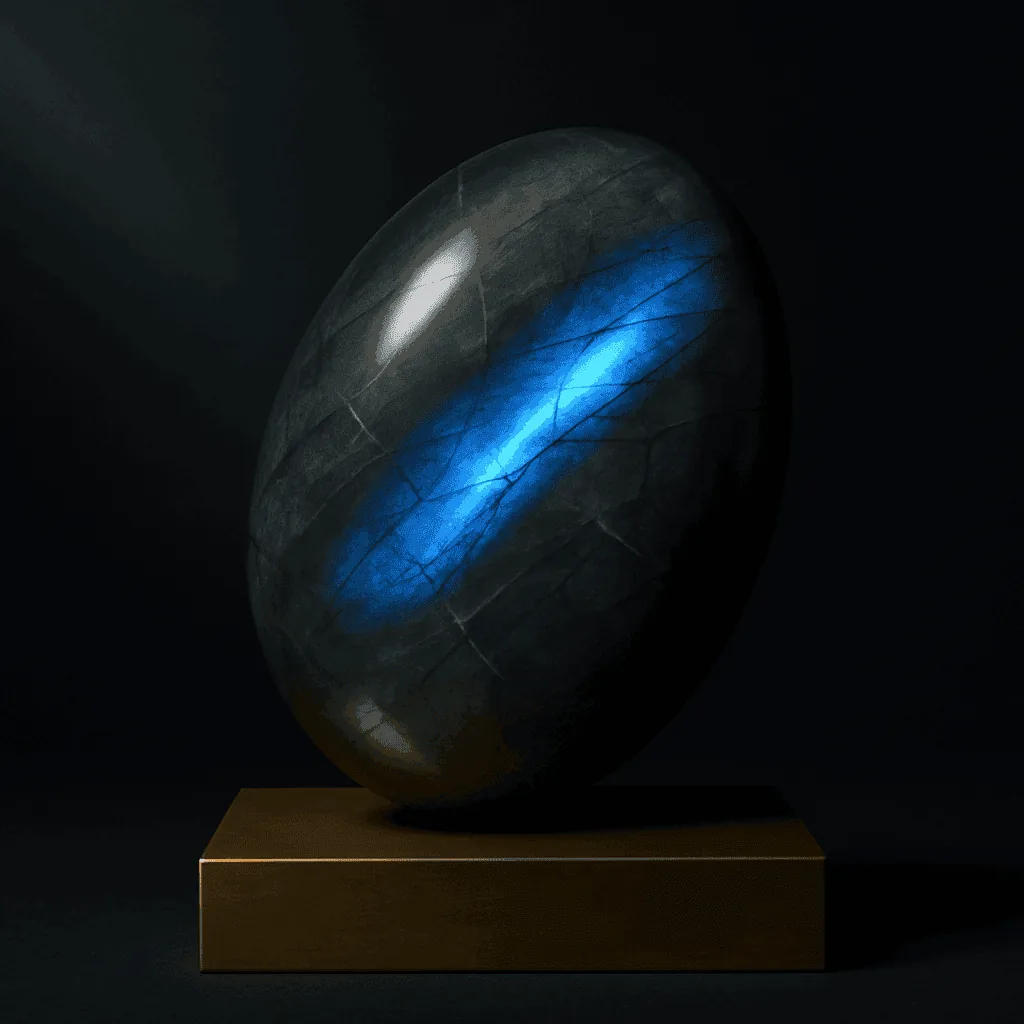
The stone is on the cloth. You tilt it once, and a flash of blue rises across the surface like weather. You tilt it again to show someone, and the blue is gone. The colour was there. You saw it. The stone is the same stone, the lamp is the same lamp, and yet the shimmer answered only to one angle, only for a moment, and only for you.
This is the feldspar family at work. Both moonstone and labradorite belong to it. Both do this trick with light. And almost every person who brings one of them to the loupe asks the same quiet question — is this moonstone, or is it labradorite, and why does it only flash when I am alone with it.
The answer begins with the structure. Feldspars grow in thin internal layers, stacked like pages in a half-closed book. Light enters, meets a boundary between two layers of slightly different composition, and bounces. What you see is not pigment. It is interference. The colour lives in the geometry, not the chemistry. Move the stone, and you move the geometry relative to the light. That is why the flash arrives and leaves on the tilt.
In moonstone, the effect is called adularescence. The sheen is soft, milky, and seems to float a little above the surface, as if a smaller moon were resting just under the polish. It moves in a broad, billowing way. The colour is usually a cool blue or a quiet white. Hold a moonstone to the light first. Tilt it slowly. The glow drifts across the dome, gentle, like breath on glass. It does not snap. It rolls.
In labradorite, the effect is called labradorescence. Same family of optical interference, slightly different crystal structure, very different temperament. The flash here is sharper. It arrives in patches, not in clouds. Peacock blues, electric greens, sudden coppers. You tilt a labradorite ten degrees and a whole field of colour either ignites or vanishes. There is no drift. There is a threshold, and the stone is either on one side of it or the other.
So the way to tell them apart is not by colour, and not by name on the label. It is by how the light behaves when you move the stone.
Hold it to the light first. Then begin to tilt it, very slowly, watching the surface. If the sheen rises and falls like a tide — broad, soft, following your hand — the stone is doing adularescence. It is a moonstone, or one of its near cousins. If the colour appears all at once across a patch, holds for a few degrees of tilt, then vanishes as you cross some invisible angle — the stone is doing labradorescence. That is the labradorite signature, and once you have seen it you will not mistake it.
There is a second tell, for stones where the first is ambiguous. Look at the body of the stone between flashes. Moonstone, when it is not flashing, tends to look translucent and slightly cloudy, like a piece of frozen milk. Labradorite, when it is not flashing, tends to look dark — grey, smoky, almost dull. The drama of labradorite is the contrast. The body is dim until the angle is right, and then the colour ignites against the dimness. Moonstone has no such darkness to hide in. Its glow lives closer to the surface and the stone itself is paler underneath.
There is a third clue, if you have a loupe. Look at the inclusions before the colour. Moonstone often shows tiny needle-like inclusions and fine internal fissures, sometimes arranged in a way called a centipede pattern. Labradorite usually shows clear, straight twinning lines running across the flashing zones. The cleave tells the truth. The structure is right there in the stone if you slow down enough to see it.
Now — the disappearing flash. The reason a moonstone or a labradorite refuses to show its colour the moment you turn it toward another person is not shyness, and not mood. It is geometry. The angle that worked for your eye does not work for theirs. The light source, the stone, and the viewer form a small triangle, and the flash lives only where that triangle closes correctly. Move any one point, and the colour leaves. This is why the stone seems to answer to fingertips, not to pockets. It is asking for the patience of a single pair of eyes, a single lamp, a single slow turn of the wrist.
Set the stone on the sill tonight, between the lamp and the dark window. Tilt it once, and watch what kind of light it gives back. The stone knows what it is. You only have to move slowly enough to see.