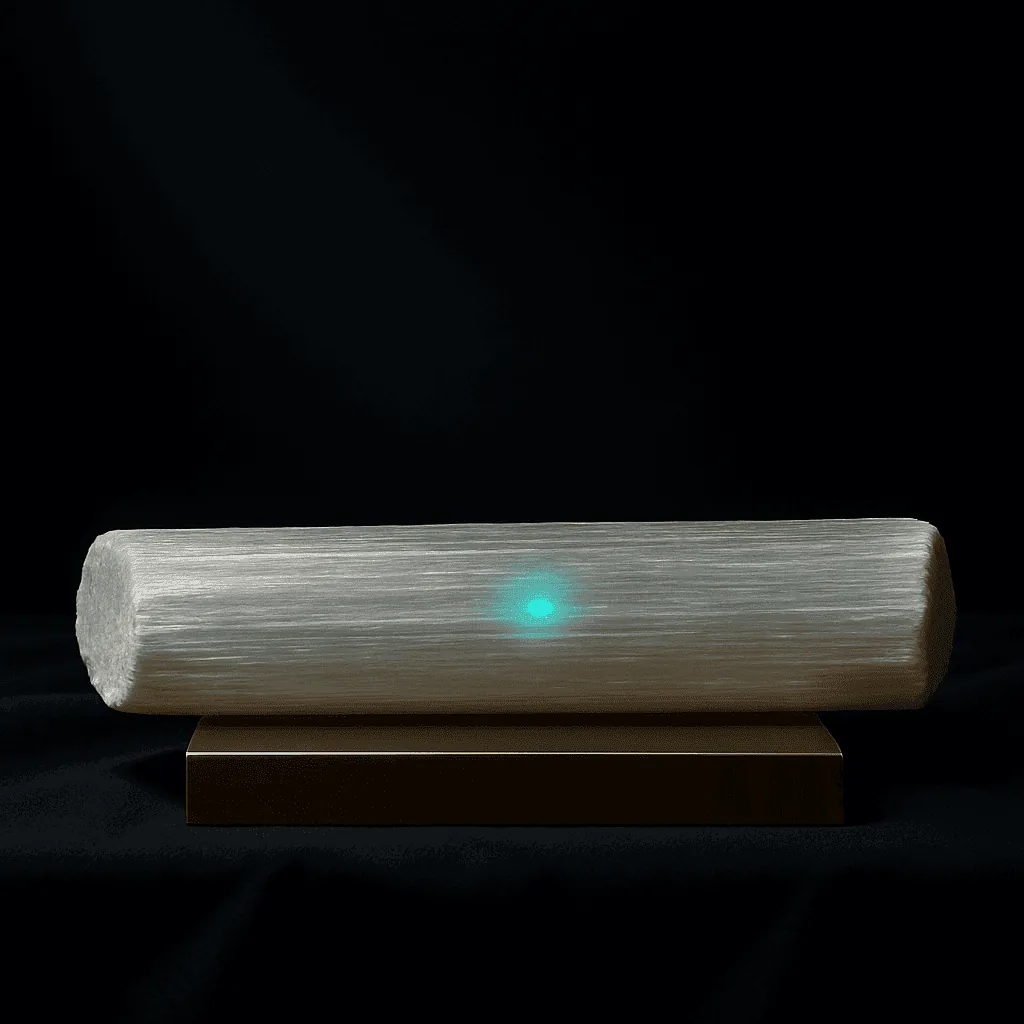
The wand on the shelf catches the lamp and throws it back as a soft white bar of light. You know the one. Long, fibrous, faintly silken, sold to you at a fair by someone who called it selenite and wrapped it in tissue. It has lived on your sill through three moons now. It has not chipped. It has not dimmed. It has only kept being what it is, quietly, while the name on its little paper tag has remained quietly wrong.
Most of what gets sold as selenite is not selenite. It is satin spar. The two are siblings, not twins. Both are gypsum. Both are soft enough that a fingernail leaves a mark. Both glow under lamplight in a way that has earned them a place on every altar and shop counter from here to the coast. But they are not the same stone, and the journal entry that calls them the same stone is an entry that will quietly mislead you for years.
Hold it to the light first. That is where the difference begins to show.
True selenite is the clear one. It cleaves in flat sheets, like sheets of mica or thin glass. You can sometimes see straight through a good piece. The terminations are sharp. The faces are mirror-flat where the crystal split clean. When you turn it under the loupe, you are looking at a single transparent crystal, or a stack of them, and the light goes through, not along.
Satin spar is the fibrous one. The wand. The tower. The polished palm-piece that throws a moving line of light across its surface when you tilt it — a cat's-eye shimmer the trade calls chatoyance. Look at the underside. You will see the fibres running lengthwise, packed tight, like the grain in a piece of bleached driftwood. Light does not pass through satin spar. Light travels along it, down the fibres, which is why a wand held to a candle seems to drink the flame at one end and pour it out the other.
Then there is the third sibling, the one nobody puts on a shelf. Gypsum itself, the parent mineral, soft and chalky and the colour of plaster because, in a sense, it is plaster. Alabaster is gypsum. The white statue in the museum and the wand in your palm are the same compound, arranged differently by water and time. Knowing this changes how you hold the wand. You are holding a stone whose cousins have built cathedrals.
The distinction matters for the journal, not for the magic. A journal that names everything selenite loses the texture of what you actually own. Six months from now, when you reach for the clear cleaved plate and find only the fibrous wands, you will not know which one you were looking for. The shelf becomes a blur of white. The naming is what keeps each stone separate in memory, and memory is what a collection is made of.
So when a new piece arrives, the work is small and slow. Set it on the cloth. Turn it once under the lamp. Ask whether the light goes through it or along it. Ask whether it cleaves in sheets or runs in fibres. Look at the underside. The cleave tells the truth. Write down what you see before you write down what it is supposed to mean.
Selenite proper is the cleaved plate, transparent, often called a window. Satin spar is the fibrous wand or tower, silky, faintly luminous along its length. Gypsum is the soft pale mass underneath both of them, the family name on the door. Three entries. One mineral. The journal holds all three without confusing them, and that is the whole point.
There is a quiet pleasure in this kind of accuracy. It is not pedantry. It is the same attention that lets a baker know one flour from another, that lets a gardener know which leaf is the weed. The stone does not care what you call it. But you will care, eventually, when the shelf is full and the names have to do the work of telling you what you have.
The stone knows what it is. The name is for you.
Tonight is a waning moon. A soft phase for sorting, for going back through what you already own and seeing it again with clearer eyes. Take the wand down from the sill. Turn it once. Note whether the light runs through or along. Write the right word in the right column. Set it back. The shelf is a little more honest than it was an hour ago. Already in motion.