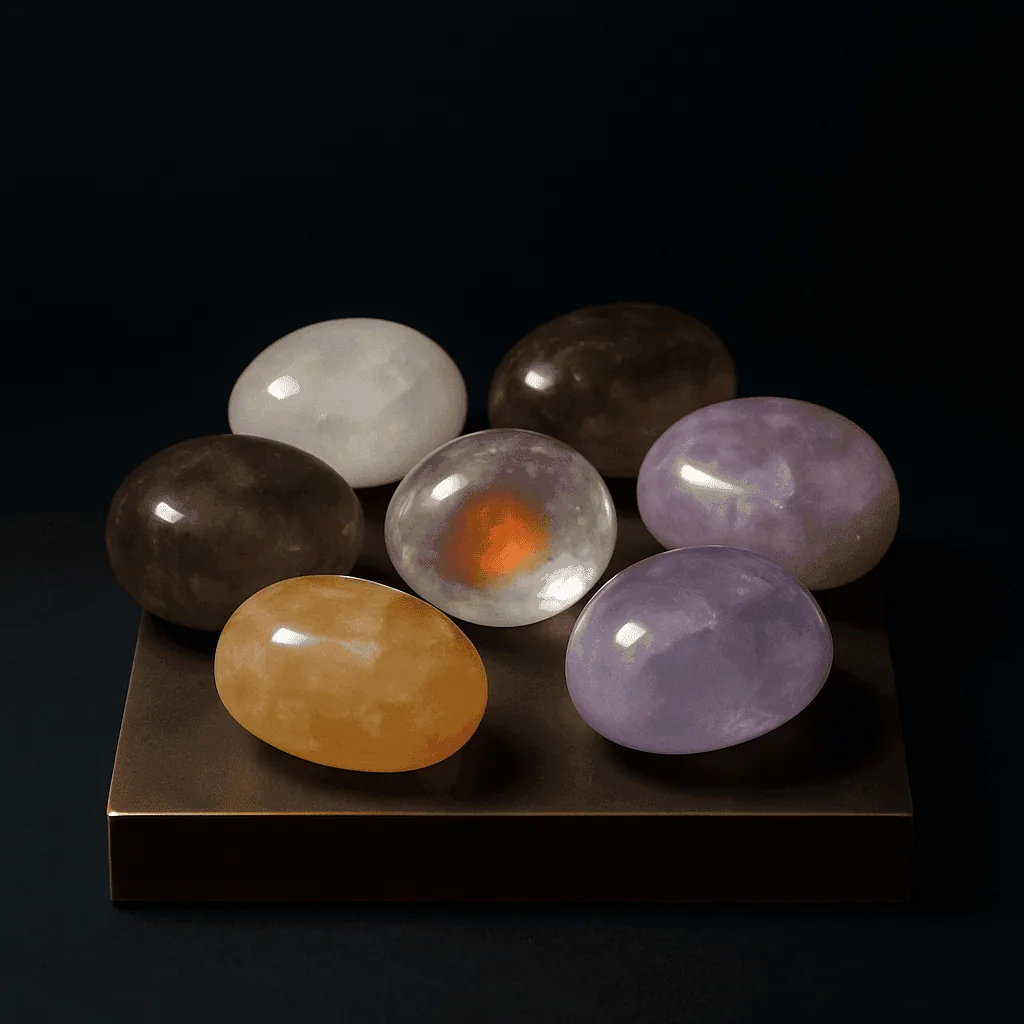
Pull the front drawer open. Six stones, side by side. The amethyst, the citrine, the smoky one you found in the riverbed, the rose someone gave you, the clear point, the rutilated with its gold threads. Hold one to the light. Now another. The colours argue. The weight in the hand does not. Set them in a row on the cloth and look at the terminations. The same six-sided crown. The same patient geometry. You have been collecting one mineral for years and calling it six things.
This is the quiet trick the quartz family plays on the newer eye. The colour shouts and the structure stays silent, so we name the shout. Amethyst gets its own shelf. Citrine gets its own shelf. The smoky one ends up in a different bowl entirely because it looks nothing like the rose. But the mineral underneath is the same mineral. Silicon and oxygen, locked in the same lattice, repeating the same angle. What changes is what crept in while the stone was forming, and what the earth did to it on the way up.
Look at the inclusions before the colour. That is where the family resemblance lives.
Amethyst is quartz that grew in the presence of iron, and then the earth handed it a small dose of radiation over a long stretch of time. The iron and the radiation made the purple together. Warm an amethyst long enough and the purple gives way to a yellow-gold. The stone becomes citrine. Most of the citrine on the shelf at the gem show began its life as amethyst and was coaxed through an oven. The true unheated citrine is rarer than people think. The mineral did not change. Only the temperature of its memory.
Smoky quartz is the same lattice again, this time with a trace of aluminium and the same slow gift of radiation. The smoke is not a coating. It is the crystal itself remembering what it absorbed. Heat a smoky stone and it clears. The smoke leaves the way the purple leaves an amethyst. Underneath, the quartz is waiting, as it always was.
Rose is a softer story. The pink comes from microscopic fibres of another mineral threaded through the quartz, scattering the light back at you in that particular blush. Hold a rose quartz to a bright window and the haze you see is not a flaw. It is the fibre doing what fibre does. The cleave tells the truth here. Rose rarely forms in clean points. It prefers the massive habit, the rounded heart, the tumbled cheek.
Clear quartz is the family without the disguise. No iron, no aluminium, no radiation story, no fibre. Just the lattice, doing its geometry in the open. Every other quartz on your shelf is this stone with something added. That is worth sitting with for a moment. The clear point is not the plain one. It is the one that did not need anything to become itself.
Rutilated is clear quartz that grew around needles of titanium dioxide. The gold threads inside it are a different mineral entirely, frozen mid-sentence by the quartz forming around them. Two stones in one hand. The host and the guest, locked together. Hold it to the light first and watch the needles catch.
One mineral. Six moods. The drawer was never as crowded as it looked.
Once you see the family, the shelf reorganises itself in your mind. The amethyst and the citrine stop being cousins and become the same stone at two temperatures. The smoky and the clear become the same stone with and without its absorbed history. The rose and the rutilated become the same stone hosting different guests. You stop collecting colours and start collecting conditions. What was the iron doing. What was the heat doing. What threaded itself in while the lattice was still forming. The questions get better. The drawer gets quieter.
This does not make any of them less. The amethyst is still the amethyst. The purple is still the purple, earned over a span of time you cannot imagine. What changes is the way you hold it. Not as a separate species with its own folklore, but as one expression of a mineral that knows how to wear many faces and stay the same underneath.
Set the six stones back in the drawer tonight, but in a new order. Clear at the centre. The others around it, by what each one carried in. The amethyst with its iron. The smoky with its aluminium. The rose with its fibre. The rutilated with its needles. The citrine where the amethyst used to be, after the heat. The stone knows what it is. You are only now beginning to see what it has been telling you the whole time.