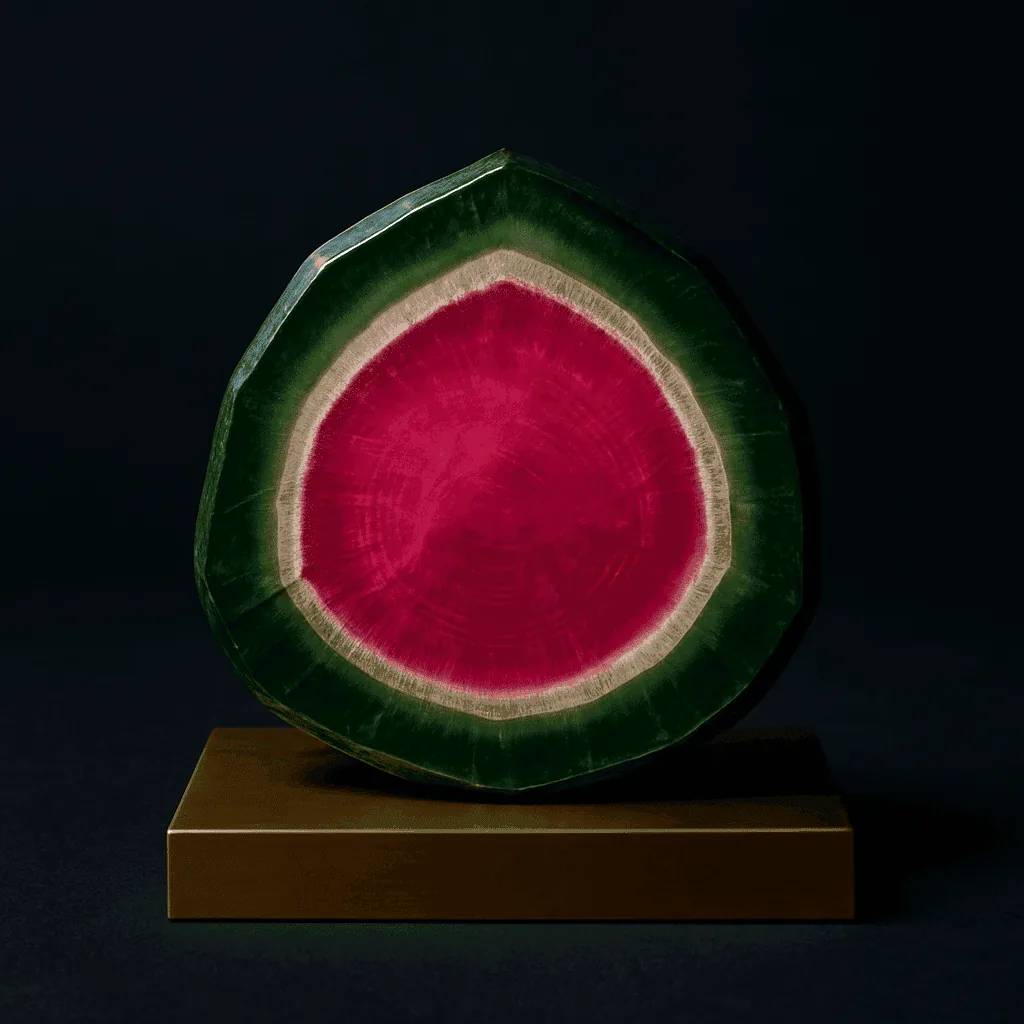
The slice sits on the cloth, cut clean across the crystal. Pink at the centre. A pale rind. Then green at the edge, deep as wet moss. The light comes through it the way it comes through stained glass at dusk. Someone seeing it for the first time always asks if it is painted, or layered, or two stones glued at the seam. It is not. It is one stone. Grown that way, from the inside out, by the same patient chemistry that built the black wand beside it on the shelf.
This is the trouble with tourmaline. Most stones declare themselves. Amethyst is purple. Citrine is gold. Lapis is the colour it has always been. Tourmaline refuses the shortcut. The black baton, the pink shard, the green pencil, the watermelon slice — they look like four different minerals on four different shelves. They are not. They are the same lattice, the same six-sided column, the same striated sides running down the length. The variation is what the stone drank while it grew.
Start with schorl. The black one. Heavy in the hand, opaque, often the first tourmaline a collector meets without knowing it. Iron is what made it black. Iron, and a lot of it. Look at the side of a good schorl wand and you will see the striations running parallel down the column, fine grooves like the stone was combed. That is the tell. Quartz does not do that. Obsidian does not do that. Hold it to the light first, then turn it — the grooves catch and release.
Move to elbaite, and the family opens. Elbaite is the chemistry that lets tourmaline take colour. Lithium enters the lattice. The iron steps back. What was opaque becomes translucent, sometimes gem-clear at the termination. Pink elbaite — what the old trade called rubellite when it went deep enough — is lithium and a little manganese. Set a rough piece on the sill in afternoon light and the colour deepens toward the tip, paler at the base, as if the crystal was reaching for something while it grew. The termination tells the truth about how it ended.
Green tourmaline — verdelite, in the older books — is the same elbaite system with different trace metals doing the colouring. Look at the inclusions before the colour. Tourmaline grows in pegmatite, and pegmatite is a chaotic room. Tiny fractures, healed seams, threads of other minerals caught in the column. A clean green tourmaline is rarer than a clean amethyst, and the price knows it. Most have a softer cloud somewhere in the body. That is not a flaw. That is the record of where it was when the heat went out of the rock.
Then the watermelon. Pink core, green rind, sometimes a pale band between them. It happens when the chemistry of the pocket shifted while the crystal was still growing. The lithium-manganese mix that made the centre pink gave way, at the edge, to whatever made the rind green. The crystal kept its shape. The colour changed around it. Slice the column across the grain and the cross-section appears — the impossible painting, made by nothing but time and what the pocket had on hand.
There are more. Indicolite, the blue one, scarce and shy. Dravite, the brown, warm as wood. Paraiba, the electric copper-blue that turned the gem world over in the nineties. Achroite, colourless, almost never seen. Each one is the same crystal system answering to a different recipe. The hardness will tell you the rest — seven to seven and a half, harder than glass, softer than topaz, scratched by quartz only with effort.
What to do with a tourmaline depends on which one came to you. The schorl is a grounding stone, weighty, content at the threshold. Set it where the day enters. The pink elbaite is lighter in the hand and in the temperament — it answers to fingertips, not pockets. The green wants company; lay it near the others. The watermelon is its own conversation. Hold it to the light first. Then turn it.
If the moon matters to you tonight, know that tourmaline is patient with all of it. It does not wax or wane. It was finished growing a long time ago. What it does now is sit on the cloth and remind you that one stone, given enough time and the right pocket of melt, can hold the whole spectrum. Pink at the centre. Green at the edge. Black, beside it, from the same family.
The stone knows what it is. Already in motion.